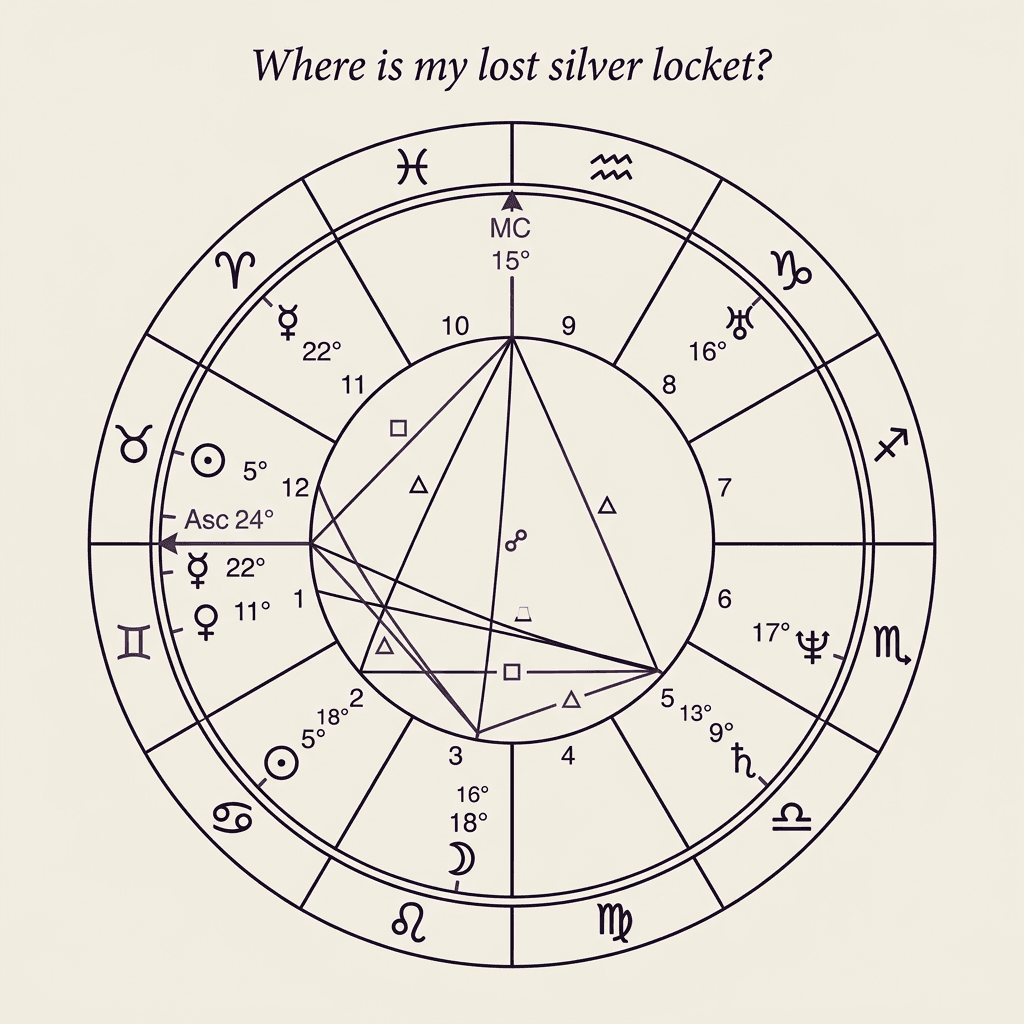
Horary astrology answers a specific question by casting a chart for the exact moment the astrologer understands the question, then reading that chart for a yes or no, a location, a person, or a timeline.
Horary astrology is a branch of horoscopic astrology in which a chart is cast for the moment a question is received and understood. The term comes from the Latin hora, meaning "hour." Each house governs a category of question; planetary rulers of those houses become significators; their aspects and dignities supply the answer. William Lilly's 1647 Christian Astrology remains the primary working manual. Astrolium's horary feature applies Lilly's house rulerships, essential dignities, and prohibition rules to every chart.
Origin and history
The technique has roots in Hellenistic astrology, but its working form was shaped in the Islamic Golden Age. The 9th-century Arab astrologer Sahl bin Bishr codified most of the rules that later medieval astrologers used. His work passed into Latin translation and reached Renaissance England, where William Lilly (1602-1681) produced the definitive English manual: Christian Astrology (1647), a dense three-volume text with hundreds of worked examples covering lost objects, illness, travel, marriage, and litigation.
Lilly's book is still in print and still read as a primary source. His approach is systematic: assign the question to a house, identify the planet ruling that house's cusp as the quesited's significator, read the aspect between that significator and the querent's significator (usually the ruler of the Ascendant or the Moon), and judge accordingly. The system rewards strict application of rules over interpretive flexibility.
Horary faded with the broader collapse of traditional astrology in the 18th and 19th centuries, then revived in the 20th century through the work of Olivia Barclay, who republished Christian Astrology in 1985, and John Frawley, whose The Horary Textbook (2005) brought Lilly's rules into modern language.
The essential dignities system (domicile, exaltation, triplicity, term, face) is central to horary judgment. A significator in dignity tends toward a favorable outcome for that significator's side; one in detriment or fall suggests weakness.
How it works
The astrologer casts a chart for the moment the question is fully understood. Location is the astrologer's, not the querent's. The chart must pass certain tests before it is judged: the Ascendant at 0-3 degrees is often considered "too early to tell"; Ascendant at 27-29 degrees suggests the matter is too far advanced; Saturn in the 7th house in Lilly's system is a traditional warning against the astrologer making a judgment.
Each of the 12 houses governs a category of life. The first house and its ruler represent the querent (the person asking). The seventh house governs a marriage partner, an opponent, or in Lilly's system, the astrologer. The second house covers money; the fourth, property and the father; the fifth, children and speculation; the sixth, illness and servants; the seventh, partners; the eighth, death and shared resources; the ninth, travel and religion; the tenth, career and honor; the eleventh, hopes and friends; the twelfth, hidden enemies and imprisonment.
The question assigns the matter to one of these houses. "Will I get the job?" puts the job at the tenth house, the querent at the first. The ruler of the tenth becomes the significator of the job; the ruler of the first becomes the significator of the querent. If those two planets are applying to a conjunction, trine, or sextile, the answer tends toward yes. A separating aspect, or aspect to the wrong planet, tends toward no. The Moon's next aspect adds a secondary testimony.
Reception (where one significator is in the sign or exaltation of the other) modifies the judgment significantly. Two planets in mutual reception can complete a matter even without a direct aspect.
How practitioners use it
Horary is used for specific, bounded questions: lost objects, whether to accept a job offer, whether a deal will close, the condition of an absent person, who will win a contest. It does not answer open-ended questions well. "What should I do with my life?" is natal astrology's territory, not horary's.
The question must be genuine and timely. Lilly taught that questions about matters more than 3 months away are generally not "ripe" enough for judgment. Practitioners who have worked with the technique consistently report that questions asked without real urgency produce charts that are genuinely difficult to read. The chart often shows the querent's indifference back at them.
Fixed stars in horary astrology are used selectively. Lilly flagged Algol, the Pleiades, and a handful of other malefic stars conjunct the Ascendant, Moon, or significators as negative testimony. Modern practitioners vary on how much weight to give fixed stars in horary versus natal work.
The house system matters more in horary than in natal work because the cusp's exact degree determines which planet rules which question. Lilly used Regiomontanus; some modern practitioners prefer Placidus or whole sign houses for horary. The choice changes which planet rules a house and can change the judgment.
In Astrolium
The Astrolium horary feature casts a chart for any question in seconds, assigns Lilly-style house rulerships, displays each planet's essential dignity score (domicile through face), and highlights applying aspects between significators. The horary astrology guide walks through judgment in five steps, with worked examples for the most common question types. For timing within a horary judgment, the planetary hours calculator shows which planet rules each hour of the day from the querent's location.