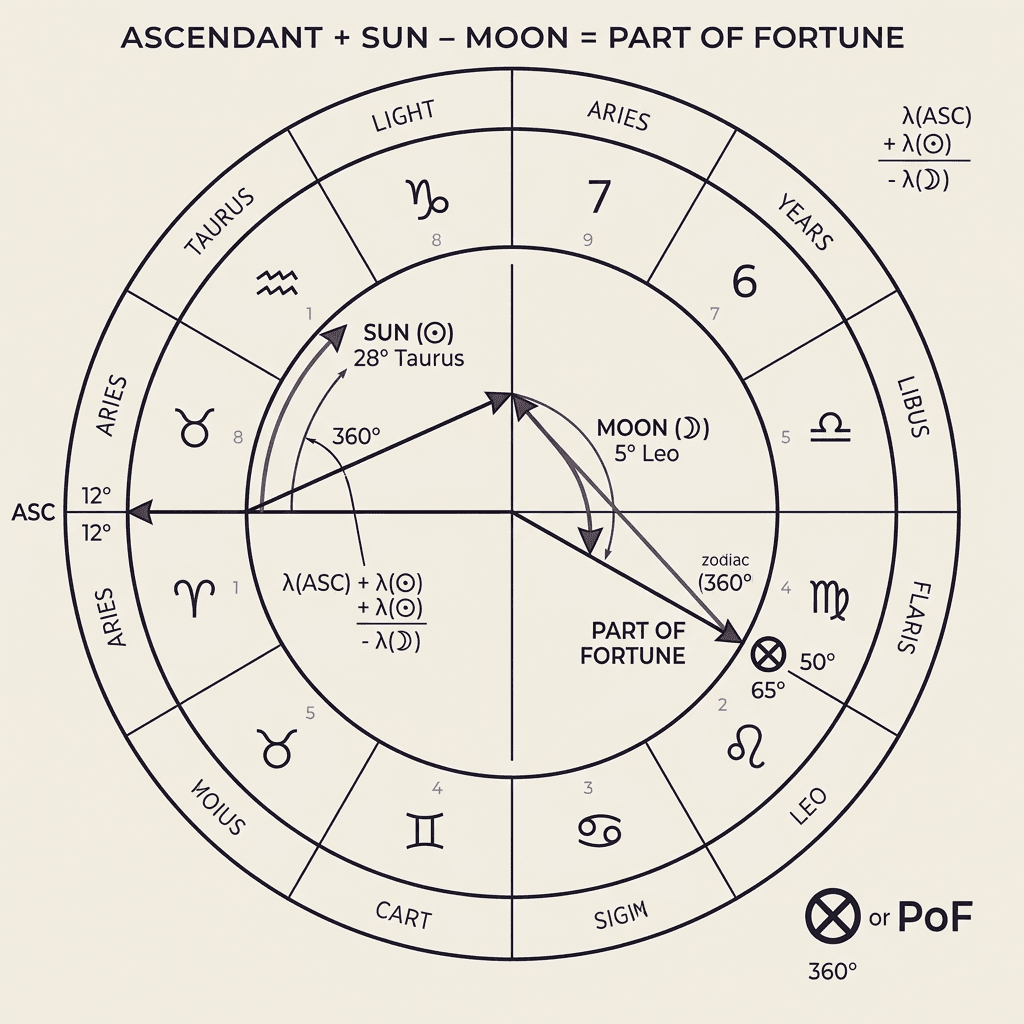
The Part of Fortune is a calculated point in a natal chart that marks where the Ascendant, Sun, and Moon converge into a single degree, read by Hellenistic astrologers as the body's relationship to material ease, vitality, and the flow of circumstance.
The Part of Fortune (Lot of Fortune) is one of the seven Hermetic Lots, calculated using the Ascendant, Sun, and Moon, with the formula flipped depending on whether the chart is diurnal or nocturnal. It predates the Ascendant technique in written sources and appears in Paulus Alexandrinus's 4th-century Introductory Matters as a primary indicator of bodily vitality and material fortune. Astrolium calculates it automatically with sect-aware formula switching.
Origins and history
The Lot of Fortune is the oldest and most central of the seven Hermetic Lots. Each lot is associated with one of the 7 classical planets; this set was first systematically described by Paulus Alexandrinus in the 4th century CE. The lots themselves are older than that; Dorotheus of Sidon used Fortune in the 1st century CE, and the underlying technique likely predates Greek astrology entirely, with probable roots in Babylonian or Egyptian astronomical practice.
Medieval astrologers transmitted the technique under the Latin name Pars Fortunae, and most Arabic-language astrologers gave it a central role in natal and horary work. The Arabic tradition introduced roughly 97 additional lots alongside the original seven, which is why the broader family is sometimes called "Arabic parts," though that name is slightly misleading, since the core Hermetic seven are Greek in origin.
The technique fell out of favor during the 18th and 19th centuries along with most traditional methods. It came back with the Hellenistic revival of the 1990s and 2000s, partly through Robert Hand's translations and partly through Robert Schmidt's Project Hindsight. Today it is standard equipment in traditional and Hellenistic practice.
How to calculate it
The formula depends on sect: whether the Sun is above or below the horizon at birth.
Day chart (Sun above the horizon): Ascendant + Moon - Sun
Night chart (Sun below the horizon): Ascendant + Sun - Moon
Both can be restated as a spatial measurement. In a day chart: start at the Sun's degree, count counterclockwise to the Moon's degree, then measure that same arc out from the Ascendant. The endpoint is Fortune. In a night chart, reverse the starting point: begin at the Moon and count to the Sun.
The logic behind the reversal: the formula always moves from the sect light toward the other luminary. In a day chart, the Sun is in sect (the ruling luminary); in a night chart, the Moon is. The measurement tracks from the luminary "in power" toward the luminary "in subordination," then projects that arc from the Ascendant.
At the equinoxes, when the Sun is on the horizon, day and night charts produce the same result. Otherwise, the two formulas give different degrees — sometimes separating Fortune's two possible positions by more than 90 degrees across the 360 degrees of the zodiac — which is why sect-awareness matters for every Fortune calculation.
What Fortune's placement means in practice
The Lot of Fortune is read primarily by house placement and by the condition of its sign ruler, called the Lord of Fortune in traditional texts.
House placement describes where ease and material circumstance tend to manifest across the 12 houses: Fortune in the 10th shows career as the vehicle; in the 7th, partnerships; in the 2nd, income from personal skill or possessions. The standard Hellenistic reading treats the house containing Fortune as a fortunate house for the native; things associated with that house tend to come more easily than the rest of the chart might suggest.
The Lord of Fortune's condition matters as much as Fortune's house placement. If Fortune is in Aries, Mars rules it. A well-placed, dignified Mars in good sect indicates that the themes of Fortune will manifest productively. A badly placed, out-of-sect Mars suggests that ease will be harder to access despite Fortune's house placement.
Benefic planets in the same sign as Fortune or in trine or sextile to it reinforce the reading. Malefics conjunct Fortune, especially out-of-sect malefics, are one of the classic indicators of difficulty with material circumstances, which Hellenistic practitioners read in the context of the whole chart rather than as a standalone judgment.
In Astrolium
The Astrolium Part of Fortune calculator computes the Lot with automatic sect detection, showing both the day and night positions for comparison. The natal chart view displays Fortune in the wheel alongside the Lord of Fortune's chart position and condition. For context on the broader Hermetic system, see the arabic parts guide and the related entry on the Lot of Spirit.