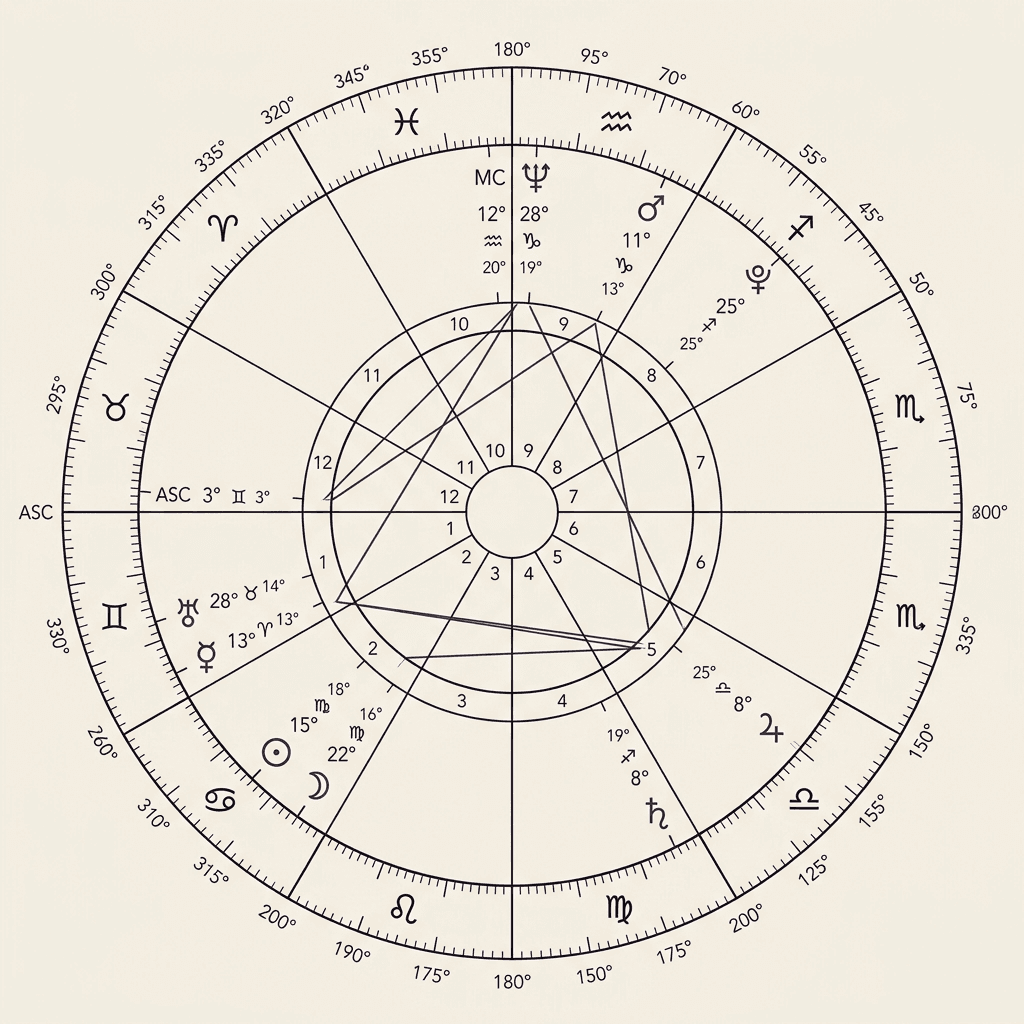
A natal chart is a diagram of the sky at the exact moment and geographic location of a person's birth, showing where the Sun, Moon, and planets appeared relative to the horizon and to the twelve signs of the zodiac.
A natal chart requires a birth date, time, and place to calculate. The chart contains 10 planets, 12 houses, and the angles between them. The oldest surviving individual horoscope dates to 410 BCE in Babylon; Ptolemy codified the interpretive framework in his Tetrabiblos around 140 CE. Astrolium generates a complete natal chart from three inputs and produces a structured reading within seconds.
What the natal chart is and where it came from
Astronomers in Babylon tracked planetary movements as early as 2000 BCE, but those observations were for collective forecasting — omens for kingdoms, not individuals. The individual natal chart as we know it emerged in the Hellenistic period, somewhere in the 4th to 5th century BCE, as Greek philosophical ideas about the soul and individual fate merged with Babylonian sky-watching practice.
The earliest surviving natal chart for an individual is dated to 410 BCE. By the 2nd century CE, Claudius Ptolemy had systematized the interpretive framework in the Tetrabiblos, establishing the conceptual vocabulary — signs, houses, aspects, dignities — that modern Western astrology still uses.
The chart is sometimes called a nativity or a horoscope, though "horoscope" has drifted in common usage toward the Sun-sign column rather than the full chart. The technical word for a natal astrologer in Greek was horoskopos: one who watches the rising degree.
The structure of the chart
Three inputs define the chart: birth date, birth time, and birth location.
Date places the Sun in a zodiac sign and sets the approximate positions of all slower-moving planets. Time is what calculates the Ascendant, the Midheaven, and the house cusps — the most position-sensitive parts of the chart. A birth time off by four minutes shifts the Ascendant by approximately one degree. An hour off can put it in the wrong sign entirely. Location anchors the calculation to a specific point on Earth.
The twelve zodiac signs (Aries through Pisces) describe how planets express. The twelve houses (1st through 12th) describe the life domains where planets operate: body and appearance (1st), finances and possessions (2nd), communication and siblings (3rd), home and parents (4th), creativity and children (5th), work and health (6th), partnerships (7th), shared resources and transformation (8th), philosophy and travel (9th), career and reputation (10th), community and groups (11th), hidden matters and retreat (12th).
The aspects are the angular relationships between planets — how many degrees apart they are on the chart wheel. The major aspects: conjunction (0 degrees), sextile (60 degrees), square (90 degrees), trine (120 degrees), opposition (180 degrees). Tight aspects between planets are often the most distinctive features of a chart.
How an astrologer reads it
No two natal charts read the same way even if two people share similar placements. Context is everything — a planet's sign, house, aspects, and the overall chart structure all modify each other.
A working reading typically proceeds in this order:
- Identify the Ascendant and its ruling planet. The Ascendant ruler is often called the chart ruler; its sign, house, and aspects shape the overall tenor of the chart.
- Read the Sun's sign and house. The Sun describes core identity and conscious purpose.
- Read the Moon's sign and house. The Moon describes emotional needs and instinctive responses.
- Note the planets near the chart angles (Ascendant, Descendant, Midheaven, IC). Angular planets carry disproportionate weight — they are the chart's loudest voices.
- Work through the remaining planets by house.
- Assess aspects: which planets are in tight contact, and what does that contact say?
The how to read a natal chart guide on Astrolium covers this sequence step by step.
Different house systems divide the chart differently. Placidus is the most common in contemporary Western practice. Whole Sign houses — where each house equals one complete sign — is the Hellenistic standard and increasingly popular in modern practice. The house systems guide covers the practical differences.
In Astrolium
The chart generator produces a natal chart from any birth data. The natal report adds a written delineation for every planet and angle. The natal chart feature includes fixed-star contacts, Arabic parts, and house system switching so you can read the same chart through multiple lenses without recalculating. For predictive work building on the natal chart, transits, progressions, and the solar return tool all anchor to the natal positions.