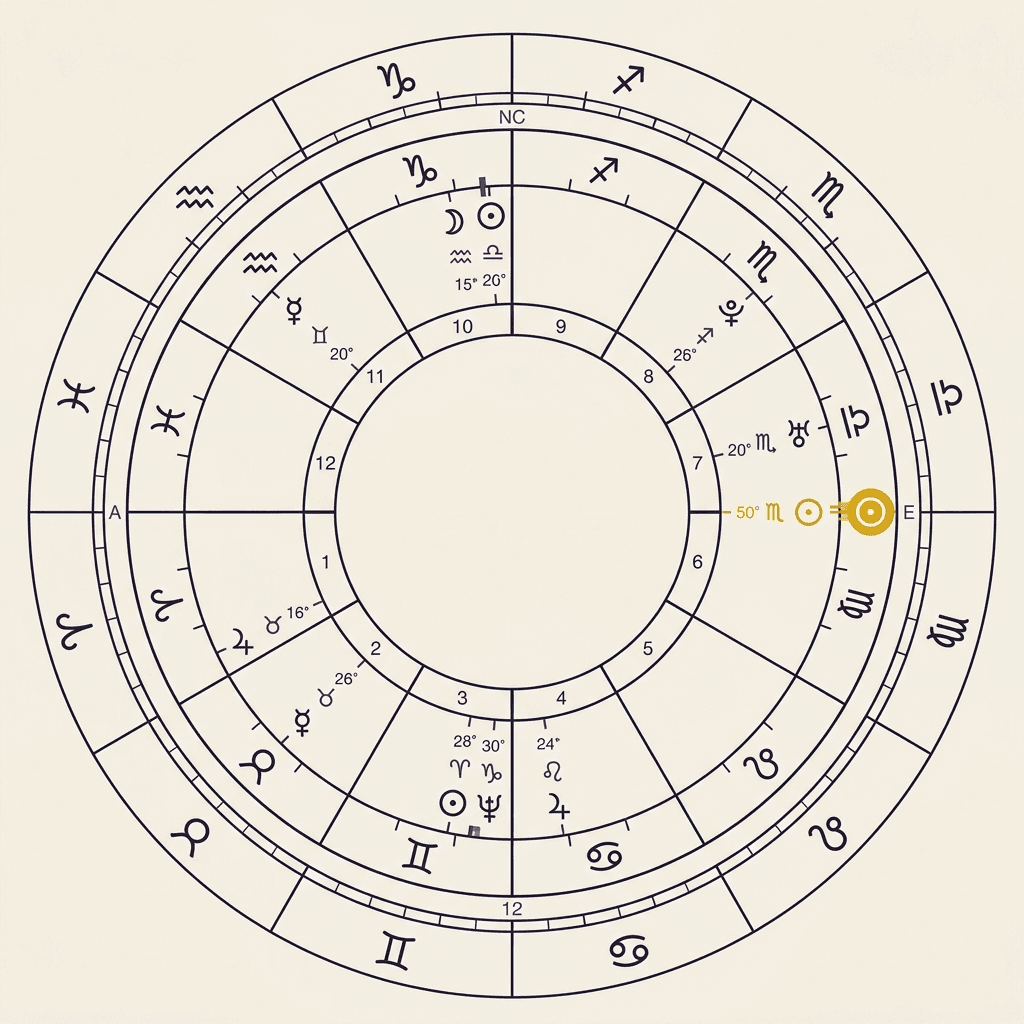
A solar return chart is cast for the exact moment the transiting Sun reaches the same degree and minute it occupied at your birth — an event that happens once per year and falls within a day of your birthday.
The solar return chart captures the sky at the precise moment the Sun returns to its natal position, accurate to within a few minutes. It functions as a forecast chart for the 12 months ahead, from one birthday to the next. The solar return Ascendant and the house placement of the natal chart ruler are the two most diagnostic features. Astrolium generates a solar return chart for any year automatically from your birth data.
What the solar return is
The Sun returns to its natal degree once every 365.25 days, which is why birthdays happen when they do. The solar return chart treats that moment as the starting point for a 12-month chapter of your life. It is separate from the natal chart and does not alter it; it sits alongside it as a distinct forecast instrument.
The technique has a long history. Hellenistic astrologers used annual returns — the Greek term was "anniversary" — as part of their predictive toolkit alongside profections and primary directions. Abu Ma'shar, the 9th-century Arabic astrologer whose work shaped medieval European astrology, wrote systematically on annual revolutions. The technique survived into Renaissance practice through Girolamo Cardano and Jean-Baptiste Morin, who documented detailed methods for reading solar returns as standalone annual charts.
The modern interpretive approach is largely descended from Morin's Astrologia Gallica (1661), though most contemporary practitioners have loosened his rigidly hierarchical system in favor of more flexible house-by-house analysis.
How the calculation works
The chart is calculated for the moment the Sun's ecliptic longitude exactly matches its natal ecliptic longitude. This is not necessarily your calendar birthday — the exact moment can fall hours before or after midnight on the birthday date, sometimes landing a calendar day earlier or later depending on the year.
The chart is cast for your location at the time of the return, not your birth location. This detail matters. If you spend your birthday in a different city, the solar return is calculated for that city. The Ascendant degree changes with location, and the Ascendant is one of the chart's most sensitive points. Some practitioners deliberately choose birthday travel destinations to position favorable solar return Ascendants — placing the solar return Ascendant over a benefic natal planet, for example. This practice is called solar return relocation.
Three numbers define the chart:
- Your natal Sun degree and minute (from your birth data).
- The current year.
- Your location when the Sun returns.
Reading the solar return in practice
The solar return is read as a standalone chart and also in relationship to the natal chart. Both layers carry information.
Reading the solar return alone works through the same 12 houses as any chart, each carrying its own topic:
- The Ascendant sign and degree set the overall tone for the year. A solar return Ascendant in Scorpio reads differently from one in Libra, even for the same natal chart.
- The solar return Sun's house placement shows the domain of life receiving the most solar focus for the year. Sun in the 10th house of the solar return: career and public role are the year's center of gravity. Sun in the 4th: home, family, and private life.
- The solar return Moon's house and sign describe emotional weather for the year.
- Any planets near the Ascendant or Midheaven of the solar return are activated prominently.
Overlaying the natal chart:
- Where do solar return planets fall in the natal house wheel? A solar return Mars in the natal 2nd house points to financial initiative or financial friction for the year.
- Which natal planets does the solar return Ascendant conjunct or oppose? That contact describes what the year's theme activates in your foundational chart.
A complete reading integrates both layers. Experienced astrologers also layer in profections — the annual time-lord technique — to identify which natal house is activated by age that year, then check whether the solar return emphasizes the same territory or a contrasting one.
In Astrolium
The solar return chart tool generates your solar return for any year and location. You can compare it against your natal chart in a bi-wheel view and read solar return planets by natal house. The profections calculator generates the corresponding annual profection so you can read both techniques together. For the broader predictive context, the solar return guide covers integrating the chart with transits and secondary progressions.