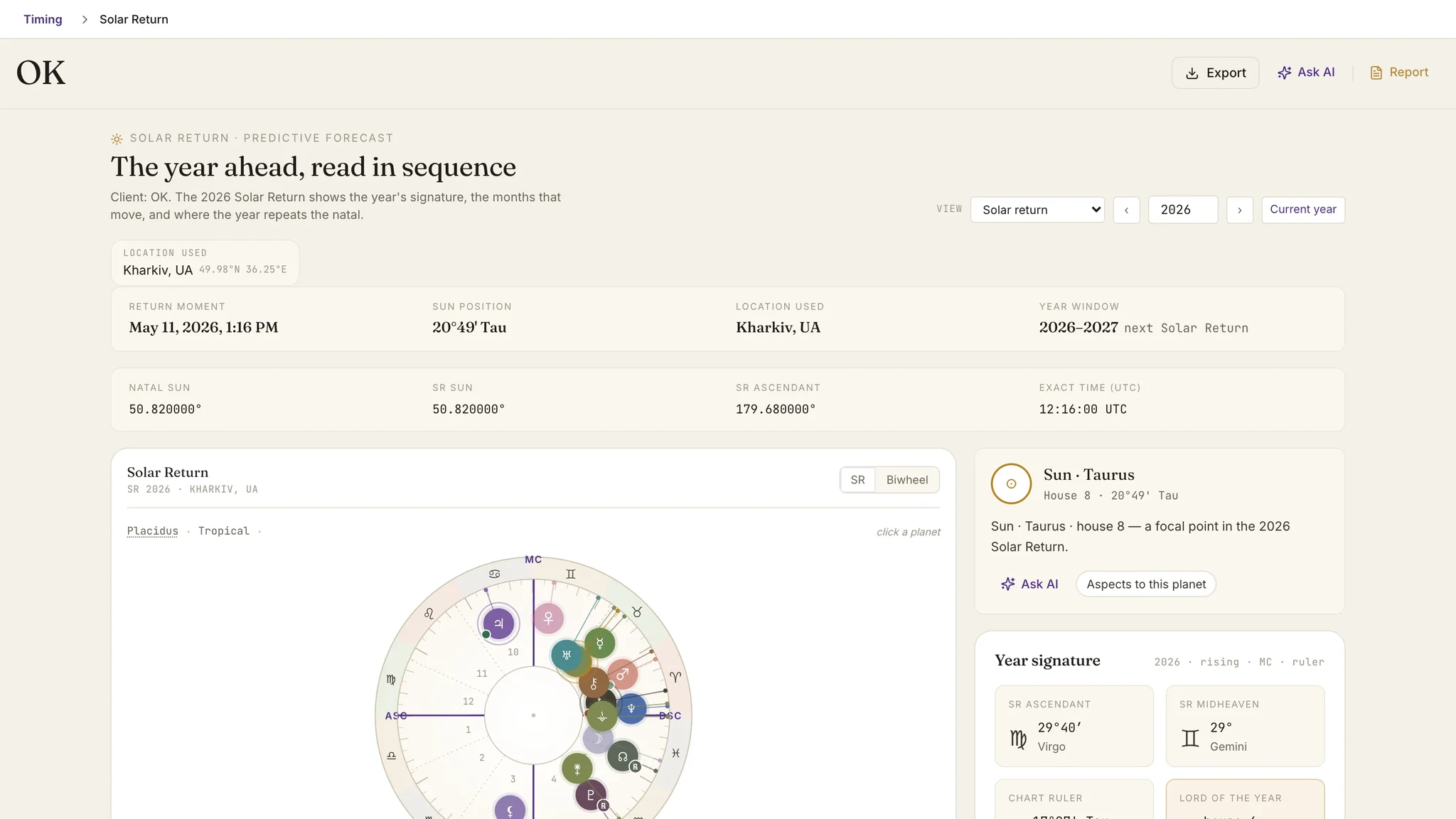
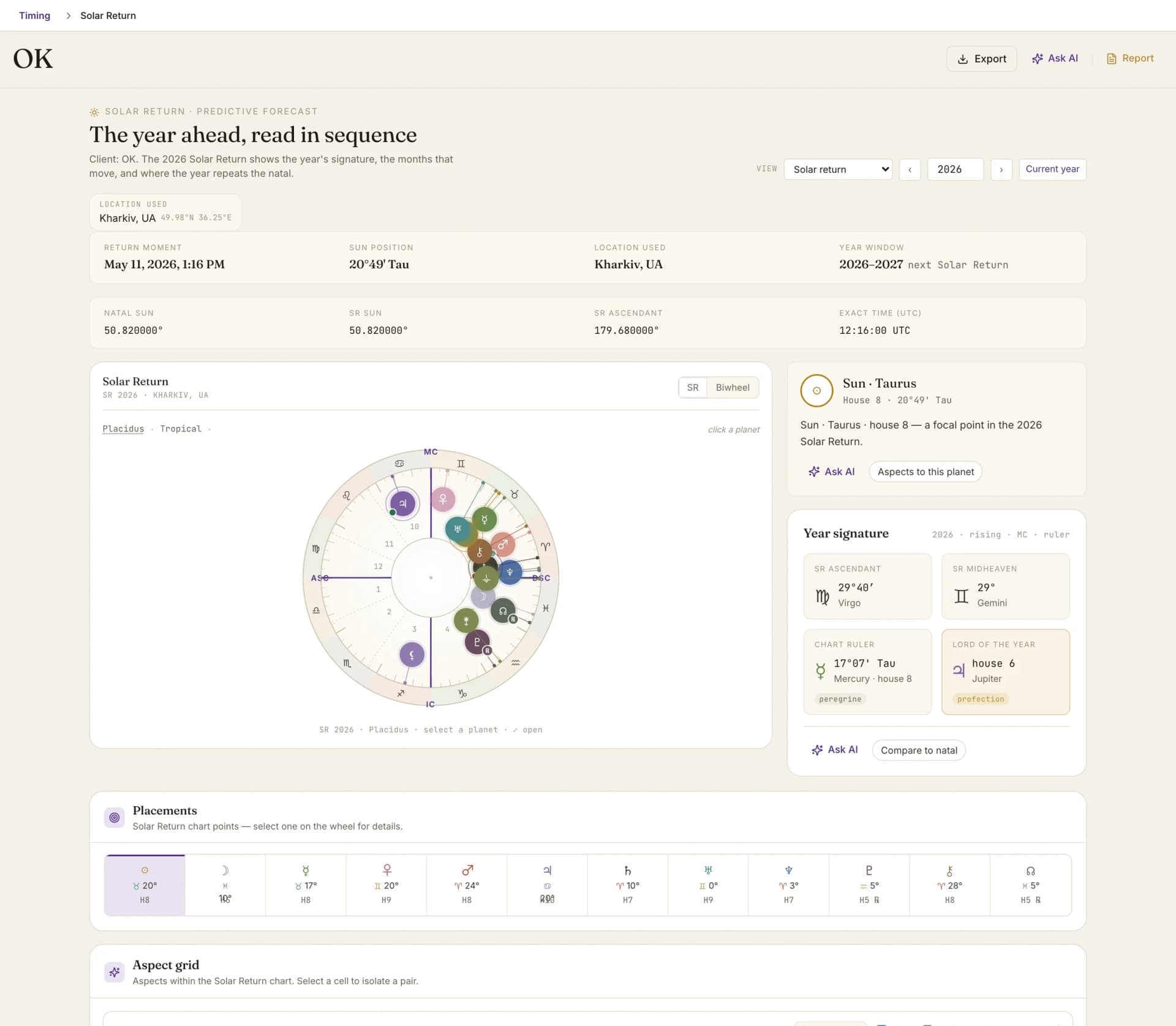
Astrolium computes the solar return chart the way professional practitioners read it: the precession-corrected wheel, paired with the profected year-lord, with the 12-month transit overlay attached automatically. The math runs on the Swiss Ephemeris with arc-second precision across any location in the gazetteer.
The free solar return chart calculator previews the wheel without signup. The solar return guide covers the full reading method, and the Saturn return guide shows what happens when the solar return arrives during a major outer-planet pass. See predictive timing for the ribbon engine, or jump to pricing for the $29 per month Adept plan.
What professional astrologers need from the solar return
The annual return is the single most reliable source of recurring revenue in a private astrology practice. Forum research across the working professional field — Liz Greene's students, Bernadette Brady's school, Mary Shea's relocated-return method, the Pesavento and Pottenger work — all converges on the same point: the once-a-year reading is the financial backbone of a practice. Clients schedule it. They pay for it. They come back for it.
What they don't come back for is a static wheel printed from a 1995-era report generator. They come back for the reading, which is the wheel plus the profected year plus the transits, all visible at once. Most software gives you the wheel and stops. Astrolium gives you the reading.
This isn't only for the full-time studio. A part-time or early-career practitioner billing a handful of annual readings gets the same precession-corrected wheel and profected-year overlay, and the Pro plan at $11 per month is the on-ramp before the returns suite on Adept becomes the obvious upgrade.
The chart itself
The solar return is cast for the exact moment transiting Sun returns to its natal longitude. Because the tropical year is 365.2422 days, the return rarely falls on the same clock time as your birth. Often it's the day before or the day after, hours off, occasionally even a different calendar date.
That precision matters because the angles change minute by minute. The Ascendant of a solar return cast at 09:14 will be different from one cast at 09:23. The house emphasis of the year hangs on those minutes. Astrolium pins the moment to the arc-second.
Tropical or precession-corrected
The contemporary working field is split. Liz Greene and most psychological astrologers cast the return in the tropical zodiac, the same frame the natal chart uses, with no adjustment. Bernadette Brady, Pesavento, and the sidereal-anchored school argue for precession correction — adjusting the return so the Sun is at the same sidereal degree it occupied at birth, not the same tropical degree.
The difference compounds at roughly 1.4 degrees per century. A client born in 1980 has a precession-corrected return that lags the tropical return by about 36 minutes. A client born in 1955 has one that lags by 50 minutes. The Ascendant of a precession-corrected return can be a different sign than the tropical return — which means the entire house structure of the year changes.
Astrolium ships both. Toggle from the chart settings; the wheel recasts in real time. On a sidereal return, Astrolium explicitly requests the precession-corrected instant rather than riding whatever the calculation service happens to default to, and it states the convention on screen and in the client PDF, so nobody has to reverse-engineer which method produced the chart in their hand.
The profected year, attached
The solar return is not read alone. Hellenistic practice — and the Greek tradition the technique descends from — pairs the return with the profected year-lord: the planet ruling the house that activates this birthday. Year 30 is in the 7th house, ruled by whatever planet rules your 7th. The solar return then sits inside the larger frame of that house and that planet.
Astrolium attaches the profected year automatically. The solar return wheel sits on the left of the workspace; the profected house and time-lord sit on the right; the year's strongest natal-to-profection aspects sit below. You read the year as one structure, not as a chart plus a separate report.
Solar return transits — the 12-month timeline
The third layer is the transit overlay. Every outer-planet transit hitting the solar return chart across the next 365 days is ranked and dated. The return's Ascendant catches a Pluto square in month 7. The return's Moon catches a Saturn opposition in month 4. These dates become the timeline of the year.
This is the layer most software omits. Solar Fire renders the solar return wheel and stops. To get the 12-month transit timeline, you generate a separate transit report against the return chart, then stitch it back to the wheel by hand. Astrolium does it in one workspace.
What the workspace looks like
Drop the client's birth data, click into the solar return tab, and the chart for the next return renders. Switch the location to any city for a relocated return. Toggle precession correction. The wheel recasts in real time.
Picking the location is its own question, and Sky will do the search for you. Name one or two things the client wants from the year and it ranks real places through astrocartography, then calculates the relocated solar return for the strongest candidates so you can read the actual charts rather than a shortlist of place names. If either calculation fails, it returns nothing instead of guessing.
What this replaces: opening Solar Fire, computing the solar return, exporting it, opening a transit report against the return, stitching the profected year by hand, and assembling the final deliverable across three documents. Astrolium does the whole thing in 300 ms.
Every client on the roster shows their next return date, the upcoming Ascendant sign, and the strongest active transit to the return chart. Especially useful in October and November when birthdays cluster — you can see at a glance who has a 12th-house Ascendant coming up and who has a 10th-house, without opening 40 charts.
Versus what you have now
By hand: ~45 minutes per chart per reading, separate documents for the wheel, profected year, and transit timeline, no overlay possible, relocated returns require manual coordinate entry.
Solar Fire or Astro Gold: Solar return wheel renders fine. The profected year-lord is a separate report. The 12-month transit overlay is a third report. Precession correction is a checkbox that most users never find.
Astrolium: Wheel, profected year, and 12-month transit overlay on one screen. Precession correction one toggle away. Relocated returns one field change. Dashboard view across the full roster.
Three ways practitioners use this every week
-
The annual reading. Client books in two weeks before her birthday. You open the solar return, see Mercury rising in the 1st with Saturn in the 10th, pair it with the profected 4th house, and find Jupiter trining the return Moon in month 6. The session writes itself. Twenty minutes of prep, 90 minutes of reading, repeat.
-
The relocated return. Client tells you he's spending the year in Tokyo. You relocate the return to Tokyo, find the Ascendant has changed signs, the Moon has moved from the 4th house to the 7th. The year's emphasis has structurally reorganized around partnership. You read what the relocation actually means.
-
The retrospective. Client wants to understand why last year was the year she finally left her job. You open last year's solar return, find Uranus in the 10th house with the profected year activating the 6th, and a Pluto square to the return Midheaven exact in month 8. The decision had a structural shape, and you can show her on one screen.
Cross-link
Preview the chart through the free solar return chart calculator. For the deeper reading method, see the solar return guide. For the sibling annual technique focused on expansion, see the jupiter return calculator. For the full predictive stack, see predictive timing and the Saturn return calculator. For a worked-example case study using a relocated solar return to help a client weigh a city change, see solar return relocation decision.