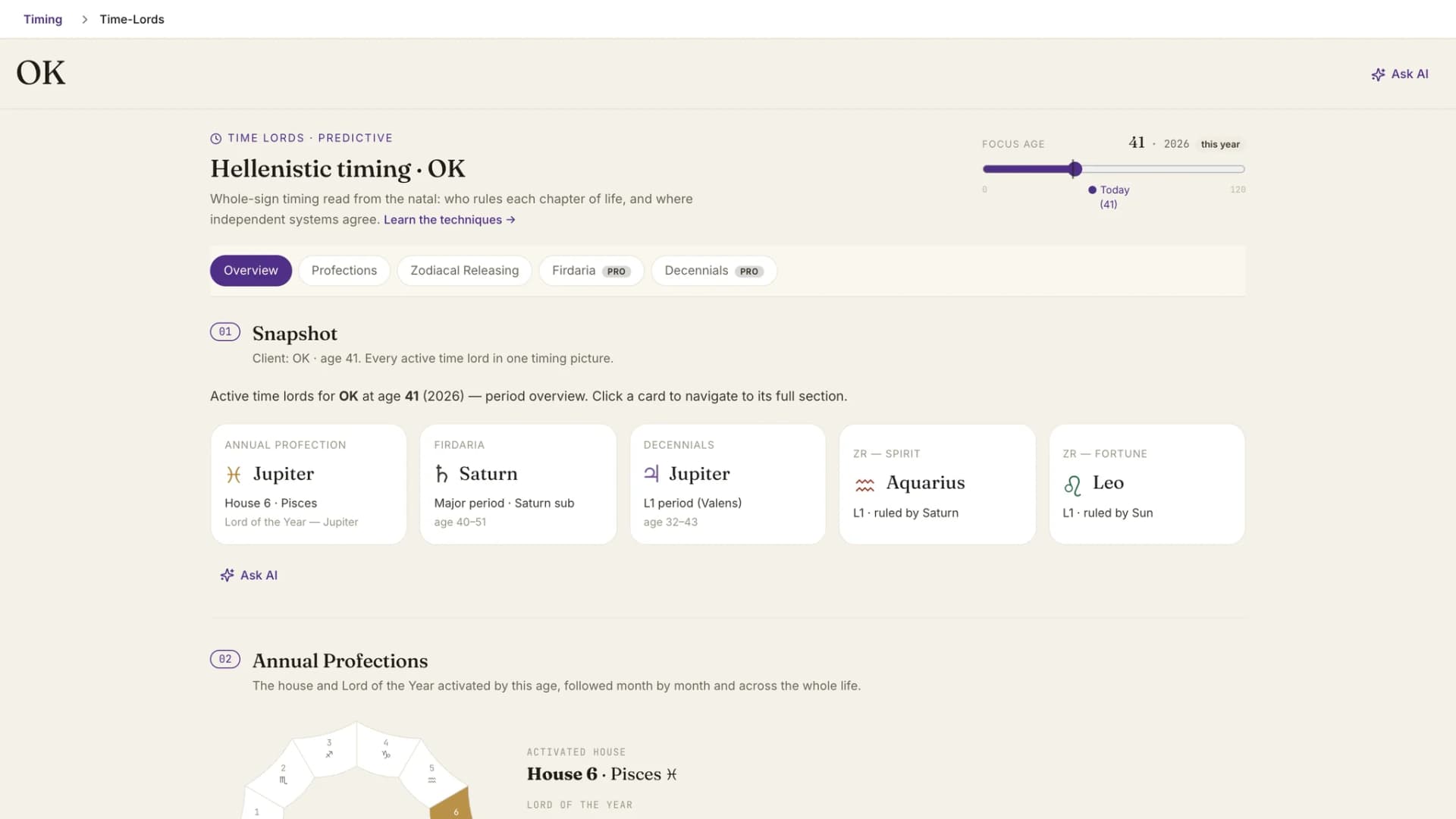
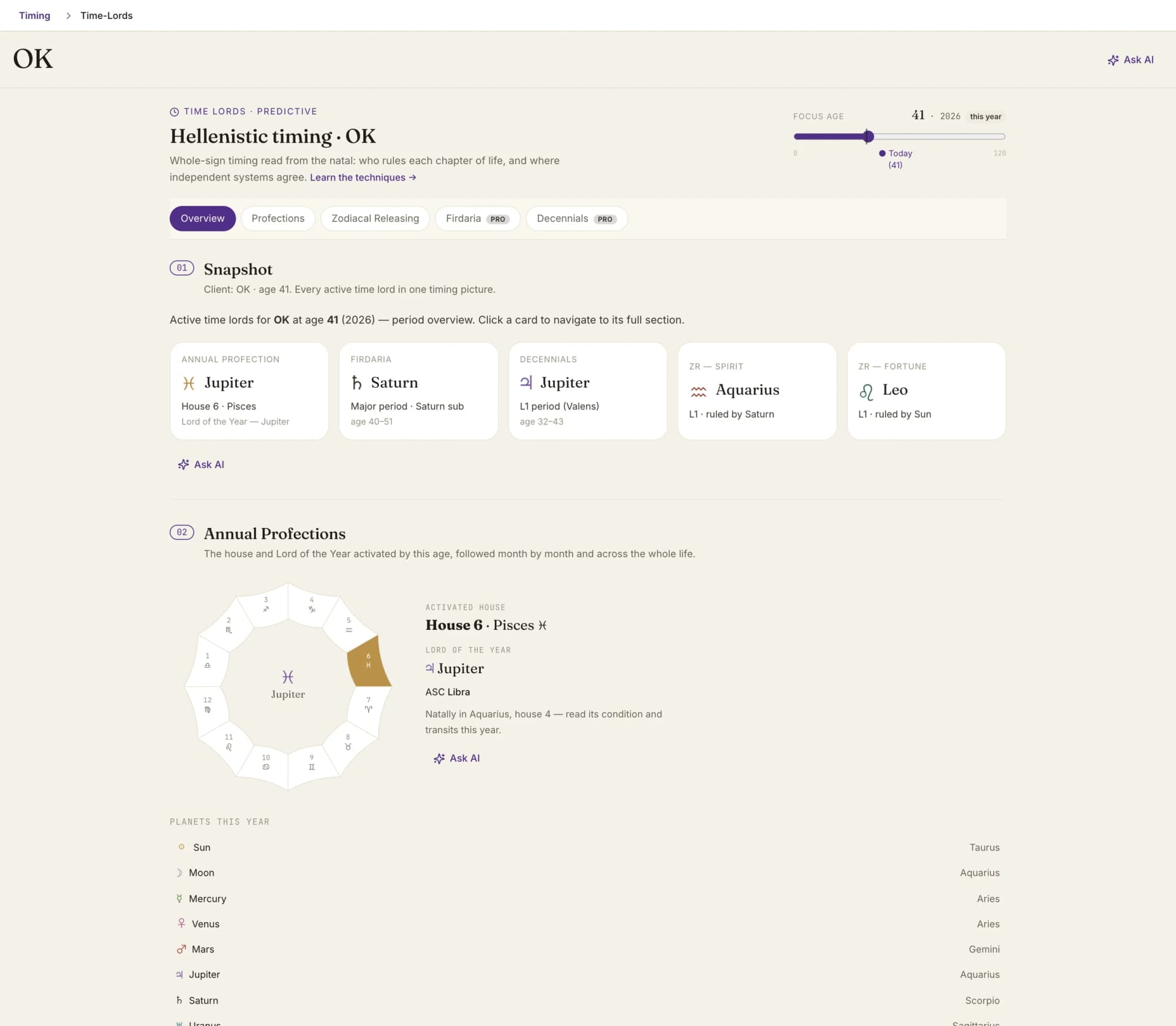
Astrolium stacks three predictive layers on one ribbon: profections (the year), Zodiacal Releasing (the chapter), and transits (the day). The scrubber covers 1900–2100, and the whole ribbon recalculates in real time as you drag — no separate reports, no stitched spreadsheets, no plugins.
The free profections calculator and zodiacal releasing tool preview two of these layers without signup. The Saturn return guide shows what happens when all three converge on a single chart. See pricing for the $29 per month Adept plan, or the synastry feature for how the ribbon attaches to couples.
What predictive timing actually is
The classical practitioners didn't pick one technique. They layered. Profections told them which house was running the year. Zodiacal Releasing told them which chapter of life they were inside. Transits told them which specific Tuesday the chapter would speak on. The reading happened across all three.
Most modern software treats each technique as a separate module — a profections report, a ZR plugin, a transits table — and the practitioner stitches them by hand. Astrolium stitches them once, on one ribbon, and lets you scrub.
The three layers
Layer 1 — the year (profections)
One sign per year, advancing from your Ascendant. Profections tell you which house — and therefore which planet — runs the room this birthday. Astrolium highlights the year-lord automatically every birthday, flags time-lord aspects as the year unfolds, and renders the annual profected chart in one click.
Year 1 of life is the Ascendant sign. Year 2 is the next sign. By the time you reach 12, you're back to year 1. Every 12 years you cycle through the houses. The technique survives 21 centuries because the structure is simple and the predictions are testable.
Layer 2 — the chapter (Zodiacal Releasing)
The Hellenistic technique preserved by Vettius Valens and reconstructed in the 1990s by Project Hindsight. It divides life into chapters and sub-chapters released from the Lot of Spirit (action, career) or Lot of Fortune (body, sustenance). Major and sub-periods are auto-calculated. Loosing-of-the-bond moments surface with a bowtie icon. Peak periods (LB transitioning to angular) are highlighted on the ribbon.
A typical reading: a 15-year major period of Aries with sub-periods of Aquarius, Pisces, then Aries. The Pisces sub-period peaks if Pisces is angular from the natal Lot. Astrolium marks that peak; you don't have to compute it.
Layer 3 — the day (transits)
Outer-planet conjunctions, eclipses, retrograde stations. The events that force the year-lord and the chapter to express themselves on a specific date. Astrolium runs triple-pass windows for retrograding planets, auto-flags eclipses on natal angles, and filters by planet, aspect, orb, and intensity.
A Saturn return isn't one date — it's three (forward, retrograde, forward again) across roughly 9 months. Astrolium gives you the window, not just the peak.
What the workspace looks like
Drag along any year between 1900 and 2100. The whole ribbon — profections, ZR sub-periods, transits — recalculates in real time. Stop on a date, screenshot it, paste it into your session notes. What this replaces: opening Solar Fire, running a profection report, closing it, opening another report for ZR, running a separate transit table, stitching the three by hand.
The dashboard shows every client's profected year, current ZR sub-period, and active transits at a glance. Tap any row to drop into their full predictive ribbon. Filter by who's in a peak period this month, or who has Saturn returning. Especially useful before booking-season check-ins — you can see who actually needs to come in this quarter.
Versus what you have now
By hand: ~45 min per chart per session, three separate spreadsheets, errors compound silently across years, impossible to share with the client.
Solar Fire or Astro Gold: Profections ship as a report only, no overlay. ZR requires a third-party plugin or nothing at all. Transits ship as a table, no visual ribbon. Layered view: not possible.
Astrolium: All three layers on one ribbon. Real-time scrubber from 1900 to 2100. Triple-pass retrograde windows automatic. One-page PDF export per client.
Three ways practitioners use this every week
-
The yearly check-in. Client returns for an annual reading. You scrub to their next birthday — new year-lord highlighted, ZR sub-period change visible, the two big transits of the year already marked. Twenty minutes of prep becomes two.
-
The "is this the year?" Someone asks if 2027 is when they should make the career move. You scrub to 2027, see profected 10th house with Jupiter as year-lord, ZR sub-period turning angular, no Saturn squares. You answer with structure, not vibes.
-
The retrospective. Client wants to understand why 2019 broke them. You scrub backward, find the loosing-of-the-bond, Saturn return, and eclipse on the IC all stacked in the same 4 months. The conversation that follows is one neither of you could have had without seeing it.
Cross-link
Preview each layer through the free profections calculator, zodiacal releasing tool, and Saturn return calculator. For the per-client transit reading underneath the ribbon's third layer, see the transits feature — open one chart, scrub to a date, read the wheel. For relationship timing, see synastry — the same ribbon engine, run against the composite Ascendant. For the deeper read on each technique, see the profections guide, zodiacal releasing guide, and Saturn return guide.