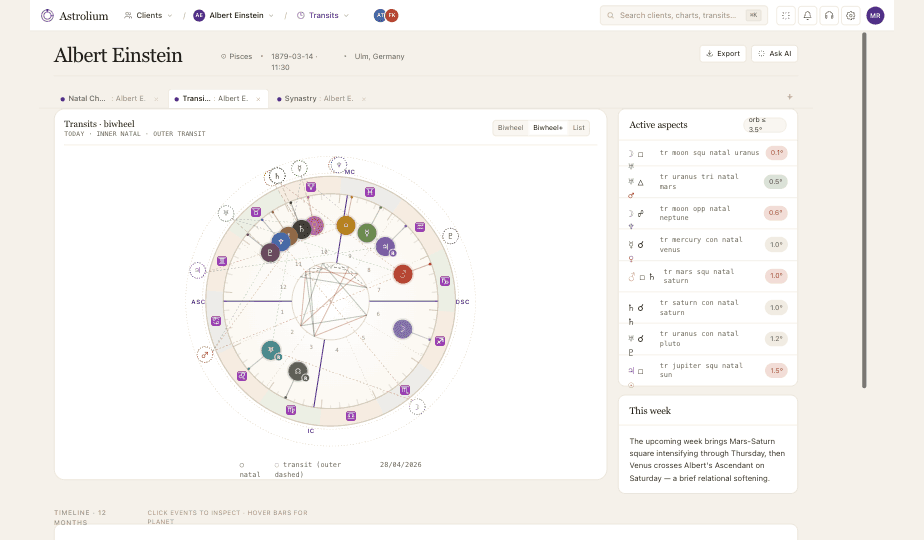
The Astrolium Saturn return calculator gives you all three return dates — first at age 29 years, second at 58 years, third at 88 years — with the full triple-pass retrograde windows for each. Math runs on the Swiss Ephemeris, in your browser, in under 30 seconds. No login, no email, no upload.
The full reading sits inside the predictive timing feature, where Saturn returns stack against profections and Zodiacal Releasing on one ribbon. For the interpretive framework, read the Saturn return guide. For the partnership timing equivalent, see the synastry feature. For the $29 per month Adept tier with roster-wide scanning, see pricing.
What you get
Saturn takes 29.4571 years to orbit the Sun. When it returns to the exact degree it occupied at your birth, that's a Saturn return. Most people experience three: around age 29, 58, and 88.
The first marks the end of an extended adolescence. The second is a reckoning with your second act. The third — for those who make it — is a kind of distillation. Saturn doesn't make these things happen on its own. It exposes what was already there and gives the structure a deadline.
Because Saturn retrogrades, the return rarely happens in a single moment. It's a triple-pass: forward across the natal degree, retrograde back across it, forward across it again. That's why the calculator returns a window of about 9 months, not just the peak date. For the full interpretive framework, read the Saturn return guide.
The three returns
First return — around age 29 years
The one that gets a name. Career pivot, marriage, divorce, the apartment move that turns out to be the move. Often a father issue surfaces. Often the work you've been doing on autopilot since college becomes intolerable. The first return is rarely subtle — Astrolium shows the 9-month window so you can see when the pressure begins to build and when it crests.
Second return — around age 58
The reckoning. What was the first half actually for? Often a body event, a parent's decline, the late-career bet. Less rage than the first return, more clarity. The second return reads people who have already had a first one, so the question is about distillation rather than rebellion.
Third return — around age 88
For the lucky few. Distillation. Often quiet. The legacy question, but answered. Astrolium computes the third return for any birth chart so practitioners working with older clients can see it directly — most software stops at the first.
How the calculator works
Drop your birth data — date, optional time, and place. The math runs in your browser on the Swiss Ephemeris, the same library Solar Fire and Astro Gold use under the hood. So the absolute positions match to the arc-second. What Astrolium adds is the visual layer: the chart wheel for the return moment, the triple-pass dates laid out as a window, the natal house Saturn rules so you know which area of life gets the structural pressure.
Whole-sign houses are recommended for traditional Saturn return work, but Astrolium supports all 23 house systems (free on every plan) — Whole Sign, Placidus, Porphyry, Equal, Koch, Regiomontanus, and more — switchable from the dropdown without re-entering birth data.
Nothing is stored. Nothing is emailed. We don't know who you are.
After the calculator
A Saturn return doesn't happen in a vacuum. It activates the natal house Saturn rules and the house Saturn sits in by transit. It can square or oppose other planets along the way — those compound squares are the real signature of the return. It runs alongside other timing: your profected year, the current Zodiacal Releasing period, eclipses on your angles.
The full reading is the whole sky, not one transit. For the structured way to read all of it together, see the predictive timing feature — same calculator output, but stacked against profections and ZR on one scrubbable ribbon.
For the 4,000-word interpretive guide that walks through reading your Saturn return alongside everything else, see the Saturn return guide. For practitioners running this on a whole roster of clients, the pricing page covers the $29 per month Adept tier and the batch scanner.
Cross-link
Run other timing techniques: profections calculator, zodiacal releasing calculator. For the partnership timing version, see synastry calculator. For the full feature stack, see predictive timing.