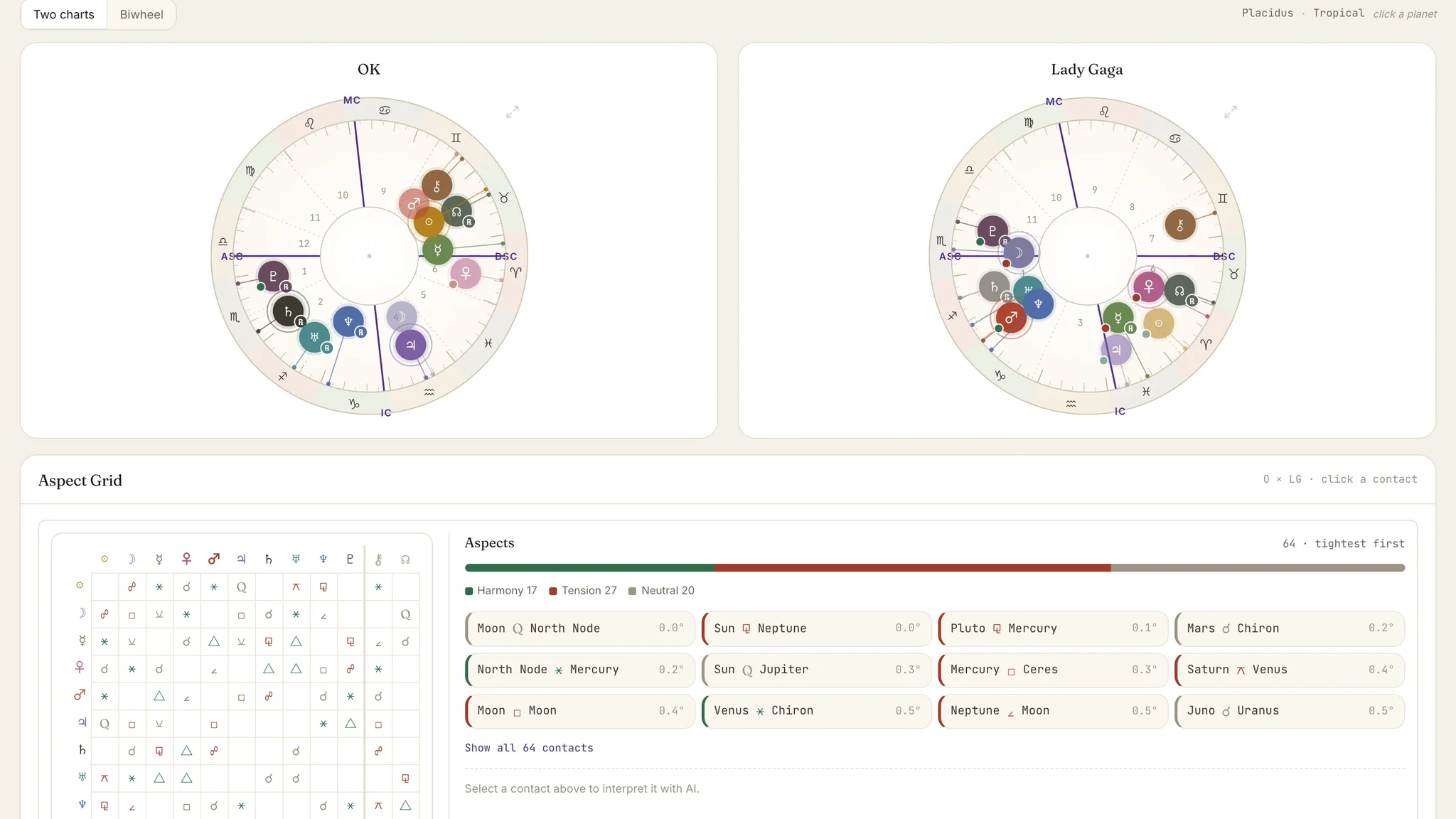
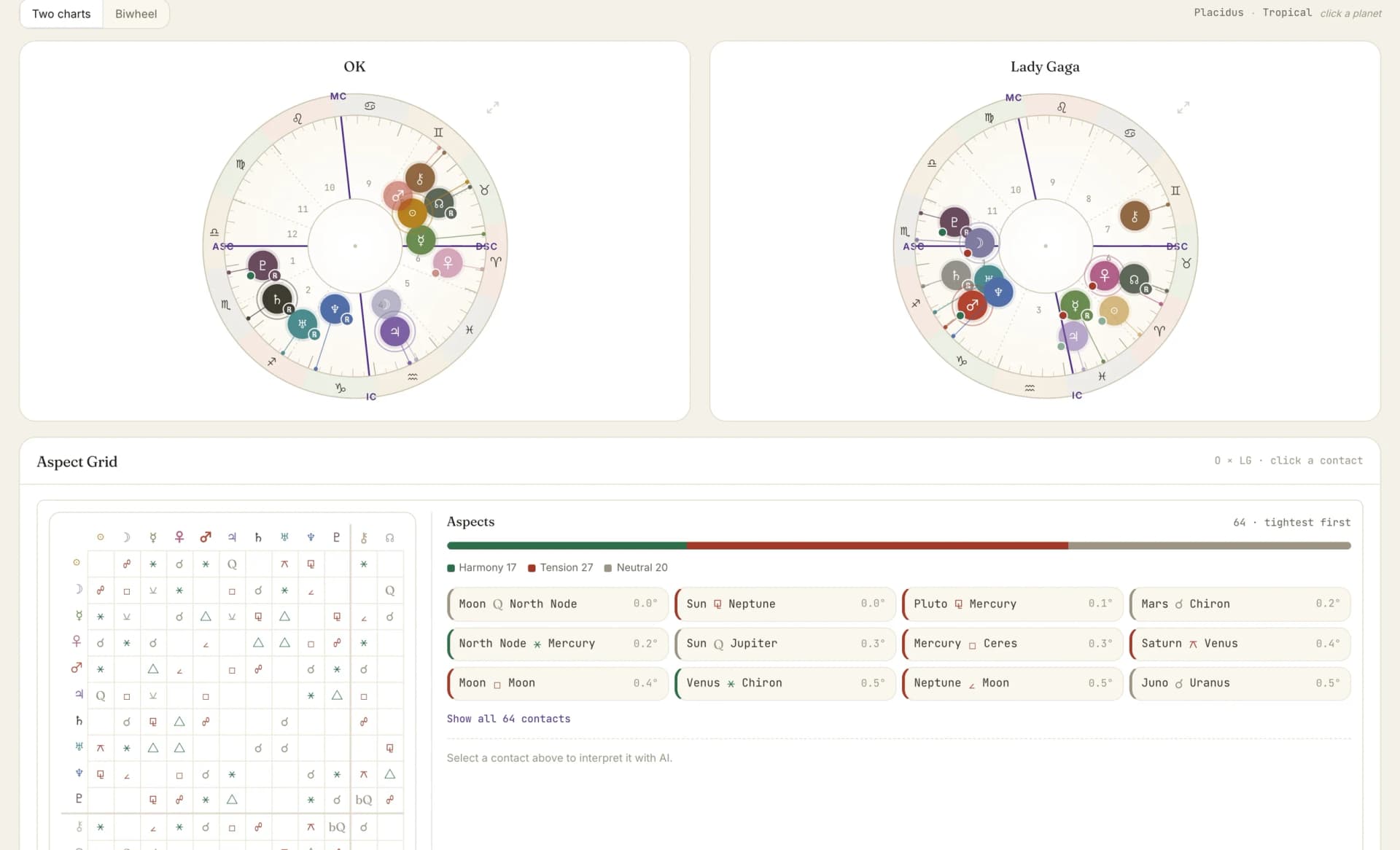
Astrolium runs the three classical layers of relationship astrology — inter-aspects, house overlays both directions, and the composite chart — on one screen, then attaches the timing layer so the couple's year is visible too. The 5x7 inter-aspect grid renders in 80 ms with a 6 degree orb and sect-aware rulerships.
The free synastry calculator previews the ranked aspects without signup. The synastry guide covers the full reading method. See the predictive timing feature for how the composite plugs into transits and profections, or jump to pricing for the $29 per month Adept plan.
What a synastry reading actually needs
A working astrologer doesn't pick between inter-aspects, overlays, and the composite — they read them as one structure. The grid tells you which planets contact each other. The overlay tells you which rooms of life those contacts activate. The composite tells you what the relationship looks like as its own entity, with its own birthday and its own year-lord.
When all three sit on one screen, the read changes. A pattern that looks soft on the grid (Venus trine Venus) might land hard once the overlay shows A's Venus in B's 12th house. A composite that looks unremarkable becomes urgent when its profected year just turned to the 7th house and Saturn is squaring its Sun for ten months.
The three layers
Layer 1 — the contacts
The inter-aspect grid covers every angle from one chart's planets to the other's. Sun-Moon and Venus-Mars do the romantic talking. Saturn does the long-term talking. The outers do the karmic. Astrolium ranks by orb x weight, not by counting hits, so a Venus-Mars conjunction at 1 degree dominates a Venus-Mars conjunction at 7 degrees.
Sortable columns let you re-rank by orb, by weight, or by planet. Hover any cell for the full read of that contact. Classical rulers are on by default; one toggle swaps in modern rulers if your school works that way.
Layer 2 — the rooms
Where do A's planets fall inside B's house cake? Where do B's planets fall inside A's? These are two different readings, and the asymmetries are usually where the relationship's truth lives. Astrolium shows them side by side.
A common example: A's Sun in B's 10th house (A is publicly important to B) while B's Sun lands in A's 12th house (B is privately important to A). That asymmetry is a real conversation, and it took two charts to surface it. Astrolium supports whole-sign and quadrant systems and highlights the angular asymmetries (10th vs 12th, 7th vs 1st) so the structural difference is obvious.
Layer 3 — the third chart
The composite is the relationship as its own entity. Astrolium computes it by midpoint (the 1970s standard) or by Davison (a real chart cast for the time-and-place midpoint of the births). Both run profections, zodiacal releasing, and transits the same way a natal chart does.
This is the layer most consumer tools skip. It's also the one practitioners reach for when a client asks "what's happening with us right now?" The composite's year-lord answers that better than either partner's profected year alone.
What the workspace looks like
Drop both partners' birth data into the two-row form, click compare, and the grid renders. Click into the composite tab to switch chart modes. Click into the timing tab to drop the composite onto a profections + transits ribbon — same ribbon used in predictive timing, but with the composite Ascendant on the axis.
What this replaces: opening Solar Fire twice, computing inter-aspects in one window, dragging the composite into a third window, and manually annotating which contacts matter for a session. Astrolium does that work in 80 ms.
Every couple on your roster sits on the dashboard like a solo client. Each row shows the composite's profected year, the strongest active synastry transit, and a flag if the couple is in a Saturn-on-Venus or composite-eclipse window. Especially useful before couples-counselling check-ins — you can see which composite Saturn is squaring which composite Sun this quarter without opening a single chart.
Versus what you have now
By hand: ~60 minutes per couple per session, two charts then a third for composite, asymmetries usually missed, no timing layer at all.
Solar Fire or Astro Gold: Inter-aspects ship as a table only. Overlays are one direction or take laborious setup. Composite is a separate chart, not on the screen with the grid. Composite timing isn't on one screen with anything.
Astrolium: Grid, overlays both ways, composite, and composite timing on one screen. Both overlay directions automatic. Composite profections built in. Couples view on the dashboard.
Three ways practitioners use this every week
-
The pre-marital reading. Couple comes in before deciding to commit. You compare in 2 minutes, surface the Saturn contact and the asymmetric overlay, then drop into the composite to read the relationship's own architecture. The conversation that follows is structural, not romantic.
-
The "what is happening" check-in. A long-married couple comes in because the year feels off. You scrub composite transits and find Saturn squaring the composite Sun for 10 months. The off-feeling has a structural cause and an end date.
-
The post-mortem. Client wants to understand a finished relationship. You overlay the two charts and find the loosing-of-the-bond, Saturn return, and Pluto-on-Venus stack that ran across years 4–6. The reading isn't a verdict; it's a clarification.
Cross-link
For the free preview, run two charts through the synastry calculator. For the underlying timing engine, see predictive timing. For the deeper reading method, read the synastry guide. For the wider couples toolkit — Juno, Vertex, Davison, and love-language overlays — see relationship astrology. For the comparison with classical desktop software, see Solar Fire vs Astrolium.