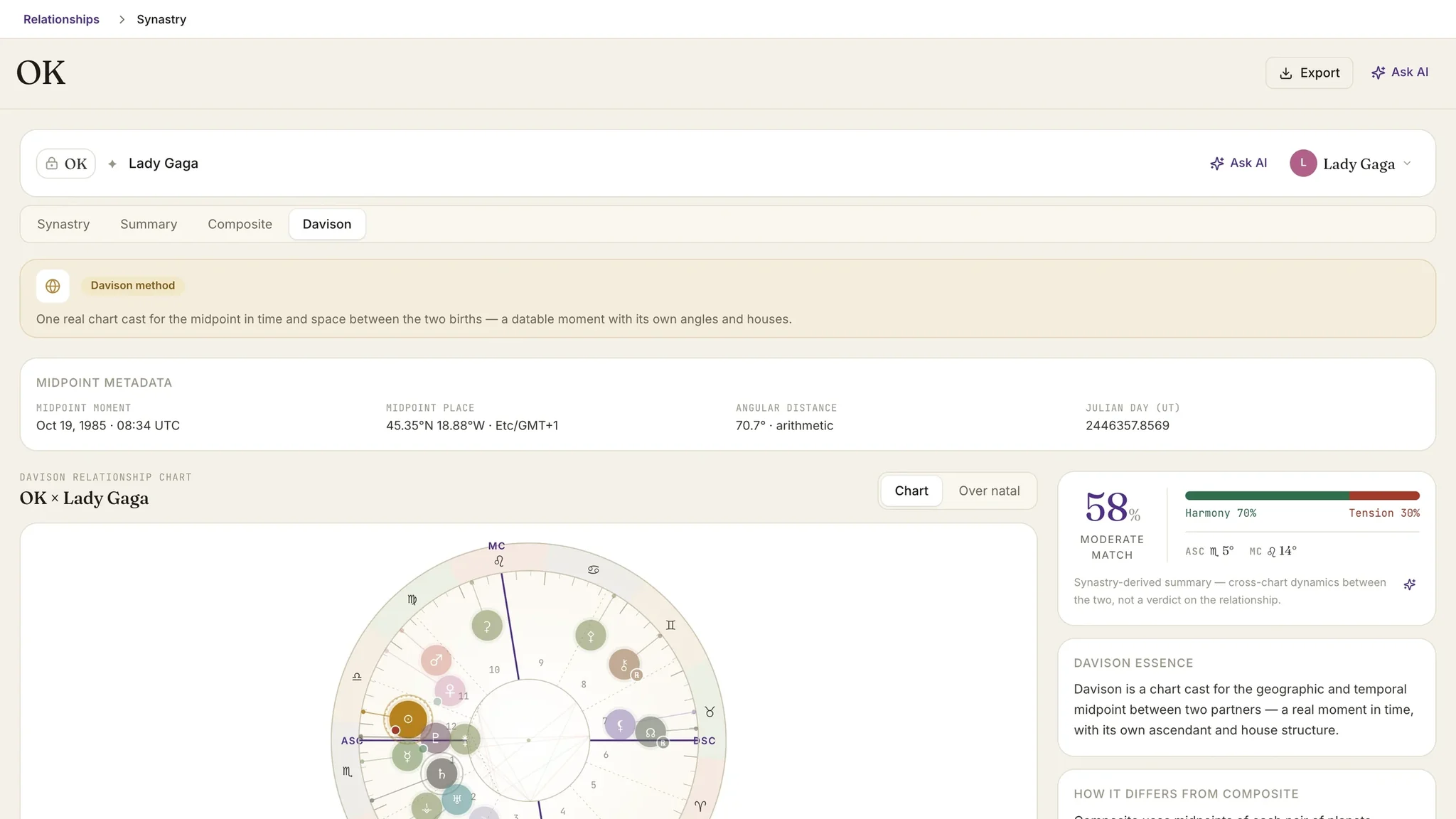
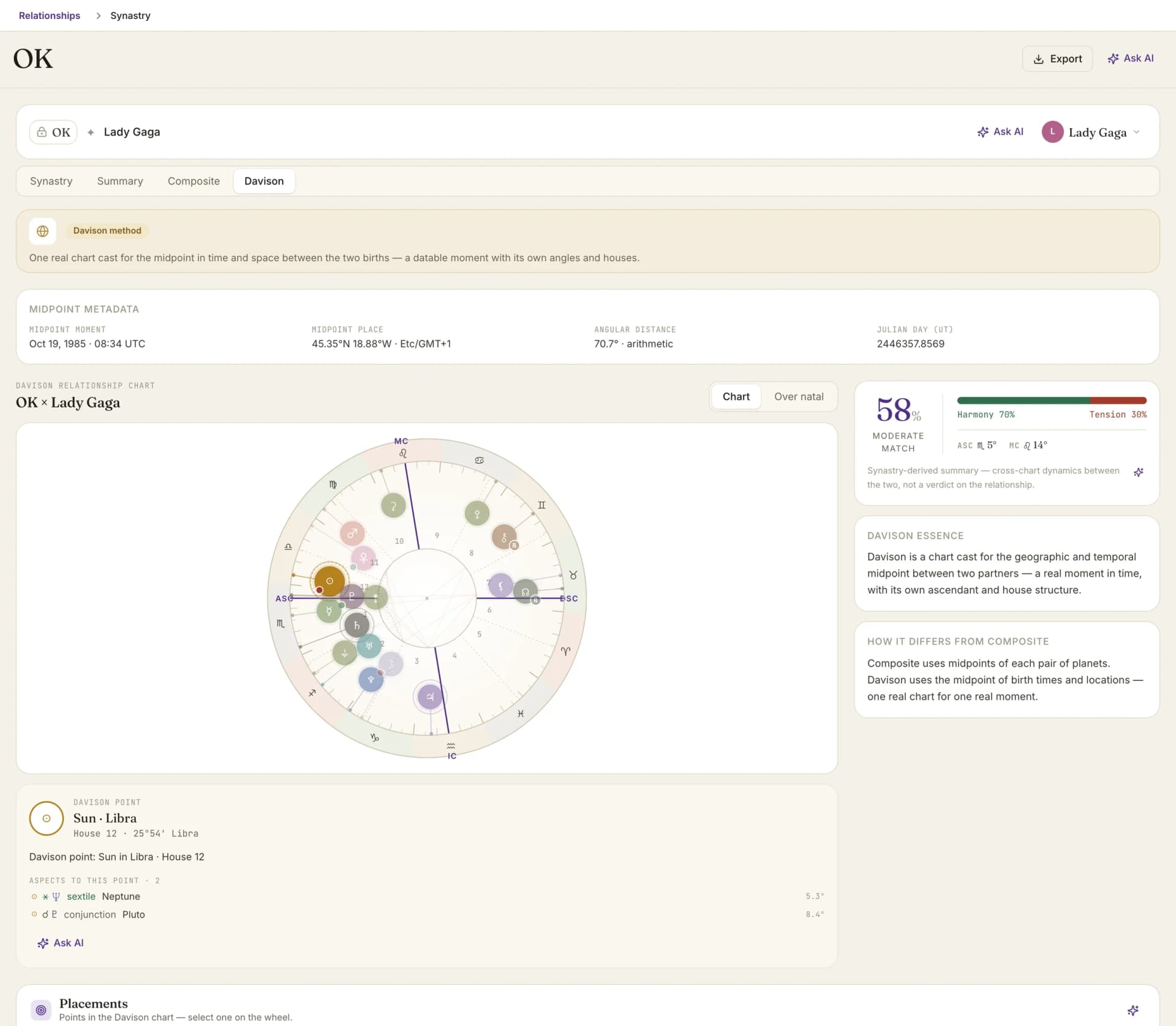
Relationship astrology examines how two natal charts interact and what they create together. The two primary techniques are synastry, which overlays the charts and compares all 10 planets across both wheels, and composite, which merges them into a single midpoint chart representing the relationship as a distinct entity.
Synastry works through inter-aspects — the angles formed between one person's planets and another's. A Venus-Mars conjunction across two charts suggests strong initial attraction. Saturn aspects often describe where commitment and structure meet resistance. The nodes and outer planets add layers about karmic resonance, long-term growth, and collective themes the two people work through together.
The composite chart, by contrast, is not about two individuals — it is the chart of the relationship itself, read across all 12 houses. Where the composite Sun falls describes the core purpose of the pairing. The composite Moon shows the emotional baseline. Composite Saturn in the 7th house is a very different relationship than composite Venus there, even if the individual charts look compatible in synastry.
Beyond synastry and composite, Juno and the Vertex add specific lenses on commitment and fated meeting. The love language calculation draws on 4 factors — Venus, Moon, Mars, and the 5th house — to show how each person expresses and receives affection, which is often where otherwise compatible couples experience friction. For a printable summary of any pairing, see the PDF reports feature.