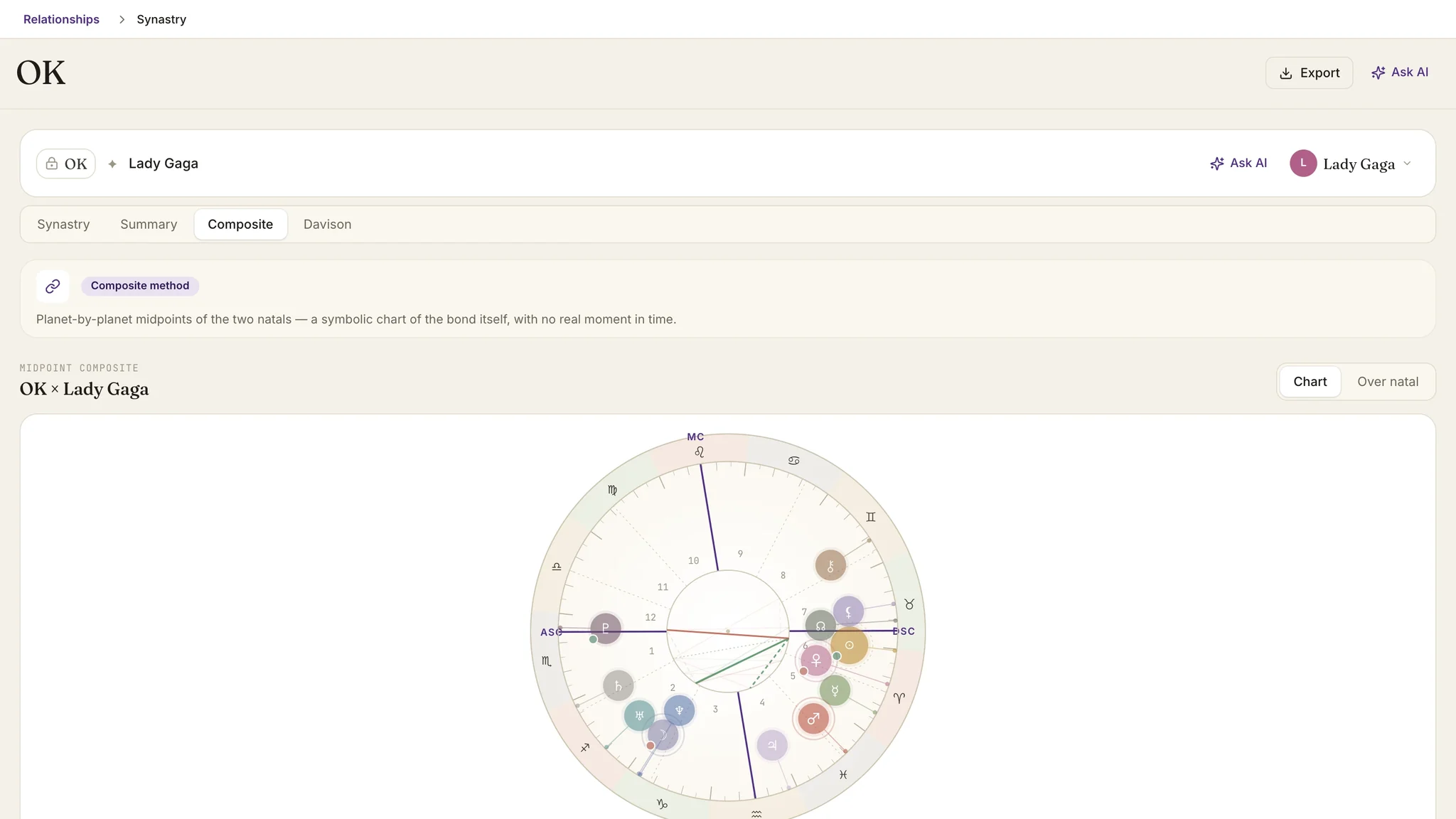
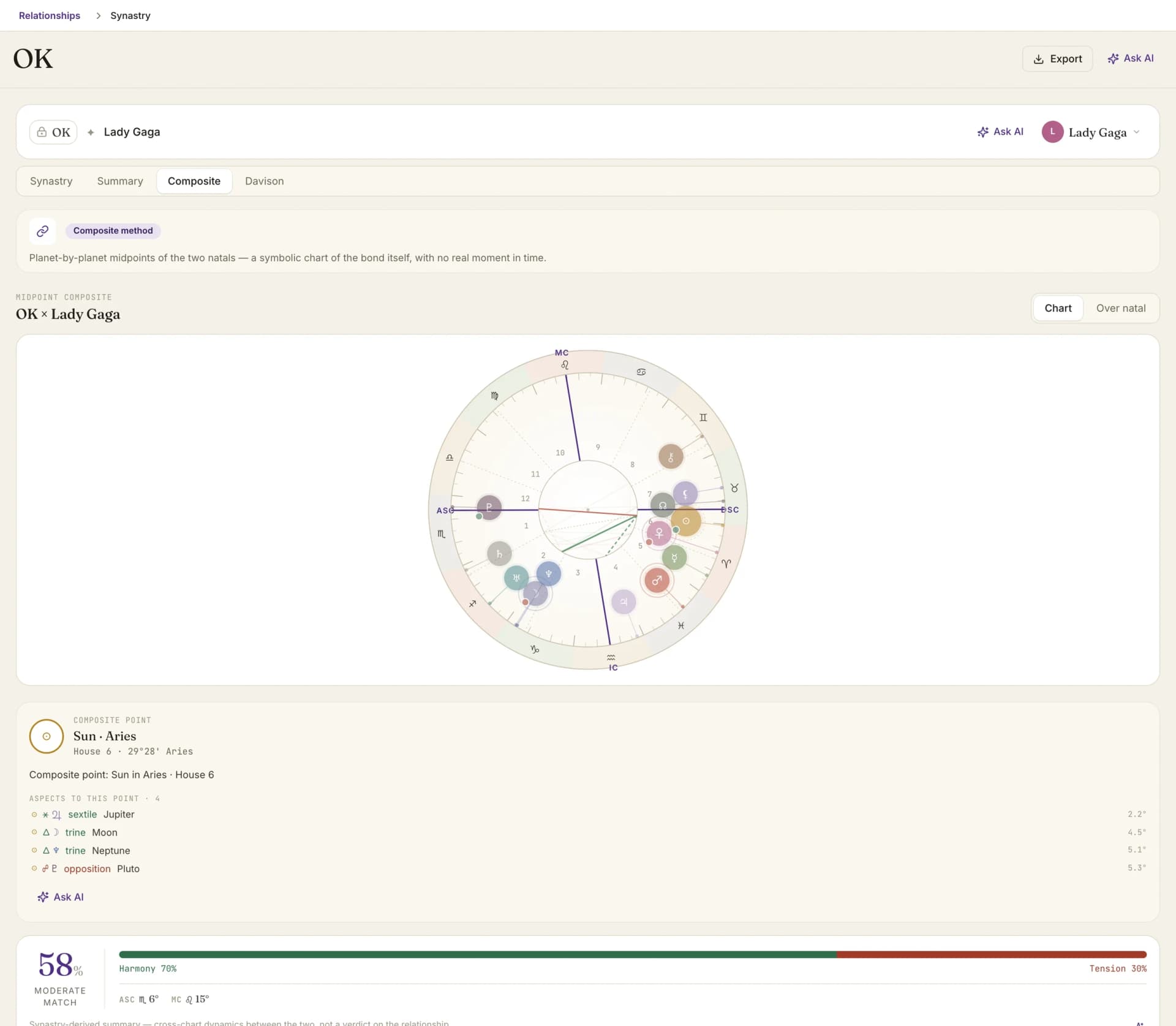
Astrolium computes the midpoint composite and the Davison chart on one screen and attaches the timing layer to both. The midpoint composite averages the 10 planetary longitudes of the two natals; the Davison is a real chart cast for the time-and-place midpoint of the births. Both render in under 300 ms, both transit, both profect from their own Ascendant.
For the free preview, run two charts through the composite chart calculator. For the comparison of the two techniques, read the composite vs Davison guide. For the full synastry stack (biwheel, inter-aspect grid, house overlays), see synastry charts in Astrolium. For the $29 per month Adept plan, see pricing.
Why the composite is a chart, not a report
Synastry tells you how 2 people feel inside a connection. The composite tells you what the connection itself is. Robert Hand's 1975 Planets in Composite turned this from a niche midpoint technique into the standard layer of modern relationship astrology, the chart you read when a client asks "what is this thing we're in?" The technique itself is older than Hand: Charles Carter discussed planetary midpoints as a structural tool in the 1920s, and the Ebertin school formalised the midpoint method through the mid-20th century. Hand's contribution was reading the midpoints as a single chart rather than a list of degree-by-degree contacts.
The midpoint composite is built by averaging. For every planet, you take the shortest arc between Person A's longitude and Person B's longitude and place the composite planet at that midpoint. The composite Ascendant is the midpoint of the two Ascendants. The result is a derived chart: it has no birth moment, no ephemeris position, but it has structure.
Ronald Davison proposed an alternative in 1977. Instead of averaging planetary positions, average the birth moments themselves. Take the midpoint date, midpoint time, and midpoint location of the two births, then cast a real chart for that moment. The Davison chart sits on the ephemeris. Transit Saturn really does aspect its Sun. That is why some practitioners, especially those doing long-term relationship work, prefer Davison.
The two composites, side by side
Astrolium shows the midpoint composite and the Davison on one screen, with the inter-aspect grid attached below. The agreements between them are stable structural facts about the relationship. The disagreements are where the reading lives.
A common pattern: midpoint composite Sun at 14° Cancer, Davison Sun at 22° Cancer. Same sign, same general feel, slight difference in the degree the Sun lands on. The reading is mostly stable.
A less common pattern: midpoint composite Sun at 29° Gemini, Davison Sun at 2° Cancer. Different signs, different rulers, different stories. The midpoint reads as airy, communicative, light. The Davison reads as watery, protective, home-centred. The disagreement itself becomes the question. Does the relationship live more in its words or more in its home?
What the timing layer does to a composite
Most composite tools render a chart and stop. The chart is a portrait; the practitioner stares at it and reaches for an interpretation. The interesting move is to treat the composite like any natal chart and run time against it.
A composite chart has an Ascendant, so it has a profected year. A composite Sun, so transits aspect it. A composite Saturn, so eventually a composite Saturn return arrives. A 7-year-old relationship is structurally different from a 28-year-old one.
Astrolium drops the composite straight into the predictive timing ribbon. Profections of the composite Ascendant give the year-lord for the relationship. Transits aspect the composite planets and angles. Zodiacal Releasing runs on the composite Lot of Spirit and Lot of Fortune. The relationship gets its own calendar.
This matters most for couples-counselling questions of the form "why does this year feel so heavy?" If transit Saturn is squaring the composite Sun for 10 months, the answer is structural and has an end date. If the composite is in a 7th-house profection year and the lord is Mars under transit Pluto, the year is dominated by partnership questions and the question has weight beyond either partner's individual chart. Liz Greene in Relating and Lois Sargent in Synastry both argue that the relationship's own time is what clients actually live; the natal layer answers a different question.
What this replaces
By hand: computing midpoints across 10 planets and the Ascendant takes ~30 minutes per couple. Deriving the time-and-place midpoint for Davison and casting it from the ephemeris is another 20 minutes. Re-running both for a different orb or house system means starting over. No timing layer is feasible by hand.
Solar Fire or Astro Gold: the midpoint composite ships as one report, the Davison ships as another, and they are not on the same screen. Transits to the composite are a separate report. Profections of the composite require a third-party module or are not available at all.
Astrolium: midpoint composite, Davison, inter-aspect grid, and the timing ribbon on one screen. Both composites recompute in real time when you change the orb policy or house system. The dashboard surfaces every couple whose composite is in a heavy transit window this quarter.
On the dashboard
Every couple on the roster shows the composite's current profected year, the strongest active transit to the composite, and a flag if an eclipse is within 1 degree of the composite Sun, Moon, or angles in the next 6 months. Astrolium can sort the whole roster by composite Saturn-on-Venus exposure or by composite eclipse proximity. Useful before couples-counselling check-ins, useful before a quarterly planning session with a busy practice.
Three ways practitioners use this
The pre-marital conversation. A couple comes in before deciding long-term partnership. You run the composite and the Davison side by side, surface the agreement on the angles, and read the composite's profected 7th-house year. The conversation that follows is about whether the relationship has the structural capacity for what the couple is asking it to do. Stephen Arroyo's principle from Relationships and Life Cycles applies: astrology describes structure, not fate.
The "why does this year feel different" check-in. A long-married couple comes in because the rhythm has shifted. You scrub composite transits and find Pluto opposing the composite Moon for 18 months. The shift has a name and an end date.
The post-mortem. A client wants to understand a finished relationship. You read the Davison's transits across the years the relationship ran (Saturn returns, eclipse hits, Pluto contacts) and the trajectory has a structural account, not just a narrative one.
Cross-link
For the free preview without signup, see the composite chart calculator. For the technique comparison, read composite vs Davison. For the underlying synastry feature with the inter-aspect grid and both house overlays, see synastry charts in Astrolium. For the timing engine, see predictive timing. For the full reading framework, read the how to read synastry chart guide.