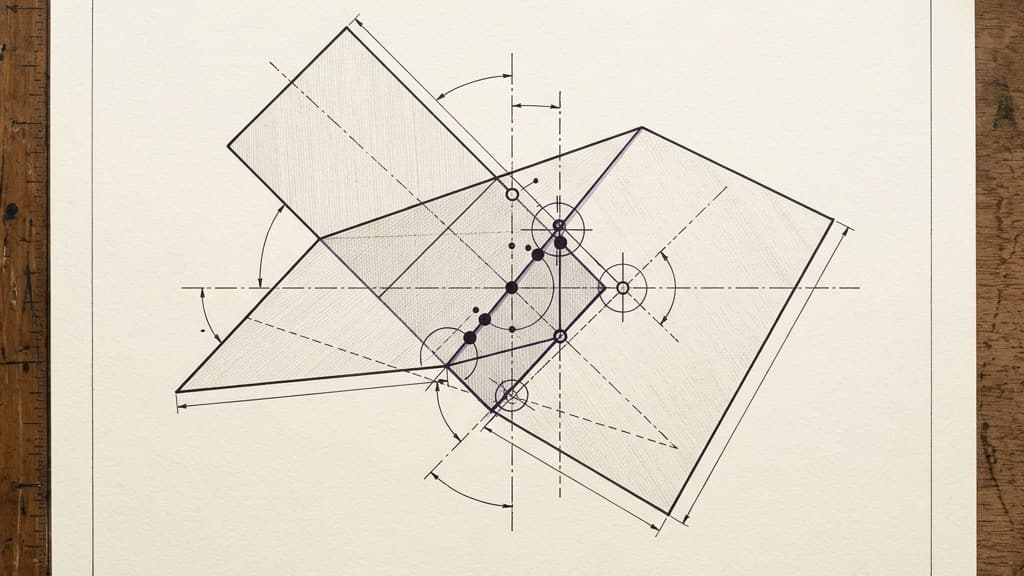
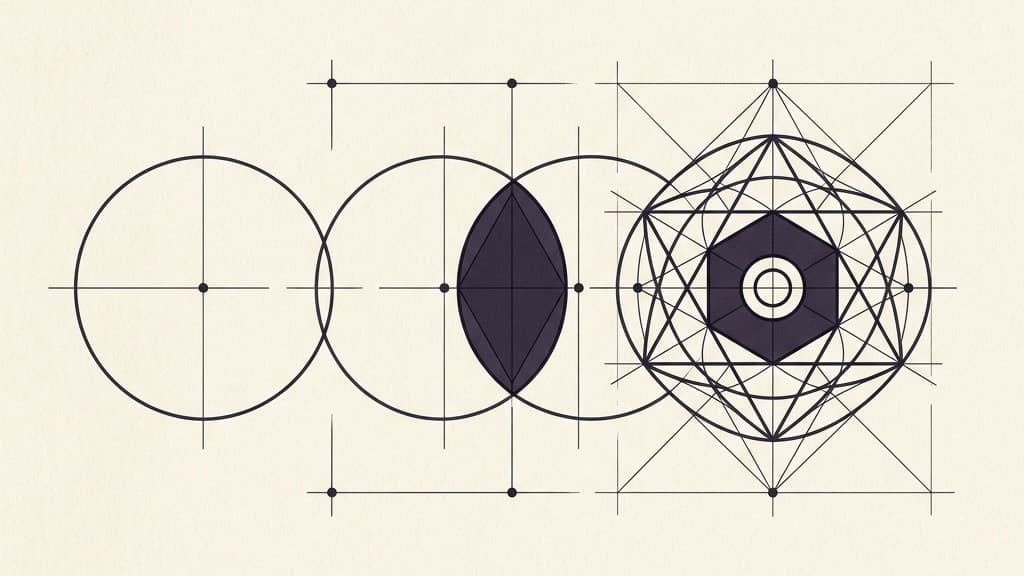
The composite and the Davison answer the same question with different mathematics: what is the relationship as its own entity? This guide covers what each chart is, where they agree, where they disagree, and which to reach for in client work. Astrolium computes both side by side in under 300 ms; the comparison is 1 click, not 2 chart casts.
For the reading method that uses these charts, read the how to read a synastry chart guide. For the free preview, run two charts through the composite chart calculator. For the full feature, see composite & Davison in Astrolium. For the $29 per month Adept plan, see pricing.
Two charts, one question
The composite chart and the Davison chart both describe a relationship as a third entity, but they compute it differently. The midpoint composite, systematised by Robert Hand in 1975, averages the planetary longitudes of the 2 natal charts and derives the composite Ascendant and Midheaven from the 2 natal angles. The Davison, proposed by Ronald Davison in 1977, instead averages the birth moments and locations themselves and casts a real chart for that midpoint date, time, and place. Composite is derived; Davison is real and sits on the ephemeris, which means transits to the Davison are computable in a way transits to the composite are not. Astrolium computes both side by side, with the cross-aspects and the relationship timing attached, in under 300 ms. Practitioners use them together: midpoint composite for the relationship as a third entity, Davison for the relationship as a real event in time. Free, no account required.
Synastry compares 2 charts to each other. Composite and Davison turn the 2 charts into 1. The motive is the same: a client asks "what is this relationship?" and the practitioner wants a single chart to point at, not 2 charts and a grid of cross-aspects. The composite and the Davison both deliver that single chart. They just compute it differently, and the difference is the reading.
What the midpoint composite is
The midpoint composite is built by averaging. For every planet in the 2 natal charts, the technique takes the shortest arc between the 2 longitudes and places the composite planet at the midpoint. The composite Sun is the midpoint of the 2 birth Suns. The composite Moon is the midpoint of the 2 birth Moons. The composite Ascendant is the midpoint of the 2 birth Ascendants. The result is a chart that has no birth moment, no ephemeris position, but has structure.
Robert Hand's 1975 Planets in Composite established the modern convention. The midpoint composite had been used in derivative ways since the 1920s, when Charles Carter and (separately) the Ebertin school in Germany used midpoints as analytical tools. Hand's contribution was treating the full midpoint set as a single chart you can interpret like any natal: signs, houses, aspects, angles.
The composite chart's strengths:
It is a derived chart, so it has no dependency on accurate birth times beyond what is needed for the natal Ascendants. If one birth time is approximate, the composite Ascendant inherits the approximation but the composite planets are still readable. It is straightforward to compute by hand if needed (each planet takes ~30 seconds). It is the chart most reference books and most client conversations expect.
The composite chart's limitations:
It is not on the ephemeris. The composite Sun at 14° Cancer corresponds to no date in any year. Transits to the composite are an approximation: you are watching transit Saturn pass over an averaged Sun position, not a Sun position that the sky has actually held at any time. For static readings this is fine. For timing work it is a known limitation.
What the Davison chart is
Ronald Davison proposed the alternative in 1977. Instead of averaging the planetary positions, average the birth moments themselves. Take the midpoint date between the 2 births (March 1980 plus September 1984 gives December 1982), the midpoint time (10:00 plus 14:00 gives 12:00), and the midpoint location (the geographic midpoint of the 2 birth cities). Cast a real chart for that derived moment. The result is a chart that sits on the ephemeris, has a defined date, and transits like any natal.
Davison argued this approach more accurately describes the relationship as a "born" entity. The relationship has a moment in time (the midpoint of the 2 lives) and a place in the world (the midpoint of the 2 birthplaces). The chart cast for that moment is the chart the relationship would have if it were a single person.
The Davison chart's strengths:
It sits on the ephemeris. Transit Saturn really does aspect its Sun on a calendar date. Progressions, profections, and Zodiacal Releasing all run on it cleanly. For long-term relationship work, especially when the practitioner needs to time the year, the Davison reads cleaner than the midpoint composite.
The Davison chart's limitations:
It depends on accurate birth times. The Ascendant moves 1° every 4 minutes, so a 30-minute uncertainty in either partner's birth time translates to roughly 15 minutes of uncertainty in the Davison Ascendant. The geographic midpoint of 2 distant cities can also land in a location with no human relevance (the geographic midpoint of London and Tokyo is in the Arctic Ocean), though this affects the Ascendant and houses rather than the planetary positions.
Side by side: where they agree and disagree
Most of the time, composite and Davison agree on the broad strokes. Same Sun sign for the relationship, same Moon sign, same general 7th-house Saturn or 12th-house Moon. The slow-moving planets (Saturn, Uranus, Neptune, Pluto) usually land within 1 sign of each other because the gap between 2 birth dates is usually small compared to their orbital periods.
Where the 2 methods most often diverge:
The Sun sign, when the gap between births spans a Sun-sign cusp. A partner born in late March and a partner born in late September give a midpoint Sun at the average longitude (around 6° Sagittarius — averaging 5° Aries and 5° Libra). The Davison Sun is whatever the Sun was on the actual midpoint date, which could land in mid-December and put the Sun in Sagittarius, or could land in early December and put the Sun in late Scorpio. Same general region of the zodiac, sometimes the same sign, sometimes not.
The Moon, more often than the Sun, because the Moon moves 13° per day. A 6-month gap between births puts the Davison Moon and the midpoint composite Moon in different signs almost half the time.
The Ascendant, because the angles depend on the exact moment and location. Composite and Davison agree on the Ascendant only when the 2 partners are born in similar time zones and the Davison is cast in a meaningful location.
When they disagree, the disagreement is information. The midpoint composite reads as the structural average of the 2 charts; the Davison reads as the chart that the relationship "would be" as a born entity. Both readings can be true at the same time.
Why Davison is the transit-able relationship chart
This is the practical advantage of Davison and the reason many advanced practitioners prefer it. Transits to a chart that sits on the ephemeris read cleanly: transit Saturn at 12° Aries on a given date really does form a real square to the Davison Sun at 12° Cancer. The transit has a calendar date, a duration, peak dates for retrograde stations, and a clean structural meaning.
Transits to the midpoint composite are an approximation. The composite Sun at 12° Cancer is the average of 2 birth Suns, not a Sun position the sky ever held. Transit Saturn at 12° Aries forms a 90° angle to that averaged position, and many practitioners read this transit successfully. But the underlying interpretive logic — that a transit aspects a real planetary position — does not strictly apply.
For the timing layer, Davison is the cleaner technique. Robert Hand himself acknowledged this in later writing: the midpoint composite is excellent for static reading and structural snapshots; the Davison is the right chart to transit when the question is "what is happening with us this year?"
Astrolium attaches the timing ribbon to both charts. Profections, Zodiacal Releasing, and the transits view all run on whichever chart you select. The defaults are: midpoint composite for the static reading view, Davison for the timing view. You can override per project.
Why most practitioners default to midpoint composite
Despite the timing advantage of Davison, the midpoint composite remains the more popular technique. Three reasons.
First, the literature. Robert Hand's Planets in Composite is the standard reference. Most modern relationship astrology textbooks (Bil Tierney, Stephanie Jean Clement, Sue Tompkins) discuss the midpoint composite at length and treat Davison as an alternative. A practitioner trained in the 1980s through the 2010s is more likely to default to midpoint.
Second, the math. Computing 10 midpoints by hand takes ~30 seconds per midpoint, total ~5 minutes for the full chart. Computing a Davison by hand requires finding the midpoint date, midpoint time, and midpoint location, then casting a chart from the ephemeris for that moment — closer to 20 minutes by hand. Software erases the difference, but the historical convention favoured midpoint.
Third, the failure mode. When one birth time is missing or approximate, the midpoint composite degrades gracefully: the Ascendant becomes uncertain, but the planetary midpoints are intact. The Davison degrades badly: the entire chart depends on the precision of the 2 birth moments, and an approximate time can shift the Ascendant by 15 minutes of arc. For couples with imperfect data, midpoint is the safer technique.
When to prefer Davison
Long-term relationship work where the timing layer matters. Year-ahead readings, anniversary check-ins, post-mortem readings of finished relationships. The Davison's transits read cleanly and the calendar dates are real.
Reliable birth times on both sides. When both partners know their birth times to within 5 minutes, the Davison Ascendant is well-defined and the chart can be transited with confidence.
When the practitioner wants to read the relationship as a born entity. Some practitioners find the Davison's framing (the relationship as a single chart, born at a real moment) easier to think with than the midpoint composite's framing (the relationship as an averaged geometry). This is a style preference rather than a technical claim.
When to prefer midpoint composite
When one or both birth times are uncertain. Midpoint composite tolerates imprecision better.
When the question is structural rather than temporal. "What is this relationship?" reads well from the midpoint composite. "What is this relationship doing in 2027?" reads better from the Davison.
When the client expects the standard chart. Most relationship astrology books, reference materials, and online interpretations assume midpoint composite. A client who has read a book on composite charts will expect the practitioner to be discussing the same chart they read about. Midpoint is the lingua franca.
Reading both at once
The strongest reading reads both charts together. The agreements between the 2 methods are stable structural facts about the relationship — both charts agree that the composite Sun is in Cancer, both agree on the Saturn placement, both agree on the angular emphasis. The disagreements are the texture: the midpoint composite Moon is in Aries (averaged) but the Davison Moon is in Pisces (real). The relationship has both qualities, and the practitioner reading both charts will see them.
Astrolium shows the 2 charts side by side with the differences highlighted. The dashboard view surfaces the agreement-and-disagreement summary for every couple on the roster: where the 2 charts agree on the headline, where they diverge, and which divergence is largest. Useful for prep before a 90-minute couples session, useful for roster scans across a busy practice.
Common mistakes
Reading only one chart. The midpoint composite alone misses the timing read; the Davison alone misses the structural framing the client expects from the literature. Read both.
Treating disagreement as error. When the midpoint Sun is in Gemini and the Davison Sun is in Cancer, the chart is not "wrong." The 2 methods describe different aspects of the same relationship: the averaged structure versus the chart-as-born entity. Both are interpretively valid.
Transiting the midpoint composite as if it sat on the ephemeris. The composite reads transit Saturn passing over its Sun as a real event, but the underlying logic is approximate. For serious timing work, transit the Davison.
Casting the Davison from imprecise birth times. The Davison's Ascendant is hypersensitive to the precision of the 2 birth times. If one partner only knows their birth hour, do not read the Davison Ascendant or houses; the planetary positions are still usable but the angles are not.
Reading either chart without the synastry. The composite and the Davison both describe the relationship as a third entity. They do not replace the synastry layer (the 2 charts contacting each other). For the full reading method, see the how to read synastry chart guide.
What to read next
For the practitioner reading order that uses both charts, read the how to read a synastry chart guide. For the technique definitions and the history of synastry, read the synastry guide. For the broader Saturn vocabulary that often appears in composite charts, read Saturn returns. For the time-lord method that profects the composite Ascendant, read profections.
To run composite and Davison on your own couples, the free composite chart calculator takes 30 seconds. To run composite analysis on every couple in your client roster with the timing layer attached, see pricing for the $29 per month Adept plan.