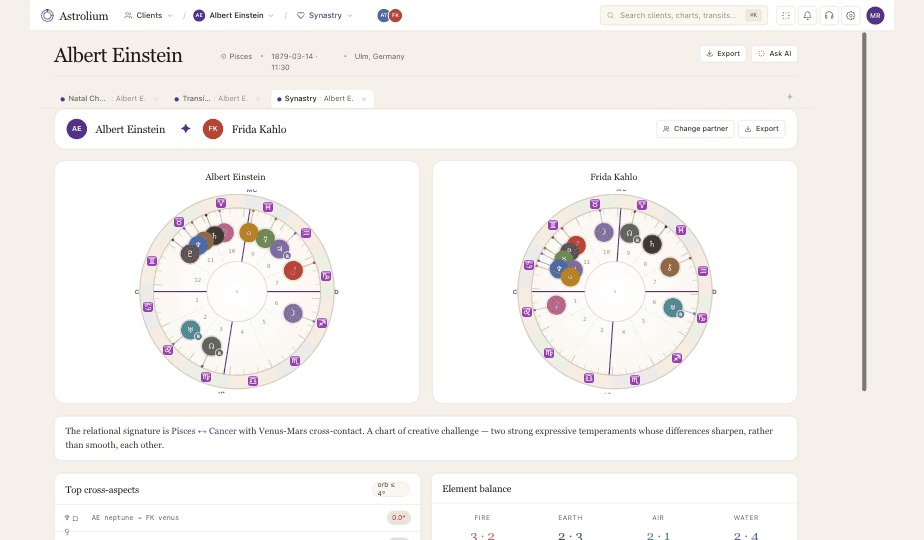
The Astrolium synastry calculator takes two birth dates and returns the ranked inter-aspects between them in under 60 seconds. Each contact is scored by tightness x weight — a Venus-Mars conjunction at 1 degree orb dominates the same aspect at 7 degrees. The math runs in your browser, on the Swiss Ephemeris, with no signup.
This is the free preview. The full synastry feature ships the 5x7 inter-aspect grid, both house overlays, the composite chart, and the timing layer on one screen. For the reading framework, see the synastry guide. For the related timing techniques, see predictive timing. For the $29 per month Adept tier, see pricing.
What the calculator returns
Synastry compares two charts by overlaying them. The inter-aspects — angles between one person's planets and the other's — describe the geometry of the relationship. The calculator runs through 7 planets x 7 planets (49 possible pairs), scores each by tightness and aspect weight, then surfaces the top 6 plus the headline. For the full reading method, see the synastry guide.
Each ranked row shows:
- The planet pair (Sun-Moon, Venus-Mars, Saturn-Sun, etc.)
- The aspect type and glyph (conjunction, opposition, trine, square, sextile)
- The orb in degrees, to one decimal
- A normalised 0–100 score reflecting tightness x weight
The composite headline at the top is the single tightest, highest-weight contact — the line you'd lead a session with.
The aspect weights, in plain language
Tight orbs matter most. A Venus-Mars conjunction at 1 degree orb is loud. The same aspect at 7 degrees barely whispers. We rank by tightness, not by counting hits.
| Aspect | Angle | Weight | Harmonic |
|---|---|---|---|
| Conjunction | 0° | 1.00 | strong |
| Opposition | 180° | 0.85 | hard |
| Square | 90° | 0.85 | hard |
| Trine | 120° | 0.75 | soft |
| Sextile | 60° | 0.55 | soft |
Conjunctions weigh most because they fuse two planetary energies into one expression. Squares and oppositions weigh next-heaviest because they create friction that drives the relationship. Trines and sextiles flow but don't necessarily activate.
The score is descriptive, not prescriptive. A high score doesn't mean easy. A low score doesn't mean doomed. Geometry tells you the terrain of the connection.
What the score doesn't tell you
The headline aspect is the loudest contact, but it's rarely the whole story. A couple can score 75 of 100 on inter-aspects and still struggle if A's planets all land in B's 12th house. The house overlay is a separate read, and the calculator doesn't surface it on the free tier.
The composite chart — the relationship as its own entity — is another read entirely. Its profected year and current Zodiacal Releasing period often matter more than the underlying inter-aspects for "what's happening with us right now" questions.
For the full picture, the synastry feature puts all three layers on one screen. For the reading method, read the synastry guide.
After the calculator
Once you've read one synastry, you usually want two: the composite chart (the midpoint chart of the two) and the Davison chart (a real chart for the time-and-place midpoint of the births). Both ship in the synastry feature. For deeper relationship work across cycles — Saturn-on-composite-Sun windows, eclipse activations of composite angles — the predictive timing feature overlays transits against both partners and the composite at once.
For practitioners running synastry across a roster of clients — couples-therapy practices, casting, hiring — the $29 per month Adept tier on the pricing page ships the roster scanner: tell it "who's in a Saturn-on-composite-Venus window this quarter" and it returns the sorted list.
Cross-link
Run the partner techniques: Saturn return calculator, profections calculator, zodiacal releasing calculator. For the full feature, see synastry charts in Astrolium. For the timing engine, see predictive timing. For the reading method, see the synastry guide.