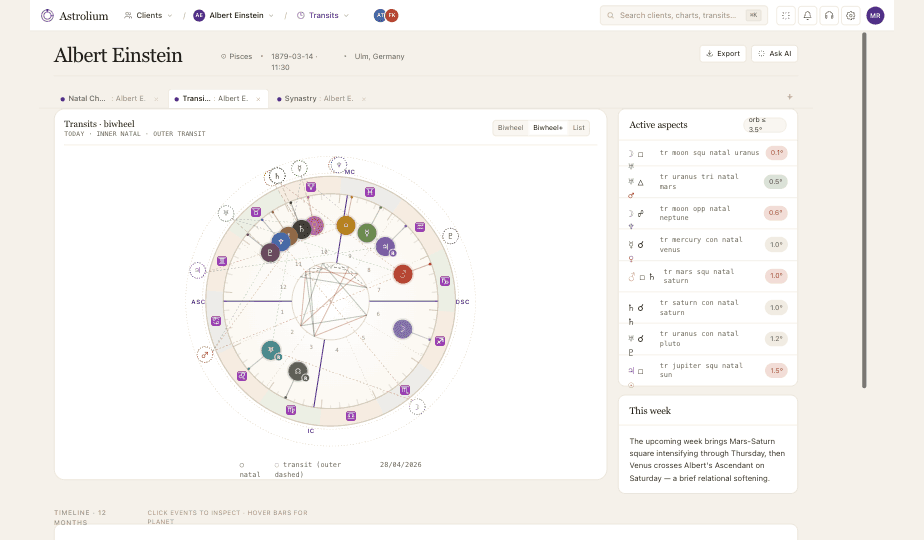
The Astrolium Zodiacal Releasing calculator lays out 8 major periods from Spirit or Fortune, flags peak years and loosing-of-the-bond moments, and shows where you are in the current L1 period — all in under 60 seconds. The technique Vettius Valens spent a chapter explaining is finally usable in the browser.
This is the free preview. The full predictive timing feature stacks ZR against profections and transits on one ribbon, with both Spirit and Fortune visible simultaneously and L1 through L4 sub-periods. For the deeper reading method, see the zodiacal releasing guide. For the related techniques, see the profections calculator and the Saturn return calculator. For the Adept ($29) plan that adds the full ribbon, see pricing.
What the calculator returns
The output is structured as three blocks:
-
The Spirit ribbon. A horizontal ribbon of 8 L1 periods drawn proportional to their length in years. The currently active period is highlighted, peak signs are tinted, and each segment shows its sign glyph and duration.
-
You are here. A featured card showing the active L1 period — sign, start date, end date, total years — plus a paragraph of narrative for that sign. This is the era you're inside.
-
Peaks and the next loosing. Two cards: which periods in your timeline are peak years (typically Cancer or Leo when angular from Spirit), and when the next loosing-of-the-bond transition falls.
What zodiacal releasing actually is
ZR was preserved by Vettius Valens in the Anthology and reconstructed by Robert Schmidt in the Project Hindsight translations of the 1990s. It maps your life into major periods (L1) and sub-periods (L2, L3, L4), each ruled by a sign with a fixed length in years.
Spirit reads action, career, and what you do. Fortune reads body, sustenance, and what happens to you. They run independently. Most practitioners read them side by side, but the calculator lets you pick one as the entry point — switch via the dropdown.
Watch for two things on the ribbon:
- Peak periods. Angular signs from your Lot (1st, 4th, 7th, 10th positions). Life-direction crystallises here. Career, recognition, the apex of one strand of work.
- Loosing of the bond. When the chain breaks and a new chapter opens. Astrolium flags it with a bowtie icon automatically.
To compute the Lots that ZR releases from, use the part of fortune calculator and the lot of spirit calculator.
Period lengths, in years (Valens)
| Sign | Years | Sign | Years |
|---|---|---|---|
| Aries | 15 years | Libra | 8 years |
| Taurus | 8 years | Scorpio | 15 years |
| Gemini | 20 years | Sagittarius | 12 years |
| Cancer | 25 years | Capricorn | 27 years |
| Leo | 19 years | Aquarius | 30 years |
| Virgo | 20 years | Pisces | 12 years |
These aren't arbitrary. They're the same period assignments Valens recorded, which come from the lengths of life-giving (Aphesis) assigned to each planet's rulership. Cancer and Leo (ruled by the Moon and Sun) get 25 and 19 years respectively — the longer assignments, which is why those signs so often hold peak periods.
What the narrative tells you
Each sign carries a tone for its L1 period. Astrolium shows the narrative for the active period as a paragraph — not a horoscope, but the structural sense of what kind of decade you're in.
- Aries: Active, initiating, often combative. The bet, the move, the new venture.
- Cancer or Leo: Peak. Visible. Recognition, home, the apex.
- Capricorn: Structuring. The institution, the discipline, the long building.
- Pisces: Dissolving, contemplative. Retreat and spiritual work.
The full set sits in the calculator output. The framing is descriptive — what kind of decade, not what events will happen inside it.
After the calculator
A profection is the year. A ZR L2 period is the season. A ZR L1 is the era. Stack them and you have a structure no transit-only reading can give you: where you are in the largest arcs of life, and what's emphasised inside it. Add transits — Saturn returns, eclipses on the angles, Jupiter ingresses — and the reading becomes whole.
For that stacking, see the predictive timing feature — same Valens math, but with profections and transits overlaid on one ribbon. For the 4,000-word interpretive guide that walks through ZR alongside the other techniques, read the zodiacal releasing guide. For practitioners running ZR across a roster, the $29 per month Adept tier ships the stack-on-every-client view.
Cross-link
Run the partner techniques: profections calculator, Saturn return calculator, synastry calculator. For the unified timing engine, see predictive timing. For the partnership angle (composite ZR), see the synastry feature and the synastry guide.