An anonymized account from a practitioner in the Astrolium community. Client names and identifying details have been changed.
A client came to me last March with a question astrologers hear often: should I move? The candidate city was Mexico City. The current city was Lisbon. Her birthday was eight weeks out, and her solar return was about to lock in for the year ahead. We pulled two charts on Astrolium, one for each city, and walked the comparison together. This is the case, anonymized: what the charts showed, what we decided to look at, and what I deliberately did not say.
For the underlying engine, see the solar return guide and the astrocartography guide. For the $79 per month Master plan with relocated solar returns and a 200-city comparison engine, see pricing.
The client
I will call her Léa. Thirty-six years old, Portuguese passport, software engineer who left her staff job in October 2025 to consult independently. Two prior natal sessions with me, one in early 2024, one in late 2024. Returning client, so the natal chart and the year's profected lord were already loaded in my head. The decision wasn't an emergency; it was an honest fork.
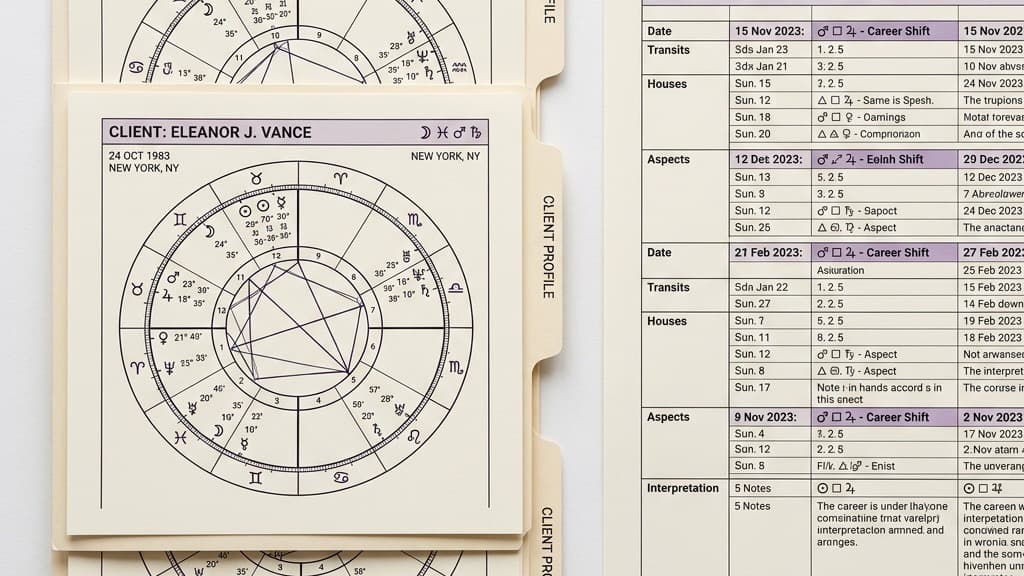
The natal chart, very quickly: Cancer Ascendant, Moon ruling the chart from a 4th-house Libra, Sun in mid-Aquarius in the 8th. Two cancer placements (Asc, Mercury) and three Aquarius placements (Sun, Venus, Saturn). Night chart. Saturn natally in the 8th and ruling the 7th by classical rulership. Her question, in her own words: "I keep getting Mexico City in my head but I don't trust whether it's a fantasy. The numbers say I could afford it. I want a second read."
I asked her to send me precise dates she could plausibly arrive. May 28 to June 5 was the window. The solar return would fire June 1, two days after her birthday, so any chart we cast had to be relocated to the city she would be in on that day.
What a relocated solar return is
For readers not deep in the technique: a solar return is the chart cast for the exact moment the transiting Sun returns to its natal degree, sign, minute, and second. That happens once a year, within 24 hours of your birthday. The chart describes the year from that return to the next.
A relocated solar return is the same chart cast for the place the person will be on the return moment, not their birthplace. The planets sit in the same signs and the same zodiacal degrees in either chart (the Sun returns to its natal longitude regardless of where you stand), but the angles and the house cusps change drastically with longitude. A solar return Sun in the 9th house in Lisbon can become a solar return Sun in the 6th house in Mexico City. Same planets, different rooms.
For the precession-adjusted variation (which adjusts for the slow drift of the equinoxes), the longitudinal positions shift by about 24 arc-minutes per year of life. At 36 years old, that's 14° of correction. Astrolium computes both versions side by side; we used the precession-adjusted version because Léa's previous returns had been more legible that way. The choice between adjusted and unadjusted is a long-running debate in the field; I won't relitigate it here. (See the solar return guide for the full argument.)
Casting the two charts
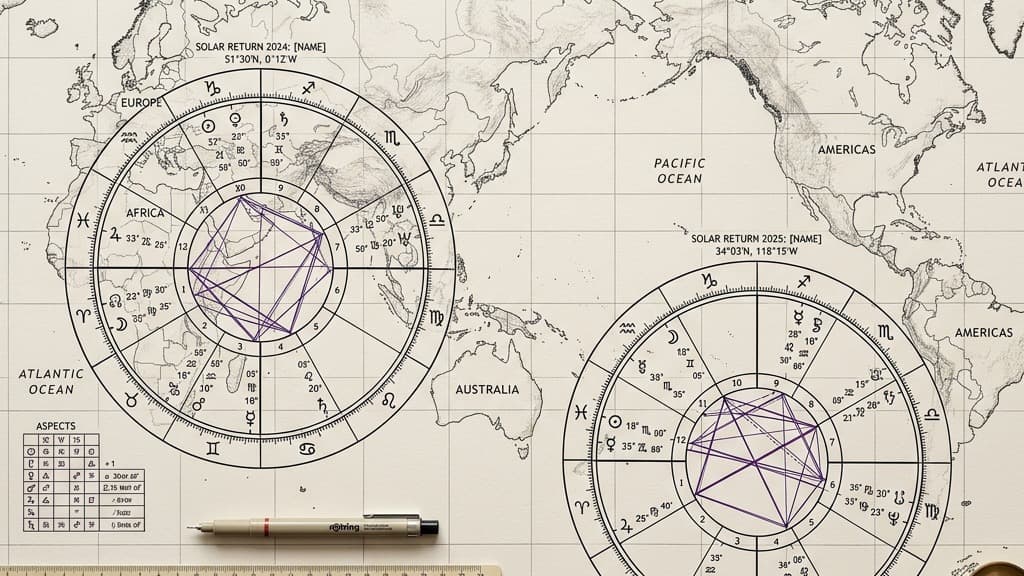
I pulled Léa's profile on Astrolium and clicked into the solar return view. The location field is a dropdown that defaults to natal but accepts any city. I cast two:
- Lisbon, Portugal. Stay put.
- Mexico City, Mexico. Make the move, arrive before June 1.
In Astrolium the two relocated solar returns render side by side. The Sun position is identical in both (mid-Aquarius, naturally); the Ascendant, Midheaven, and house cusps shift. The aspects between planets are identical (planets don't move between charts cast for the same moment), but the houses those aspects fall into are completely different.
| Factor | Lisbon (stay) | Mexico City (move) |
|---|---|---|
| SR Ascendant | Capricorn | Aries |
| Chart ruler | Saturn — 12th house | Mars — 7th house |
| SR Sun | 1st house | 11th house (community, allies) |
| SR Moon | 5th house (creativity, play) | 3rd house (speech, writing) |
| Mars-Saturn square | 3rd ↔ 12th | 7th ↔ 4th |
| Year tone | Internal, contemplative | External, partnership, public |
This is the whole point of the relocation exercise. The aspectual story is fixed: same square, same trine, same conjunction. What changes is the theatre in which the story plays out across the year. A Mars-Saturn square that lands in the 6th-and-9th in Lisbon (work and travel) becomes a Mars-Saturn square in the 10th-and-1st in Mexico City (career and body). The planets are doing the same thing. They are doing it in different rooms.
What the Lisbon chart said
Solar return cast for June 1, Lisbon. Capricorn Ascendant. Saturn ruling the chart from a 12th house Pisces, the house of withdrawal, dreams, the unseen, sometimes hospitals. SR Sun in the 1st house (mid-Aquarius rising into the 1st by whole-sign, by Placidus the Sun straddles the cusp). SR Moon in early Gemini in the 5th (creativity, children, romance). The Mars-Saturn square from the underlying year fell across the 3rd (siblings, speech, daily mind) and the 12th (the unseen).
Reading by the standard solar return doctrine: the chart describes a year of staying close to home, working inwardly, with the chart ruler retreating into the 12th. Not bad, not a disaster, but a year that suggests withdrawal, possibly a contemplative or recovery-focused chapter. Léa's natal Saturn is already in the 8th, so the 12th-house chart ruler is doubling down on internal work. There is a kind of quiet productivity here; for a different client this might be exactly what they need.
I noted to her, neutrally: "If you stay in Lisbon, the year wants you internal. Studio work, deep projects, maybe a course or a book. The chart doesn't say no to growth, but it doesn't promise visibility. The Moon in the 5th is the bright spot; there's still play and creative output, just not necessarily public output."
What the Mexico City chart said
Solar return cast for June 1, Mexico City (CST, six hours behind Lisbon at that moment). Aries Ascendant. Mars now rules the chart, and Mars sits in the 7th house. Léa's natal 7th-house rulership returns here at the SR level. The SR Sun shifts into the 11th house (community, friends, hopes, allies). The SR Moon lands in the 3rd (speech, writing, daily mind, short journeys). The Mars-Saturn square now falls across the 7th (partnership, openly-named other) and the 4th (home, roots, foundation).
Different chart. Same planets. The story has moved rooms.
Reading: a year structured around external action, partnership friction worked through in public, public-facing speech (3rd-house Moon), and a network expansion (11th-house Sun). The Mars-Saturn square in the 7th-and-4th is the harder note. Saturn in the 4th of a solar return often signals home-building under pressure: the rental that's harder than expected, the neighbourhood that takes longer to feel like home, a relationship with a place that demands paperwork and patience. Mars in the 7th means partnership work: friction, then resolution, played out in the open.
I told her: "If you move, the year wants you external. New people, public speech, building a network. The hard note is the home-and-partnership friction; Saturn in the 4th means the apartment search and the legal-residency paperwork will be harder than you want, and you'll feel that in the first 90 days. Mars in the 7th means you will be in active negotiation with at least one person (a landlord, a co-working partner, possibly someone you're starting to date) and the negotiation is the texture of the year, not a side issue."
The piece that was hard to read
There is a third chart in any relocation question, and Astrolium computes it without being asked: the natal chart relocated to the target city. Not the solar return, the natal chart itself, re-projected against the local horizon of the new city.
Léa's natal chart relocated to Mexico City moves her natal Moon (the chart ruler) from the 4th house in Lisbon (lineage, home, roots) to the 7th in Mexico City (partnership, the named other). Her natal Saturn shifts from the 8th to the 11th. Her natal Sun shifts from the 8th to the 10th.
This is the chart that describes how Mexico City as a place would be reading her, year over year, not just for the one solar return year. A natal chart relocated to a place is a long-arc statement; it describes that location's chronic conversation with the chart. The pattern was striking: the Moon-as-chart-ruler moves into the partnership house, the Sun moves to the career midheaven, and Saturn moves into the friends-and-allies house. The relocation is more public in every register. The opposite of withdrawal.
This was the part of the reading I weighed carefully. I told Léa what the relocated natal chart showed, and I named the pattern: in Mexico City, the chart is structurally oriented toward partnership and visibility. In Lisbon, it remains oriented toward family and depth. Both are valid orientations of the same chart; they describe different versions of the same person.
The conversation
The session ran 78 minutes. We spent about 25 minutes walking through the two charts and the relocated natal. Most of the rest of the time was Léa thinking aloud, which is what these sessions are actually for.
She asked the question astrologers always get: "So which one should I pick?" I gave her my standard answer, which I will reproduce here because it matters:
The chart doesn't pick. The chart shows you the shape of each path. Both are real years; both are workable; both have a cost. Lisbon costs you visibility for a year and gives you depth. Mexico City costs you stability for a year and gives you a network. What the chart can do is help you decide which cost you're willing to pay. What it can't do is decide which cost is right for your life.
She pushed back. "But which one would you pick?" I declined to answer, and I told her I declined to answer. The astrologer's job, especially with a returning client whose life I have some knowledge of, is to be very careful about substituting my judgement for the client's. Her finances were her business. Her relationship situation in Lisbon (single, recently out of a four-year partnership) was hers. Her sense of where her life was going at 36 was hers. The chart was a tool we shared. The decision wasn't.
I did, however, say what I noticed about the way she was talking. She had described Mexico City three times in the conversation as "the right thing for me right now" and Lisbon once as "safe." She had asked five times what I thought, twice phrased as variations of "would you pick this." She was, I told her gently, already deciding. The session was looking for confirmation, not direction.
She laughed. "You're right." We spent the last 10 minutes talking practically: what to look for in the first 90 days (Saturn-in-4th means rental contracts and residency paperwork; budget extra time and money for both), when to expect the Mars-in-7th to flare (the partnership-friction window concentrates around mid-July when transiting Mars perfects to natal Saturn), and when the network-building of the 11th-house Sun was likely to start landing (the 11th-house emphasis peaks in August through October).
What I deliberately did not tell her
Three things I noticed and did not voice in session, by choice:
One. The Mars-Saturn square in the Mexico City chart is the kind of pattern that can correlate with significant strain in a romantic partnership in the year ahead. I did not tell her this. Not because I doubt the reading, but because she was not asking about a partner, and a 36-year-old woman who has just left a four-year relationship does not need a stranger telling her the next year will be hard on a partner she does not yet have. If she had asked, I would have shared the pattern. She didn't, and I let it be.
Two. The 4th-house Saturn in the relocated SR can also describe a death or illness in the family of origin during the year. Léa's mother lives in Porto, in her early 70s. I weighed this and decided not to mention it. Mothers in their 70s are statistically more likely to have a health event in any given year than not; the chart is non-specifically heightening probability, not predicting an event. Telling her would have planted a worry that the chart did not specifically justify.
Three. The Mexico City relocated natal has her natal Sun on the local Midheaven within 2 degrees. This is the strongest "visible career" signal I have seen in a relocation chart in two years. I noted it to myself and named it once in the session ("the natal Sun lights up the local Midheaven, which is the strongest visibility signal in the relocated chart"), but I did not press it. She heard it once. If she wanted to weight it heavily, she would; if she did not, the comment had been made.
The discipline of not saying in a session is part of what makes astrology a practice rather than a performance. The chart contains more than the client needs to hear, and a good reading is partly a curation.
What she decided
She decided three weeks after the session, by email. She moved. The flight landed in Mexico City on May 30, two days before the solar return fired.
I heard from her again in November, six months in. The apartment search had been hard (took six weeks, three failed leases, the budget she had set was wrong by about 30 percent). She had not started dating anyone seriously, but had been in a sustained back-and-forth with a co-working partner that had the texture of the Mars-in-7th: productive friction, not romantic but not quite collegial. The network had landed. She had spoken at a small conference in October, the first public talk of her career, and the audience response had been "exactly what the 11th-house Sun would predict." Her mother was fine.
She did not say whether she would have made the move without the reading. I did not ask. The reading was not the deciding agent. It was the surface on which the decision became legible to her.
What this case studies
A few things I keep coming back to from this case, written down for my own future practice:
- The relocation question is rarely a single chart. The solar return alone is not enough. You need the natal-relocated chart as well; it tells you the chronic conversation with the place, not just the one-year story.
- The hard parts of the chart are often the right parts. Léa's Mexico City chart is structurally harder than her Lisbon chart in the first 90 days. That difficulty is the work; it is not a reason to avoid the move. Solar returns with Saturn in angular houses often describe years that are constructive and uncomfortable. The discomfort is the construction.
- Precision over volume. I did not walk her through 40 aspects. I walked her through 6: the SR Ascendant, the SR chart ruler's house, the SR Sun's house, the SR Moon's house, the strongest aspect involving Mars or Saturn, and the location of natal Sun in the relocated chart. Six elements. Anything more and I am hiding.
- The session was for thinking, not deciding. She was already deciding. My job was to surface enough of the chart that her decision could be informed without being outsourced. The line between those is the whole ethic of the practice.
Where this fits in the toolset
The relocated solar return is one of about a dozen relocation techniques I use across a year of practice. The others worth naming for working astrologers: astrocartography (planetary lines across the world map), local space (planetary directions from a given location), and the relocated transits ribbon (current transits cast against a new local horizon).
Astrolium runs all four together. The relocated solar return view I used for Léa's session is one tab; the astrocartography map is another; the local-space view is a third; and the relocated transits ribbon plugs into the same predictive timing engine every other client gets. For a client weighing a move, I usually pull the full relocation packet (about 4 minutes of clicking) and walk the strongest two charts in session.
For the underlying technique, see the solar return guide. For the related relocation literature, see the astrocartography guide. For the 200-client case study on how I run my practice end-to-end, see that piece. For the $79 per month Master plan that includes relocation views across 200 cities, see pricing.
Léa's email at six months ended with a line I keep on a note above my desk: "It was the harder year. I'm glad I picked it." The chart didn't pick. She did. The chart helped her see what she was picking.