Astrolium's astrocartography guide covers Jim Lewis's relocation method end to end: the 4 cardinal lines, the 10 planets, parans, crossings, how to read a map for a real client question, and where the method's limits live. Astrocartography is one of the most-used techniques in modern practice and also one of the most misread.
For the full predictive stack, see predictive timing. For the $79 per month Master plan with unlimited astrocartography maps, see pricing. For the one-paragraph definition, see the astrocartography glossary entry. For related Hellenistic techniques, see the profections guide and the zodiacal releasing guide.
What astrocartography is
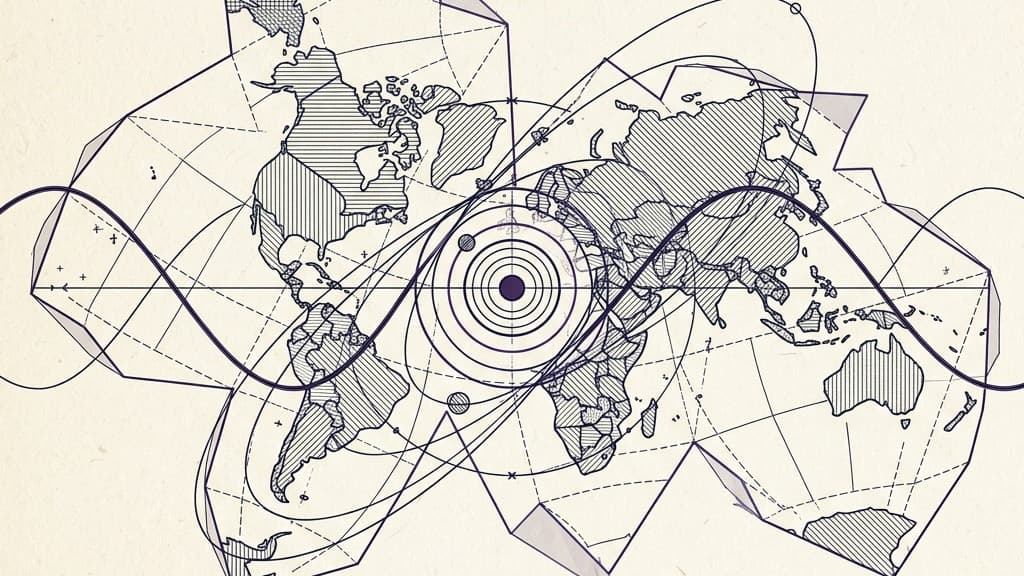
Astrocartography is a relocation technique systematised by Jim Lewis in the 1970s, drawing on older horizon-coordinate methods. It plots each natal planet's 4 angular lines (MC, IC, ASC, DSC) across a world map. Your natal planets do not change position when you move, but which planets are rising, setting, culminating, or anti-culminating relative to your new horizon does, and those angular contacts shape the daily texture of life in any location. The same Mars at 12° Leo sits in the 7th house in Berlin and on the Midheaven in San Francisco. 4 lines per planet across the 10 bodies gives 40 lines on a typical world map, plus the paran-grade power zones where two lines converge inside 250 km. Astrolium computes the full map free, lists nearby cities within roughly 700 km of each line, scores any target location 0–100 across 14 life areas, and ranks 200+ candidate cities for any chosen life theme. The technique answers one question: how does the sky shift if I move?
The math is straightforward. Your natal chart fixes the planets at specific zodiacal positions at the moment you were born. Those positions do not change when you move. What changes is which planets are rising, setting, culminating, or anti-culminating relative to your new horizon. The same Mars that sits at 12 degrees Leo in your 7th house in Berlin is still at 12 degrees Leo in San Francisco, but in San Francisco it might be on the Midheaven, putting Mars front-and-center in your career.
Astrocartography lines mark the longitudes on Earth where a planet would be on one of the 4 angles. Move to that longitude and that planet shapes your experience of the place. 4 lines per planet across the standard 10 bodies gives 40 lines on a typical Astrolium map.
This is what the lines show you. What they do not show you is whether you should move. That part is your job, and not the math's.
Jim Lewis: how the method got built
Astrocartography did not appear from nowhere. The idea that one's birth chart could be re-cast for a different location had been around in astrology for centuries. Early modern astrologers calculated "relocated" charts manually for clients who had moved. L. Edward Johndro in the 1930s and Donald Bradley in the 1950s did serious mathematical work on what they called "locality" astrology. They had the right intuition. They did not have a world map.
Jim Lewis had the map. Working in San Francisco in the early 1970s, Lewis took the relocation idea and rendered it as a continuous projection of the planetary angular lines across the entire globe. Suddenly you could see where in the world your Jupiter sat on the Midheaven, where your Saturn rose, where Mars and Venus crossed. The visual was the breakthrough. Lewis founded Astro Numeric Services in 1976 and ran the AstroCartoGraphy service (hand-drawn maps mailed to clients on paper) until his death in 1995.
The method became one of the few 20th-century astrological inventions to enter the mainstream of practice. Most working astrologers today, regardless of school, run an astrocartography map when a client asks about a move. Lewis's framing, that the technique is psychological and not deterministic, is the framing that stuck.
His later book, The Psychology of Astro*Carto*Graphy (published posthumously in 1997), is still the right starting point for anyone learning the technique seriously. It is short, blunt, and unflattering about how often the method gets misread.
The four cardinal lines, explained
Each planet has 4 lines on the map. They correspond to the 4 angles of any horoscope: the Midheaven (MC), the Imum Coeli (IC), the Ascendant (ASC), and the Descendant (DSC).
- MC line, the planet on the Midheaven. Career, vocation, public reputation, what you are visible for. The MC is the most exposed point in any chart. A planet sitting there shapes how the world sees you.
- IC line, the planet on the Imum Coeli. Home, family, foundations, the inner room. The IC is the most hidden point. A planet there shapes the texture of private life: what you come home to, what your relationship to roots looks like.
- ASC line, the planet rising on the eastern horizon. Self, body, temperament, presentation. The ASC is the threshold between the visible and the not-yet-visible. A planet rising there colors how you arrive in a place.
- DSC line, the planet setting on the western horizon. Relationships, partnerships, the other. The DSC is who you meet, marry, partner with, oppose. A planet setting there shapes the people who come into your life in that location.
The 4 lines form a pattern: the MC and IC lines run roughly north-south (longitude), and they are straight on most map projections. The ASC and DSC lines curve dramatically. They are great circles, not meridians. Near the equator the curve is shallow. Near the poles the curve doubles back on itself and the lines can swap continents.
On Astrolium's map, the lines are color-coded by planet (Jupiter green, Saturn black, Venus pink, Mars red, etc.) and tagged at the bottom of the map. The soft band around each line shows the 70 to 100 mile corridor where the line's effect is felt most strongly.
Reading the map by planet
The lines tell you what is angular. The planet tells you what the angularity is about. A short sketch of each:
Sun lines
The Sun on any angle marks places where the central self is asserted. Sun MC is the classic "I made it" line: visibility, recognition, the place you are known for the thing you do. Sun IC is the opposite: a place where you are quietly yourself, often with strong father-figure or paternal themes. Sun ASC is identity made visible: people see you. Sun DSC is the projected self in relationship; you tend to meet partners who mirror something central about you.
Moon lines
The Moon on any angle marks places of emotional formation. Moon MC is a public-facing emotional role: the place you become a caretaker, a parent, a public figure people emote toward. Moon IC is home in the deepest sense, often a place where mother themes or lineage themes surface. Moon ASC is felt-presence; you arrive in the place and the place greets you. Moon DSC is partnership through care; you meet people who need or offer maternal energy.
Mercury lines
Mercury angles bring the mind forward. Mercury MC is a writer's or teacher's line: public expression through words and ideas. Mercury IC is a place to study, write, learn quietly. Mercury ASC is the quick wit at the threshold; people meet you and you are talking. Mercury DSC is partnership through conversation; you find your interlocutors in this place.
Venus lines
Venus angles bring beauty, ease, and connection. Venus MC is a public-facing aesthetic: designer, performer, host. Venus IC is a beautiful home, a place that feels like art. Venus ASC is the line many astrologers recommend for the body: physical wellness, attractiveness, ease in your skin. Venus DSC is the romance line, the place where partnerships arrive easily and feel beautiful.
Mars lines
Mars angles bring will, action, and friction. Mars MC is a fighter's career: leadership in adversarial fields, athletes, surgeons, founders. Mars IC is the line many astrologers warn about: tension at home, family conflict. Mars ASC is the warrior's body: high energy, sometimes aggression, sometimes injury. Mars DSC brings partners who challenge you, sometimes literally.
Jupiter lines
Jupiter angles bring expansion, opportunity, and excess. Jupiter MC is the career line most clients ask about: visibility, advancement, recognition. Jupiter IC is a roomy home, a generous family, sometimes inherited wealth. Jupiter ASC is the lucky body: confidence, opportunity, but also overweight, overconfidence, overcommitment. Jupiter DSC is partnership through expansion; partners who open doors.
Saturn lines
Saturn angles bring structure, weight, and slow time. Saturn MC is the long-career line: slow build, recognition late, mastery through endurance. Saturn IC is heaviness at home, sometimes parental absence, sometimes the responsibility of caring for elders. Saturn ASC is the line many astrologers warn about: the body feels older, energy is dimmed, but the discipline that emerges is real. Saturn DSC brings partners who are older, more responsible, or more obligation-bearing.
Uranus lines
Uranus angles bring disruption, surprise, and freedom. Uranus MC is the unconventional career: the founder, the inventor, the rebel. Uranus IC is an unstable home, frequent moves, unconventional family. Uranus ASC is the disruptive arrival; you change in this place. Uranus DSC brings partners who upend your life, often suddenly.
Neptune lines
Neptune angles bring dissolution, imagination, and confusion. Neptune MC is the artist's career, the spiritual leader, sometimes the addiction. Neptune IC is the dreamy home, sometimes the alcoholic family, sometimes the mystic retreat. Neptune ASC is the body in a fog; many astrologers warn against living long on this line. Neptune DSC brings partners who are not who you think they are.
Pluto lines
Pluto angles bring depth, change, and concentrated force. Pluto MC is the high-stakes public role: politicians, surgeons, people who handle other people's crises. Pluto IC is the underground home, sometimes literal: basements, hidden lives. Pluto ASC is the intense body, sometimes the survivor. Pluto DSC brings partners who change you forever.
Parans and crossings
Two more concepts matter, and most popular write-ups skip them.
A paran (from "paranatellonta") is a latitude at which 2 planets are both angular simultaneously. Jim Lewis paid close attention to parans because they identify horizontal bands across the map (not just single cities) where 2 planetary energies combine. A Mars-Jupiter paran at latitude 38 degrees north might run from Lisbon through Naples through Beijing, and every city on that latitude carries the Mars-Jupiter combination.
A crossing is a single point on the map where 2 planetary lines intersect. Crossings are intense: both planets are angular at the same place. A Venus-Mars crossing is famous for relationships forged at that specific city. A Jupiter-Saturn crossing combines opportunity with restriction in a way that often produces breakthrough through discipline.
Astrolium renders parans as horizontal bands and crossings as marked points. Both are filtered to the 10 traditional bodies by default, with optional outer-body parans behind a toggle.
How to actually use a map
Most clients ask astrocartography questions in 1 of 3 forms.
"Should I move to X?"
The honest read: the map alone cannot answer this. The map tells you what is angular in X. It does not tell you whether X is a good idea. Look at the lines that pass through X, and the parans at X's latitude. Then run a full relocated chart for X (Astrolium does this with 1 click). Then look at the lived life. Is the move toward something or away from something? The map is a layer of evidence, not a verdict.
"Where should I move to?"
The honest read: the map is more useful here, because you can scan it for places where your most-desired planet is angular. If career visibility is the goal, find your Sun MC or Jupiter MC lines. If creative work is the goal, find Venus MC or Mercury MC. Then narrow the list of candidate cities and run relocated charts for each. The shortlist becomes practical.
"I moved to X and life changed, was that the map?"
The honest read: probably partly. Cross-reference X against the map. Often a major life-shift after a move corresponds to a strong line through the city. Sometimes it does not. Astrocartography is one of several relocation methods (local space, fine-grained relocation) and none of them is the whole picture. The map describes a tendency. It does not describe destiny.
Limits of the method
Astrocartography is one of the most popular techniques in modern astrology. It is also one of the most overstated.
Three real limits to know:
- The lines are sensitive to birth time. A 10 minute error in the birth time shifts the lines by roughly 2 to 3 degrees of longitude, enough to move a Venus MC from Paris to Stuttgart. If the birth time is not solid to within 5 minutes, the lines are guidance, not coordinates.
- The corridor is wide. The effective influence band is 70 to 100 miles on either side of the line, with the strongest effect within 25 to 35 miles. Cities exactly on a line feel the planet most. Cities 60 miles away feel it less. Cities 200 miles away mostly do not.
- The map says nothing about the rest of the chart. A Saturn ASC line is not destiny. It is one signal among many. The relocated chart, the natal aspects to that planet, the current transits all modify what the line does in lived life.
The best practitioners hold the map lightly. They treat it as a hypothesis-generator, not as an answer.
Stacking astrocartography with returns
Astrocartography becomes more useful when stacked with other predictive layers. Three stacks that work in practice:
- Astrocartography plus relocated solar return. Take the client's astrocartography map. Identify candidate cities. Run the solar return chart relocated to each candidate city for the upcoming birthday year. The combination tells you which lines are about to be activated. A Jupiter MC line in a city where your solar return Ascendant falls on natal Jupiter is a strong year.
- Astrocartography plus profections. Profections highlight which house is activated in the coming year. Cross-reference that with the planet ruling that house, then find that planet's lines on the map. If Mars rules the activated house, places where Mars is angular get extra weight in that year.
- Astrocartography plus Saturn return. During a Saturn return, candidate cities near the natal Saturn line are intensified. Some clients explicitly move toward their Saturn line during the return and use the location's pressure to consolidate the transit's work. Others move away. Both are legitimate strategies; what matters is choosing consciously.
The technique stops being a one-shot map question and starts being part of an integrated forecast. Astrolium puts all 3 layers on 1 screen.
Five common mistakes
- Reading the lines as destiny. "I have a Saturn IC through Berlin, so I will never be happy there." No. The line is a coloration, not a sentence. Plenty of people live happily on their Saturn lines.
- Ignoring the corridor. A city 80 miles from a line still feels its weaker influence. A city 250 miles away mostly does not. Many clients overweight a line that runs through a country they have never lived in.
- Using astrocartography without a relocated chart. The map shows what is angular. The relocated chart shows the rest of the sky over that city. You need both. Astrolium computes the relocated chart with 1 click from any point on the map.
- Ignoring parans. Parans are bands of latitude where 2 planets are simultaneously angular. They are at least as useful as the lines themselves. Most consumer apps do not show them. Astrolium ships them by default.
- Treating astrocartography as the only relocation method. Local space astrology, fine-grained relocation, and traditional time-lord-based relocation are all legitimate methods that sometimes disagree with the map. Cross-reference at least one other method before making a permanent move.
Where to go from here
For the full predictive stack of astrocartography lines stacked with transits, profections, ZR, and returns, see predictive timing. For the $79 per month Master plan with unlimited astrocartography maps across 200 clients, see pricing.
The Saturn return guide pairs naturally with this one. Saturn return guide covers what happens when the transit lands, including how to read it for a client mid-move. The profections guide covers the year-by-year overlay that pairs with the relocated solar return.
Jim Lewis's own book remains the best single text on the method. He was funny, irritable, and honest about the technique's limits. The technique survived him because the framing he built is durable. The map is a question, not an answer. Most clients who learn to ask the question well find the technique useful for a lifetime.