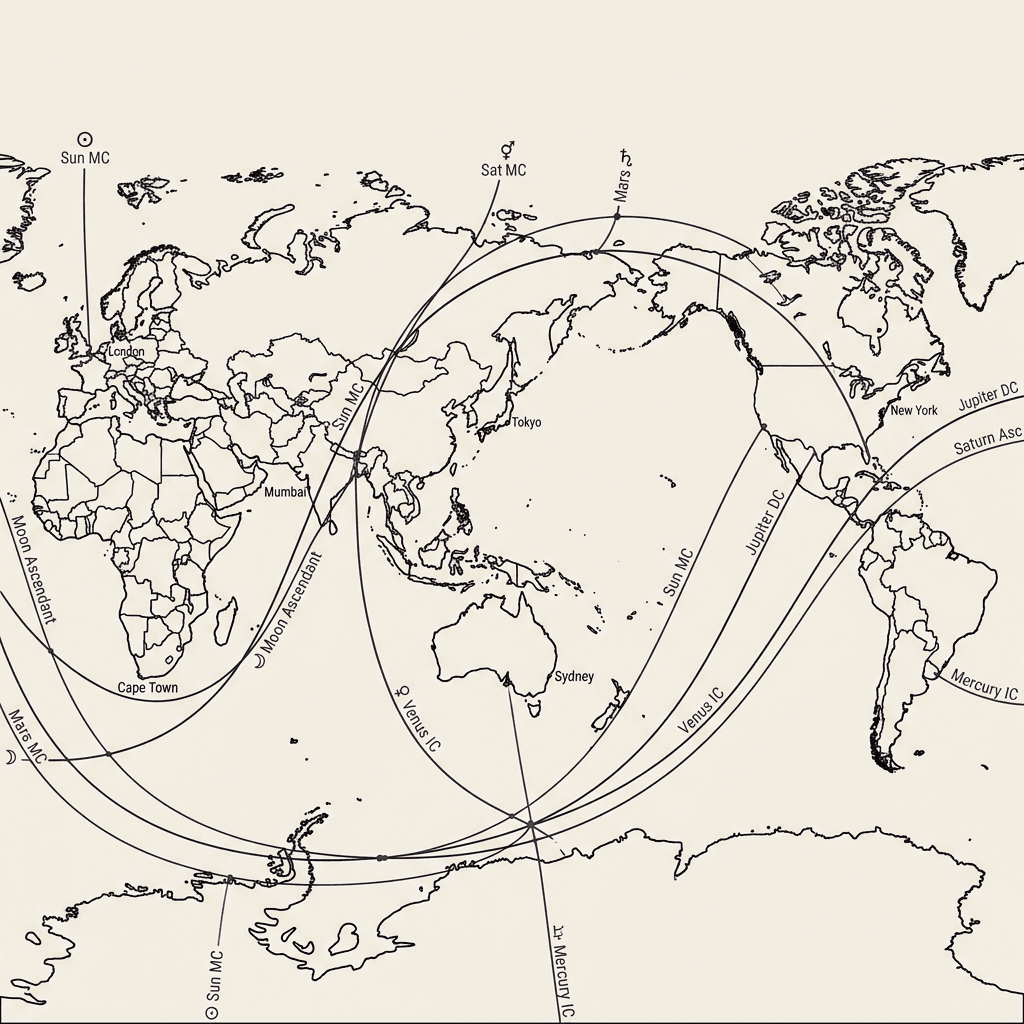
Astrocartography answers one question: if you relocated to this city, which planets would be most active in your chart there?
Astrocartography takes the four chart angles — Ascendant, Descendant, Midheaven, IC — and maps where each planet was rising, setting, culminating, or anti-culminating across the entire world at the moment of your birth. The result is a world map crossed by lines of planetary influence. Jim Lewis developed and trademarked the technique in 1976, sending hand-drawn maps to clients before any software existed to automate it. Astrolium generates your personal astrocartography map in the predictive timing suite.
Origin: Jim Lewis and the 1976 maps
Jim Lewis was an American astrologer who began distributing hand-drawn astrocartography maps to mail-order clients in 1976. The core insight was not entirely new — locational astrology in various forms goes back to ancient practice, and relocated charts had been used for decades. What Lewis added was the map itself: a visual representation of angle lines overlaid on the world's geography.
A planet rising on the eastern horizon at birth does so in a specific column of longitude wrapping from pole to pole. Lewis plotted those columns for all 10 traditional planets and the four angles, producing 40 lines per chart (some lines overlap or converge, especially near the poles). He trademarked the name AstroCartoGraphy and published The AstroCartoGraphy Book of Maps in 1989 with Arielle Guttman, mapping chart data for 136 notable figures against their career geographies.
Lewis died in 1995. The technique moved into mainstream use as astrology software incorporated it in the early 2000s, and it has accelerated substantially with the rise of location-independent work — people who can choose where they live now consult astrocartography maps before moving.
How it works
Your birth chart records the sky at a specific moment in time. That sky was the same sky everywhere on Earth at that moment, but the angles — which planets were rising or setting or overhead — varied by location. Someone born in Paris at the same instant as someone born in São Paulo shares the same planetary positions, but different Ascendants and Midheavens.
Astrocartography reverses that calculation. It asks: at this birth moment, where on Earth would a given planet have been exactly on the Ascendant? Exactly on the Midheaven? Exactly on the Descendant (setting)? Exactly on the IC (anti-culminating, at the nadir)?
The answers are lines of longitude. A Jupiter-Ascendant line runs roughly north-south through the longitudes where Jupiter was rising at your birth time. Stand on or near that line and, in theory, Jupiter's natal significations come forward in your life — public identity, opportunity, expansion, the themes Jupiter carries in your natal chart by sign and house.
Each planet generates 4 lines: one for each angle. The four line types read differently:
- Ascendant lines affect identity, appearance, the first impression you make.
- Midheaven lines affect career, reputation, public life.
- Descendant lines affect relationships, partnerships, significant others.
- IC lines affect home, roots, inner life, private circumstances.
Lines converge at "crossings" — points where two or more planetary lines intersect. These crossings are considered particularly dense with influence and are often the most actively read locations on the map.
The standard orb for a line's influence is roughly 600-700 miles (about 10 degrees of longitude at mid-latitudes). Living outside that band does not activate the line. Living within it does, with stronger effects closer to the line itself.
When practitioners use it
Astrocartography is used for relocation decisions — where to move, where to travel, where a business venture might prosper or fail. It is also read retrospectively: a client who has lived in several cities may find that significant events in each city align with the planetary lines active there.
Practitioners commonly combine astrocartography with local space charts (which track planetary azimuths from a specific location rather than longitudinal lines) and with transits to the relocated chart. Astrocartography shows the geographic zones of activation; transits show when those activations are most pronounced.
Not every line is welcome. A Saturn Midheaven line through a city may coincide with hard professional years. A Neptune Ascendant line might bring confusion or creative immersion depending on what Neptune signifies natally. The technique is descriptive, not prescriptive — the lines show where a planet is prominent, not whether that prominence will feel good.
In Astrolium
The astrocartography map is available in the Astrolium predictive timing suite. The map renders all 40 angle lines with color coding by planet. Click any point on the map to see which lines are within orb and read the planetary keywords for that location. The astrocartography guide covers line-by-line interpretation in depth. Chart data comes from the natal chart workspace.