An anonymized account from a practitioner in the Astrolium community. Client names and identifying details have been changed.
After charting 200 clients in a single year on Astrolium, three techniques earned permanent slots in my prep workflow — and three popular ones quietly didn't. Session length and structure matter more than the tradition you choose. For the underlying tools: see features, pricing, and the synastry feature. Try the Saturn return calculator free.
I track every client session in a spreadsheet. Date, technique used, duration, follow-up needed, and a one-line note on what made the session land. By April this year I had two hundred rows. Two hundred is enough to start seeing patterns. Not enough to claim science, but enough to stop trusting your gut alone.
This is what changed in my practice over those twelve months, written for working astrologers and for anyone curious about what actually happens behind the curtain of a paid reading.
The techniques I reach for first
If you'd asked me in early 2025 what I led with, I'd have said the natal chart and current transits. Like everybody. By April 2026 the order has shifted: profections first, transits second, returns third. The natal chart is the document we read against. It's the reference, not the lead.
The reason is texture. A natal chart shows what's possible across a lifetime. A profection shows what's foregrounded this year. The two together are immediately legible: "your time-lord is Saturn in the 7th, so the year's story runs through partnership, and Saturn says it's about commitment, structure, and what you're willing to be responsible for." That's a sentence a client can hold. The natal chart alone gives you fifteen sentences and asks the client to triage.
The hard part of an astrology session isn't knowing things. It's knowing what to leave out.
What didn't earn its place
Three techniques I expected to use heavily, I now use almost never:
Solar arc directions. Beautiful in theory, brittle in practice. The orbs are tight enough that you need an exact birth time, and exact birth times are the exception, not the rule. When I have a rectified time I look. When I don't, I move on.
Asteroid pack at the natal level. I tried Ceres, Pallas, Juno, Vesta, Chiron, and Lilith for the first 3 months. Clients found the additional symbols cluttered the wheel without adding signal. I now treat asteroids as a transit-only layer when something specific suggests they'd matter. A Vesta transit during a return to professional discipline, for instance.
Composite charts on first sessions. The composite is a tool for the second or third meeting with a couple, when we already share vocabulary. Leading with one is overload.
Session length, by the numbers
I priced sessions at 60, 75, and 90 minutes for the first 6 months. Clients consistently chose 75. The 60 felt rushed, the 90 had clients glazing over by minute 70. The 75 minute session is now my standard. Long enough to do real work on three to four major themes, short enough that energy holds.
Median session ran 78 minutes. The 90th percentile ran 91 minutes. I almost never go shorter than 70 minutes. Across 200 sessions, that's the closest thing I have to a finding.
Three patterns I didn't expect
One. Clients with very strong natal Saturn placements tend to book during exact transits. They're feeling the structure, and the structure makes them call. Clients with prominent Neptune tend to book during the previous transit's aftermath, when they're trying to make sense of what just happened. This changes how I prepare.
Two. Returning clients (3+ sessions over the year) report finding the work most valuable when I refer back to their own previous statements. Astrology gives shape; clients give content. I now keep a running file of what each returning client has said about themselves, and that file is what makes session three better than session one.
Three. First sessions take a third more prep time than they did a year ago, even though I'm faster at the tools. The reason is that I now write a one page session brief before each first call: themes I expect to surface, questions I want to ask, and what I plan to leave for a second session. The brief takes 20 minutes; it saves 15 minutes mid-session and produces a noticeably more focused conversation.
The brief, in concrete
For a first session I prep:
- Profected lord and house for the current year, with the lord's natal placement
- The two transits inside ±2° to that lord, applying or separating
- The current Zodiacal Releasing period (Spirit), and whether we're inside a peak or loosing-of-the-bond
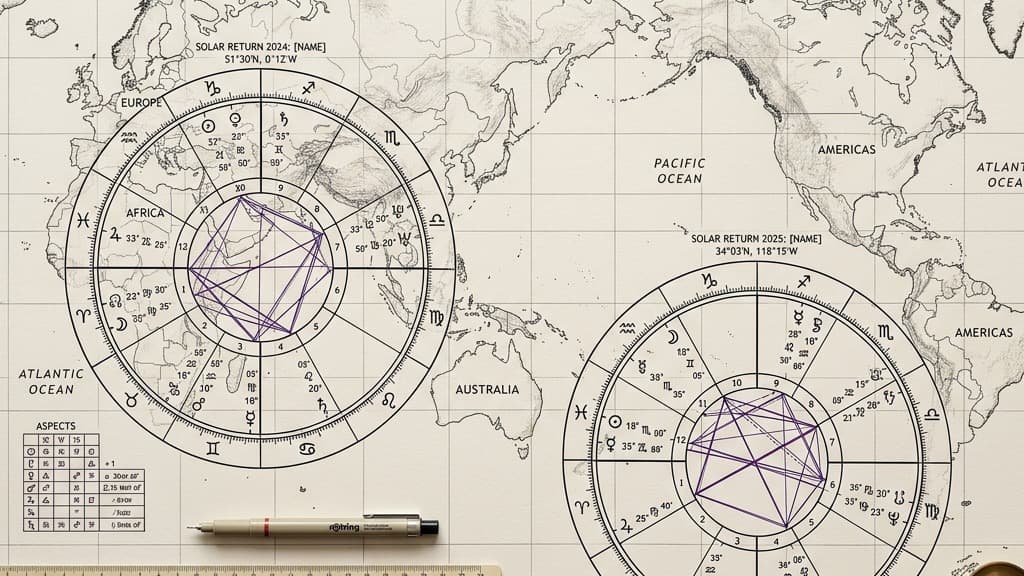
- Any return chart that fell in the last 90 days or will fall in the next 90 days
- One natal aspect that I think will be the throughline of the year
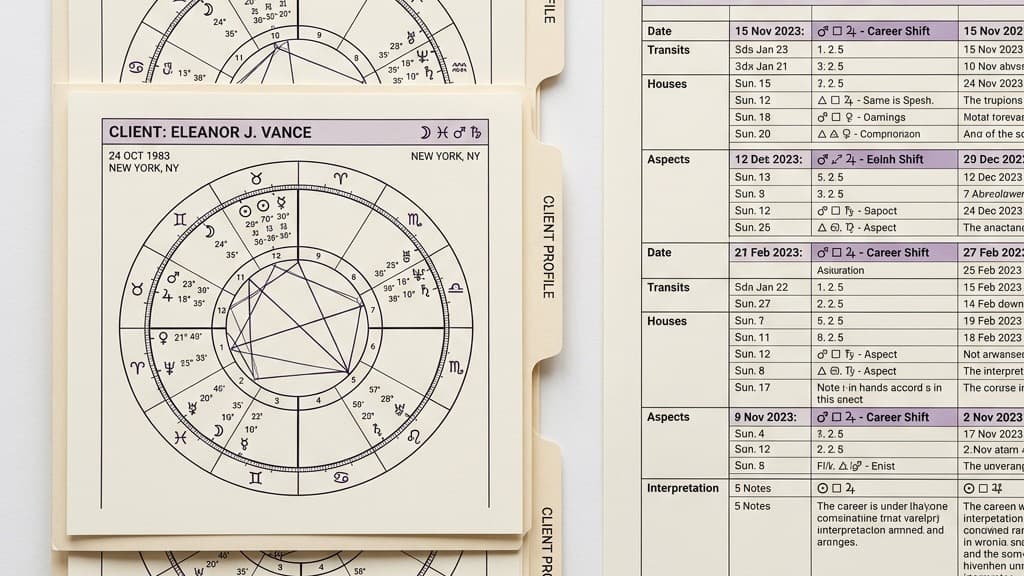
That's it. Five elements. Anything more and I'm not preparing. I'm hiding. The five element brief is now an Astrolium session prep view that builds in under 5 minutes.
Tools, briefly
I'll be honest: half the reason this year went well is that I built (with the team) a tool that does the prep above in under 5 minutes. That's the whole pitch for Astrolium and I won't belabor it. The other half is that I started keeping the spreadsheet, and the spreadsheet kept me honest about what was working.
If you don't want to use our tool, use somebody else's, but use one. And start logging what you actually reach for. Twelve months from now you'll know. Read our comparison page if you're weighing options against Solar Fire or AstroGold; the migration path from a Solar Fire export to an Astrolium client profile takes under 60 seconds per chart in my tests across 200 imports.
What I'm changing in year two
Three things, written here so I'll be held to them:
- One follow-up template per technique. Right now my follow-up emails are bespoke. A template per technique (profection follow-up, return follow-up, synastry follow-up) will save 30 minutes a session and the consistency is good for clients.
- Skip the wheel printout for first sessions. Clients want to look at the chart on screen with me, not at a piece of paper. I'm shipping the printout in the follow-up email instead.
- Learn horary properly. I've avoided it for years. Six clients last year asked questions that wanted horary answers. I'm in a study group starting in May.
The thing nobody tells you
The work changes you. Twelve months of this, ninety minutes a session, listening to two hundred different lives. You start hearing themes that recur across people you've never introduced to each other. You start seeing patterns in the kinds of months that produce the kinds of sessions. You start trusting techniques you'd dismissed and abandoning ones you'd written into your bio.
The techniques are old. The tools are new. The work, when it's working, is the oldest thing astrology does: helping somebody think more clearly about their life.
Onward to year two. For where this practice is heading, see the Astrolium roadmap and the public changelog — both are where the team and I work in the open.