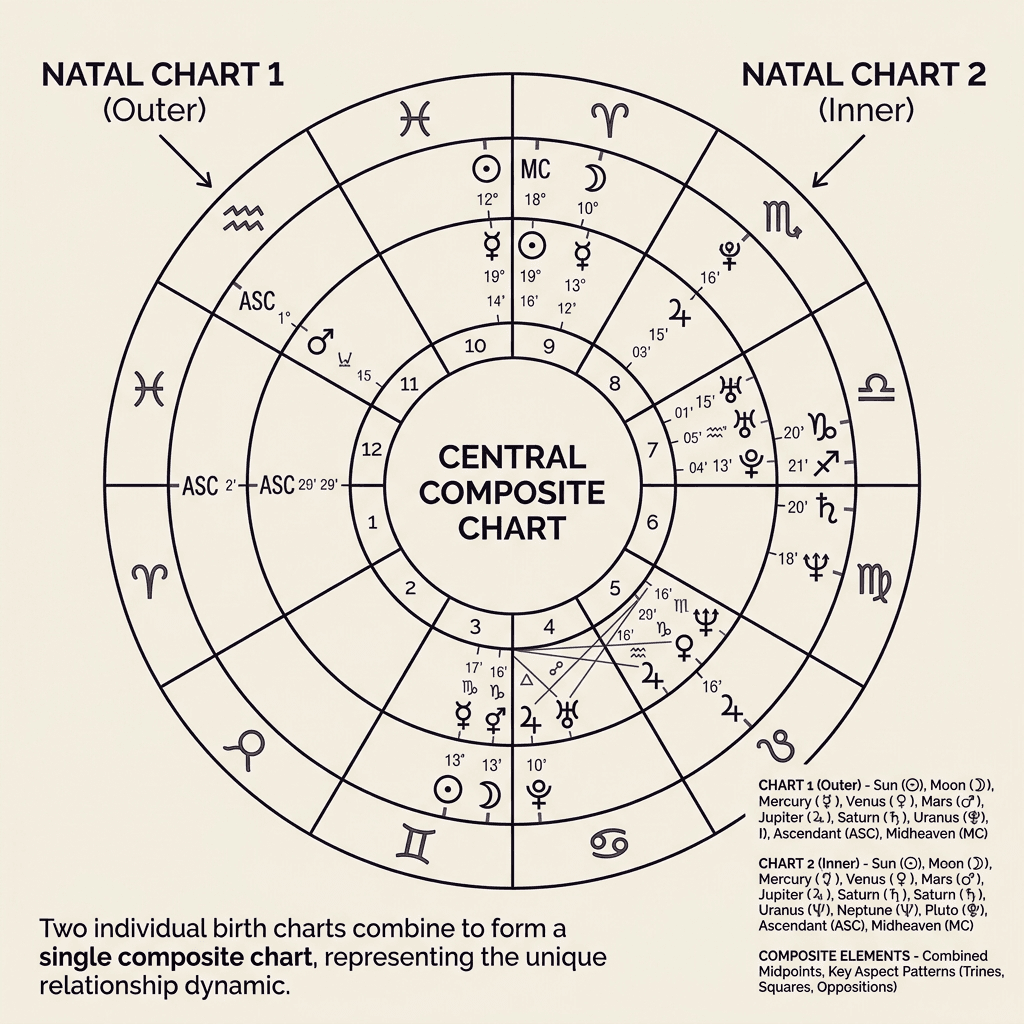
A composite chart is a single horoscope constructed by finding the midpoint between each pair of matching planets in two people's natal charts — one chart that represents the relationship as its own entity.
The composite chart takes the midpoint of each person's Sun, Moon, Mercury, Venus, Mars, and all other planets and angles, then combines those midpoints into one chart. John Townley popularized the method in his 1973 book. Because midpoints don't correspond to an actual sky moment, the composite chart is a mathematical construct rather than a real-time chart. Astrolium generates composite and Davison charts side by side for any two saved profiles.
What the composite chart is
In 1973, American astrologer John Townley published The Composite Chart, which established the midpoint method as the standard Western technique for creating a single chart to describe a relationship. The idea: take two people's natal charts, find the midpoint of each pair of the 10 planets, and treat those midpoints as if they were planets in a new chart. Sun plus Sun divided by two becomes the composite Sun. Moon plus Moon divided by two becomes the composite Moon. And so on through every planet, angle, and point.
The result is a chart that, unlike synastry, does not focus on how each person experiences the other. It describes the relationship itself — its purpose, its dynamics, its strengths and difficulties as a unit.
That abstract quality is intentional. A relationship has its own character. Two people who get along fine individually can form a partnership with a distinctive, sometimes surprising, energy. The composite chart attempts to describe that third thing: what exists between them.
Composite vs Davison: the key distinction
Ronald Davison independently developed a parallel technique around the same period, documented in his 1977 book Synastry. Instead of averaging the zodiac positions of planets, Davison found the midpoint in time and place — the average birth date, time, and geographic location — then cast a natal chart for that midpoint moment.
The Davison chart is a "real" chart in a way the composite is not. It describes an actual moment in time and an actual location in space. This gives it properties the composite lacks: you can progress a Davison chart, transit it conventionally, and apply all predictive techniques that depend on a real moment. The composite chart, being a mathematical construct, cannot be progressed in the same way.
In practical terms:
- The composite Sun and Davison Sun are rarely in the same sign.
- The Davison chart tends to show the temporal arc of a relationship — where it came from, where it is going.
- The composite chart tends to show the relationship's quality in the present tense — the dynamics at play right now.
Neither method is universally preferred. Many practitioners use both, comparing what each reveals. If the methods agree, the signal is strong. When they diverge, the practitioner reads each for its specialty.
Reading the composite chart in practice
The composite chart is read like a natal chart across all 12 houses, but every interpretation is applied to the relationship rather than to either individual.
Composite Sun in the 7th house: the partnership itself is oriented toward public partnership, formal agreements, and mutual visibility. Composite Moon in the 12th: emotional life shared between these two tends toward the private, the interior, the hidden. Composite Saturn conjunct the composite Ascendant: the relationship has a structural, serious quality; it may feel weighty, demanding, long-lasting.
What astrologers focus on:
- The composite Sun's house placement: where the relationship finds its core purpose.
- The composite Moon's house and sign: the emotional register between the two people.
- The composite Ascendant: how the relationship presents itself outwardly and how others perceive the couple.
- Any tight aspects to composite angles, particularly planets within 3 degrees of the Ascendant or Midheaven — the tightest of the 5 Ptolemaic aspects carry the most weight here.
- The composite Saturn placement: where structure, obligation, or restriction operates in the shared life.
Hard composite aspects — composite Saturn square composite Venus, composite Pluto conjunct composite Moon — are not signs to abandon a relationship. They describe real dynamics that will need conscious attention.
In Astrolium
The composite chart tool in Astrolium generates both the composite and the Davison chart for any two people in your account, so you can compare them directly. The synastry feature covers the cross-chart aspect layer alongside the composite view. For a detailed treatment of when to use composite versus Davison, the composite vs Davison guide walks through both techniques with worked examples.