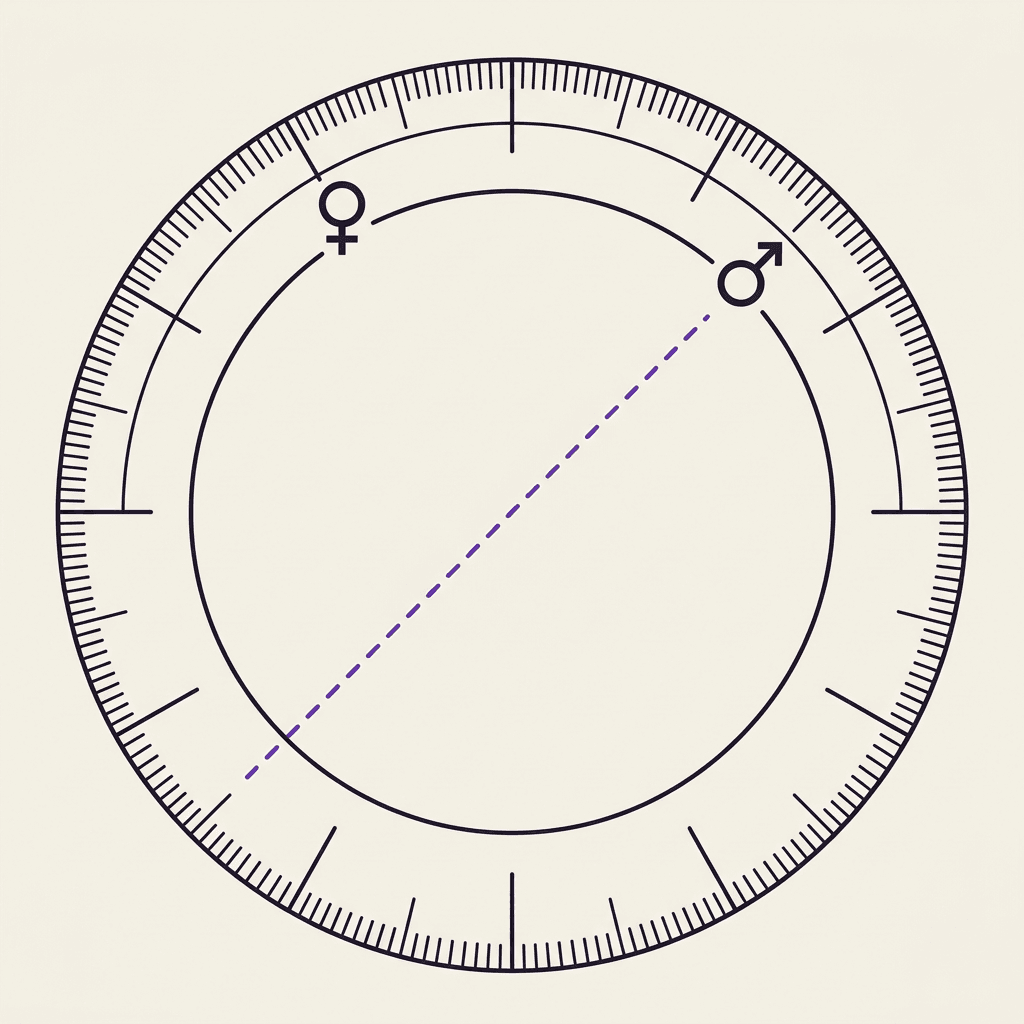
A midpoint is the degree exactly halfway between two planets in a chart, a sensitive position where both planets' combined influence concentrates.
Midpoints in astrology are calculated points equidistant between any two planets, read as positions where both planets' themes meet. The technique was first systematized by Alfred Witte in Hamburg in the 1920s and later brought into mainstream practice by Reinhold Ebertin, whose 1940 book Combination of Stellar Influences remains the field's core text. Astrolium's midpoint calculator plots all active midpoints and their tree structures in one view.
Where midpoints came from
Alfred Witte (1878–1941), a Hamburg-based surveyor and astrologer, developed midpoints as part of what became known as the Uranian system or Hamburg School. His core insight was algebraic: if two planets share a midpoint with a third, the three are in a structural relationship regardless of whether any classical aspect joins them. He expressed this as a + b = 2c, where c is the midpoint.
Witte also introduced eight hypothetical trans-Neptunian planets to extend the system, which kept Uranian astrology confined mostly to its practitioners inside Germany. The wider spread came through Reinhold Ebertin, who dropped the hypotheticals, stripped the technique to planets and angles, and published Combination of Stellar Influences in 1940. Ebertin called his version Cosmobiology and built a 90-degree dial (a circular reference dial that collapses the full 360-degree chart into one quadrant) to make midpoint trees readable at a glance.
The Sun/Moon midpoint is the most cited single midpoint in practice. It represents the integration of the two luminaries: the will (Sun) and the body and emotional life (Moon). Planets or angles landing on the Sun/Moon midpoint by conjunction, square, or opposition have been a consistent focus of interpretation since Ebertin codified the meaning.
How to calculate a midpoint
The formula is direct. Add the two planetary positions in absolute degrees (0–360) and divide by two. If the result exceeds 360, subtract 360.
Example: Saturn at 45° (15 Taurus) and Neptune at 285° (15 Capricorn). Their sum is 330. Divide by 2: 165°, which is 15 Virgo. That is the Saturn/Neptune midpoint.
Every pair of planets produces two possible midpoints: the short arc and the long arc, sitting 180° apart. The convention is to record both, since a planet conjunct either point activates the pair.
For practical work, astrologers usually check three things: whether a natal planet sits within 1–2 degrees of a midpoint (natal activation), whether a transiting planet crosses a midpoint (timing), and whether two people's charts share midpoints by composite or synastry overlay. The 90-degree dial makes this readable by folding all three of those positions onto one wheel.
How practitioners use midpoints
The most common entry point is the personal midpoints tree: Sun/Moon, Sun/Ascendant, Moon/Ascendant, and the midpoints to the Midheaven. These form what Ebertin called the "personal sensitive points." A planet or angle within 1.5 degrees of the Sun/Moon midpoint is read as deeply integrated into the chart owner's sense of purpose and partnership needs.
In predictive work, midpoints track transits and solar arc directions to sensitive compound points. A solar arc Venus reaching the natal Sun/Moon midpoint within a year is consistently associated with relationship developments, not as a mechanical rule but as a trigger for the themes both planets carry.
Midpoints also show up in synastry. When a person's natal planet falls on the Sun/Moon midpoint of a partner's chart, the midpoint owner typically experiences the relationship as central and defining. The reverse reading applies to planets on the Ascendant/Midheaven midpoint: public identification with the partner.
One practical discipline: work with orbs tighter than you would for aspects. The Ebertin tradition uses 1.5–2 degrees maximum. Wider orbs produce so many contacts that no hierarchy holds.
In Astrolium
The Astrolium midpoint calculator computes the full midpoint tree for any natal chart, marks all active natal contacts within a configurable orb, and plots solar arc directions to midpoints across a user-defined date range. The natal chart view overlays the 90-degree dial alongside the standard wheel. The technique fits naturally alongside the Hellenistic timing methods for annual prediction work.