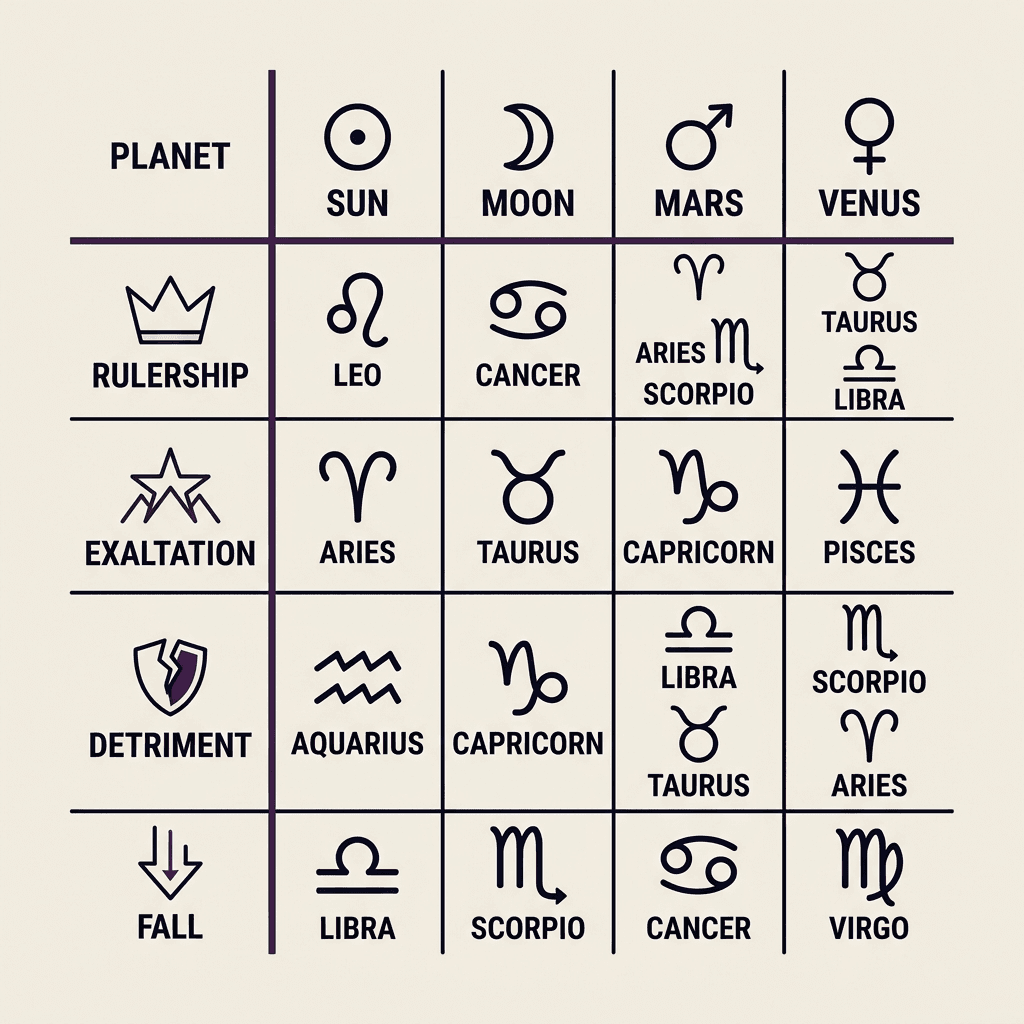
Essential dignities tell you whether a planet is in a position where it can do its job well, or one where it is weakened and unreliable. The system is one of the oldest tools in horoscopic astrology.
Essential dignities are a classical system for rating a planet's strength based on its zodiac sign and degree. Five dignities exist: domicile, exaltation, triplicity, term, and face. Each represents a different kind of placement quality, from strongest (domicile) to weakest of the five (face). Opposite each dignity is a debility: detriment opposes domicile, fall opposes exaltation. Ptolemy listed essential dignities as a primary factor in chart judgment in Tetrabiblos (2nd century CE). Astrolium scores all five on every planet in every chart.
Origin and history
The dignity system appears fully formed in Ptolemy's Tetrabiblos (2nd century CE), where it is one of the first tools introduced for reading a chart. Ptolemy drew on earlier Hellenistic sources, and the underlying ideas (that planets have signs where they rule, exalt, or express their nature well) predate him by at least two centuries.
The five-dignity hierarchy (domicile, exaltation, triplicity, term, face) was transmitted through Arabic astrology and passed into medieval European practice largely through the work of Abu Ma'shar and Guido Bonatti. William Lilly's Christian Astrology (1647) is the most-read English-language exposition: Lilly assigned numerical weights to each dignity and debility, producing a point score that practitioners could apply to both natal and horary charts.
The system fell out of use in the 20th century as modern psychological astrology moved away from classical technique. Its revival is part of the same wave that brought back whole sign houses, zodiacal releasing, and other traditional methods. J. Lee Lehman's Essential Dignities (2002) is the modern reference that practitioners cite most often alongside Lilly.
The five dignities and their opposites
Domicile is the strongest essential dignity. Each planet rules one or two signs: the Sun rules Leo, the Moon rules Cancer, Mercury rules Gemini and Virgo, Venus rules Taurus and Libra, Mars rules Aries and Scorpio, Jupiter rules Sagittarius and Pisces, Saturn rules Capricorn and Aquarius. In its domicile, a planet is in its own territory. It has full authority over the matters of that sign and any house whose cusp falls there. The debility opposite to domicile is detriment: a planet in the sign opposite its rulership. The Sun in Aquarius is in detriment; Mars in Libra is in detriment. A planet in detriment is considered weakened, displaced from its natural environment.
Exaltation is the second dignity. The traditional exaltations are: Sun in Aries (at the exact degree 19° Aries in some versions), Moon in Taurus, Mercury in Virgo, Venus in Pisces, Mars in Capricorn, Jupiter in Cancer, Saturn in Libra. A planet in exaltation is honored: well-received, functioning at a high pitch, sometimes to the point of excess. The opposite is fall: a planet in the sign opposite its exaltation. The Sun in Libra is in its fall; Saturn in Aries is in its fall. Fall suggests the planet's energy is awkwardly placed and lacks support.
Triplicity is the third dignity. The 12 signs are grouped into four triplicities by element: fire (Aries, Leo, Sagittarius), earth (Taurus, Virgo, Capricorn), air (Gemini, Libra, Aquarius), and water (Cancer, Scorpio, Pisces). Each triplicity is assigned two rulers: one for day charts, one for night charts (Ptolemy used a three-ruler system adding a common ruler; the two-ruler version is more common in practice). A planet that rules the triplicity of the sign it occupies has triplicity dignity. This dignity is sensitive to sect: a day-chart ruler in a fire sign has triplicity dignity in a day chart but not a night chart.
Term (also called bounds) divides each sign into five unequal sections, each assigned to one of the five classical planets (the Sun and Moon do not rule terms). Two tables exist: the Egyptian terms and the Ptolemaic terms. The Egyptian terms are older and appear more often in Hellenistic sources; Ptolemy listed both but favored his own table. In the Egyptian terms, Aries is divided roughly 6-12-8-5-4, assigned to Jupiter, Venus, Mercury, Mars, and Saturn respectively. A planet in its own term has a modest dignity: enough to prevent total debility, but not enough to give it strength on its own.
Face (also called decan) divides each sign into three 10-degree sections, each ruled by one of the seven traditional planets in a fixed sequence starting from Mars at 0° Aries. Face is the weakest of the five dignities. Lilly described a planet in its face but no other dignity as "a man in his own house, but destitute." It keeps the planet from being entirely without resource, but only barely.
No debilities correspond to triplicity, term, or face.
How practitioners use it
Essential dignities are used in two main ways: as a quality filter on planetary testimony, and as a component in Lilly-style horary judgment.
In natal work, a planet in domicile or exaltation is considered better able to act on its natural significations. Saturn in Capricorn in a natal chart has the capacity to produce structured, disciplined outcomes where Saturn is the relevant planet. Saturn in Aries (detriment) is considered less able to do so. This is a tendency, not a sentence. The house placement, aspects, and sect all modify how the dignity plays out.
In horary astrology, essential dignities are the primary tool for judging whether a matter will succeed and for whom it will go well. If the querent's significator is in its domicile and the quesited's significator is in its fall, the chart generally reads in the querent's favor. If the quesited's significator is strong and the querent's is debilitated, the chart reads the other way.
Mutual reception is a related concept: two planets in each other's domiciles (or exaltations) are in mutual reception and can, in some horary doctrines, "exchange" positions to form an effective aspect even without a direct applying aspect between them.
The dignity score is not the whole chart. A debilitated planet can still produce results if it is well-supported by aspect and house placement. The dignities are one layer of testimony among many.
In Astrolium
The Astrolium natal chart displays each planet's dignity status in the sidebar: domicile, exaltation, triplicity, term, face, detriment, or fall, plus the Lilly-style point score. The horary feature applies the full essential dignities table automatically for both Egyptian and Ptolemaic terms, switchable per chart. The hellenistic astrology guide covers how sect interacts with triplicity dignities in detail.