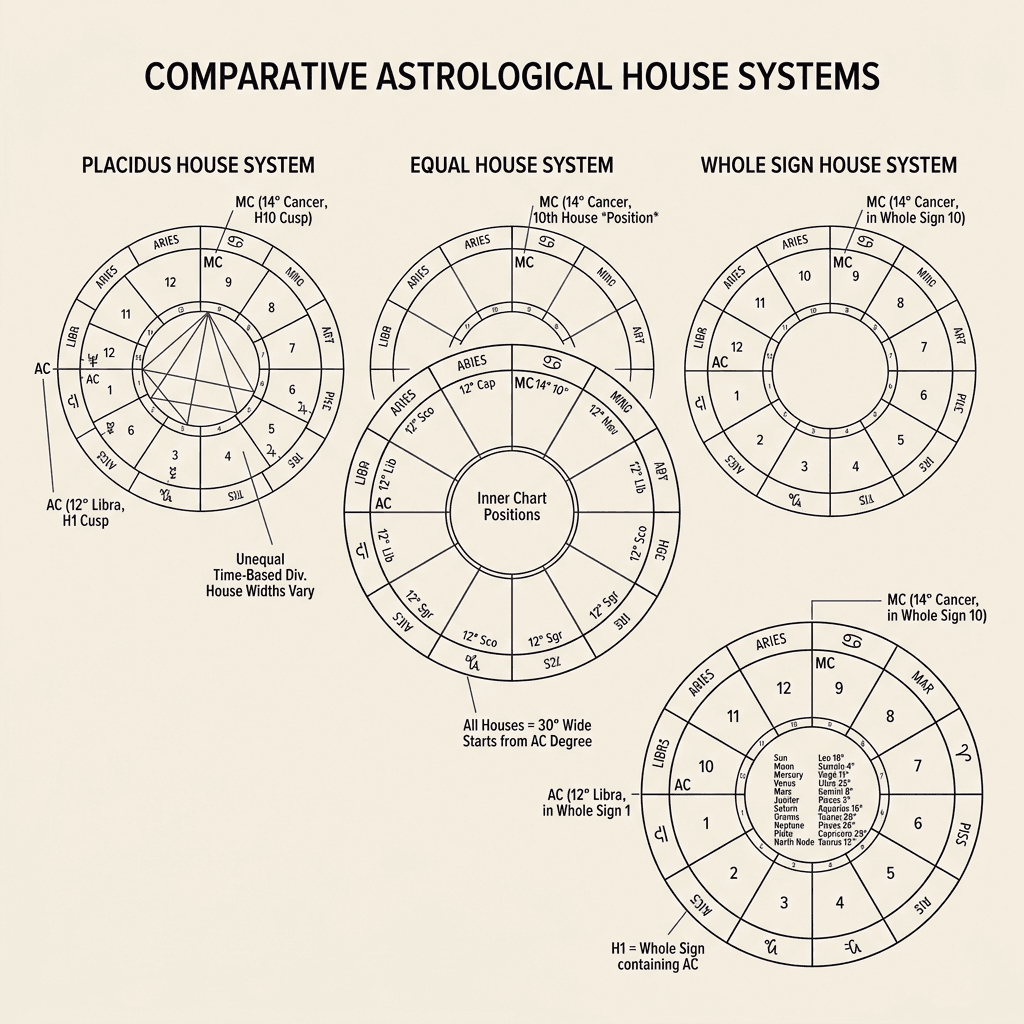
House systems are the methods astrologers use to divide the ecliptic or the sky into 12 sectors, with each sector governing a domain of life. The choice of system can shift a planet from one house to another, which is why the debate matters.
A house system is a mathematical method for dividing the sky into 12 houses, each assigned to a life domain: identity, money, communication, home, creativity, work, relationships, shared resources, travel, career, community, and the hidden. Whole sign houses are the oldest method, documented in Hellenistic astrology from the 1st century BCE. Placidus, developed by Italian mathematician Placidus de Titis in the 17th century, became the default in modern Western astrology. Astrolium ships 23 house systems and lets you switch per chart.
Origin and history
The earliest complete house system is whole sign houses, used throughout the Hellenistic period (roughly 1st century BCE to 7th century CE). In whole sign houses, the Ascendant falls somewhere in the rising sign, and that entire sign becomes the first house. The next sign becomes the second house, and so on. Every house covers exactly 30 degrees, and the system works identically at any latitude.
As mathematical astronomy developed in the Islamic Golden Age and the European Renaissance, astrologers began experimenting with systems that tied the house cusps more precisely to the actual horizon and meridian at the birth location. Regiomontanus (15th century) built one such system; Campanus built another. Placidus de Titis, a 17th-century Italian mathematician, produced the system now called Placidus, which calculates house cusps based on the time it takes a degree of the ecliptic to travel through one-third of its diurnal arc. When Raphael's Ephemeris began publishing Placidus tables in the 19th century, the system became available to anyone with a few shillings, which is largely why it became the English-language default.
Koch houses (1971) and Topocentric houses (1966) are later refinements in the same tradition. Equal house is simpler: the Ascendant marks the first house cusp, and every subsequent cusp falls exactly 30 degrees later.
Today, whole sign houses are the fastest-growing alternative to Placidus among practicing astrologers, driven by the revival of Hellenistic and traditional techniques over the past 30 years.
How the main systems work
Whole sign and Placidus divide the sky by different logic, which is why they disagree most at high latitudes and why practitioners argue about them.
In whole sign houses, the rising sign is the first house. If the Ascendant is at 15 degrees Leo, the entire sign of Leo is the first house, Virgo the second, Libra the third, and so on. The Midheaven (MC) floats: it may fall in the ninth, tenth, or eleventh house depending on the birth latitude and time of year. This is considered a feature by whole sign practitioners, not a problem: the MC marks the most elevated point in the sky, which is a separate calculation from the house division.
In Placidus, each house cusp is calculated from the Earth's rotation. The Ascendant is always the first house cusp; the MC is always the tenth. Between those fixed angles, the intermediate cusps are derived from the time it takes the ecliptic to travel one-third of its semi-arc. At moderate latitudes (30-55 degrees), Placidus produces houses of varying but workable sizes. At high latitudes (above 60 degrees north or south), some Placidus houses can span more than 60 degrees of the ecliptic while others shrink to nearly nothing. A chart cast for Helsinki or Reykjavik in Placidus can be nearly unreadable at extreme northern birth times. Whole sign houses have no such problem.
In Koch, the house cusps are based on the Midheaven's position at the time each degree of the ecliptic was on the Ascendant in the past. The results are similar to Placidus at moderate latitudes but diverge at the extremes. Koch was the preferred system in German-language astrology for much of the 20th century.
In equal house, every house is exactly 30 degrees. The system is easy to calculate and consistent at any latitude. It separates the Ascendant from the MC just as whole sign does, though the mechanism differs.
Regiomontanus divides the celestial equator into 12 equal parts and projects them onto the ecliptic. It was standard in horary astrology: William Lilly used Regiomontanus, and many traditional horary practitioners still do.
How practitioners use it
Most astrologers pick one system and use it consistently. Switching systems to make a chart "work better" is considered poor practice. The choice is usually based on tradition (Hellenistic practitioners default to whole sign), training (modern Western astrologers trained in the 20th century tend to use Placidus), or practical experience with chart accuracy.
The Placidus vs. whole sign debate is mostly a natal astrology question. In horary astrology, where the exact degree of a house cusp determines which planet rules which question, the choice of system can change the answer. Lilly used Regiomontanus; his modern followers tend to stay with it for horary even if they use another system for natal work.
Some practitioners run both systems and treat disagreements as informative. If a planet is solidly in the fifth house in both Placidus and whole sign, the fifth house reading is more reliable. If it sits at 29 degrees of a sign and ends up in different houses depending on the system, both houses are worth considering.
In zodiacal releasing and other Hellenistic techniques, whole sign houses are the standard because the original texts assume that system. Mixing Placidus charts with Hellenistic timing techniques produces inconsistencies in house-based delineations.
Birth time accuracy matters more in Placidus than in whole sign. A two-minute error in birth time shifts the Placidus Ascendant by roughly half a degree, which can change which house a near-cusp planet occupies. In whole sign, the same two-minute error rarely changes a house placement because the entire sign acts as one house.
In Astrolium
The Astrolium house systems feature ships 23 house systems. Switching systems is a single click per chart. The chart wheel redraws immediately without recalculating the planetary positions. The Placidus and whole sign options are the most-used defaults. The house systems guide covers the mathematical logic behind each major system and which traditions favor each one. For charts cast at extreme latitudes, Astrolium flags when Placidus produces unusually large or small houses and suggests whole sign or equal house as alternatives.