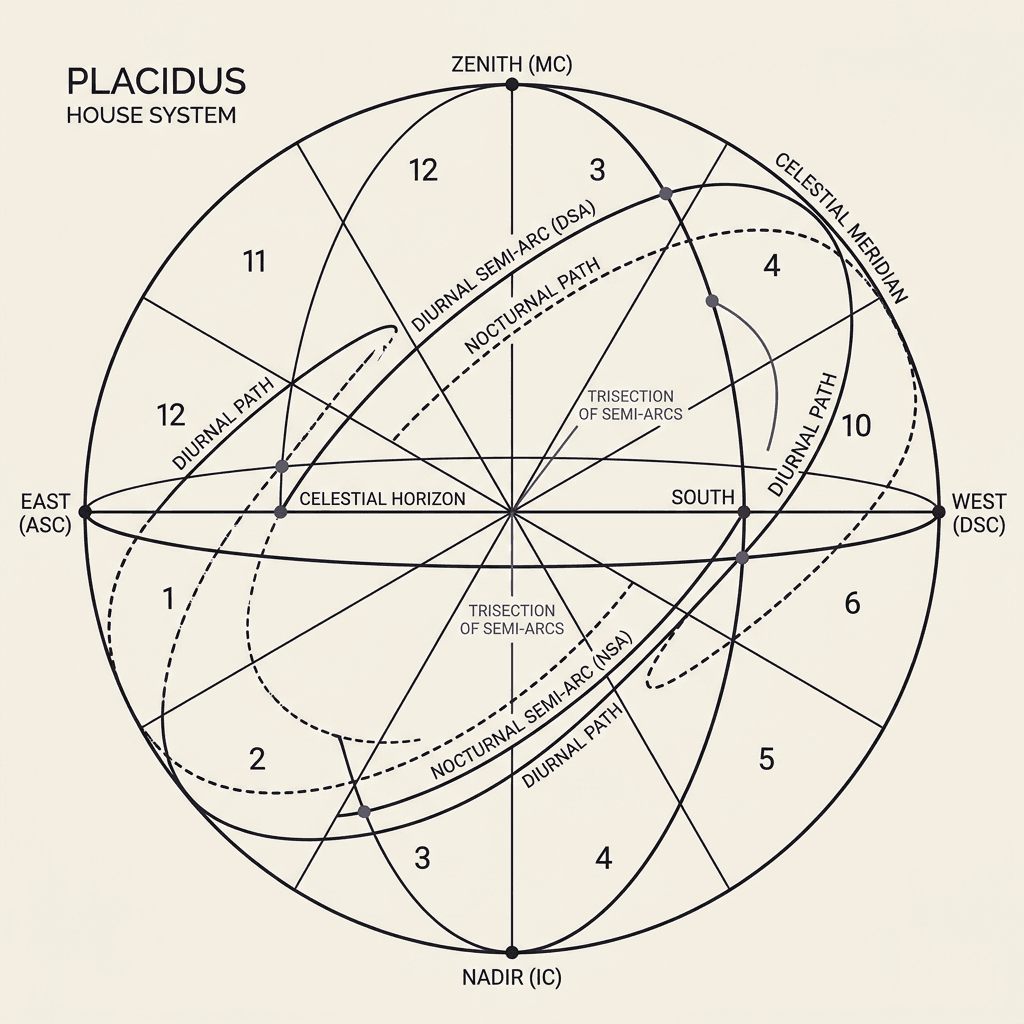
Placidus is the house system most practitioners encounter first, because it ships as the default in nearly every major astrology program.
Placidus divides the chart into 12 houses by measuring how long each degree of the ecliptic takes to travel from the horizon to the meridian. Houses are unequal in size; a degree near the Ascendant may pass through in minutes, while one near the Midheaven can take hours. Astrolium calculates Placidus houses to arc-second precision and lets you switch to any other system in one click.
Origin and history
The system is named for Placidus de Titis, a 17th-century Italian monk and mathematician who published tables of house cusps in 1650. But the method is older. Giovanni Antonio Magini published equivalent tables in 1602, and the underlying time-based logic traces back to Claudius Ptolemy's Tetrabiblos (2nd century CE), where he described house division in terms of semi-arcs — the time a degree takes to travel from horizon to meridian.
What Placidus actually did was systematize those tables and attach his name to them. By the 18th century his tables were reprinted across Europe, and when astrology publishing expanded in England they became the dominant reference. Almanac publishers stuck with Placidus; the system defaulted into practice by inertia as much as design.
It was not until the 20th century that astrologers began seriously comparing systems. By then Placidus was too embedded in software defaults to dislodge easily, and most practitioners trained on it had little motivation to switch.
How it works
Placidus is a time-based system. The calculation takes the Ascendant (the degree of the ecliptic rising over the eastern horizon at birth) and the Midheaven (the degree culminating overhead) as fixed anchors, then divides the semi-arc each other degree travels between horizon and meridian into three equal time segments.
Those trisections produce the intermediate house cusps — the 11th, 12th, 2nd, and 3rd on one side; the 5th, 6th, 8th, and 9th on the other. The result is 12 houses of unequal size. Near the equator, houses stay close to 30 degrees each. Move toward the poles and the distortion grows. Above roughly 60° north latitude, some zodiac degrees never reach the horizon at all, making Placidus mathematically undefined for those births. Software handles this by switching to an alternative system automatically, or by flagging the chart.
The Midheaven always falls on the 10th house cusp. The Ascendant always falls on the 1st. Between those anchors, everything else is calculated from local sidereal time and the obliquity of the ecliptic.
When practitioners use it
Most Western astrologers trained after 1950 use Placidus by default, often without examining the choice. It works cleanly for birth latitudes between roughly 60°S and 60°N, which covers the vast majority of clients.
Practitioners stay with Placidus for a few reasons. Primary directions and many timing techniques were historically developed and tested within the Placidus framework, so changing systems mid-study breaks continuity. Published delineation books — especially those covering derived house methods and solar returns — typically assume Placidus without stating so.
The system also produces noticeably intercepted signs (signs that fall entirely inside a house, touching no cusp) more often than whole sign or equal house do, which some practitioners read as a meaningful chart feature.
For clients born above 60°N — Iceland, northern Norway, Alaska, most of Canada above Edmonton — Placidus breaks down and another system is the right choice. The house systems guide covers when to switch.
In Astrolium
Placidus is one of the house systems available in the Astrolium chart engine. Switch between Placidus, whole sign, equal house, Koch, Regiomontanus, and Campanus from the chart settings panel. All house-sensitive calculations — profections, primary directions, solar returns — update in real time when you change the system. If a birth latitude makes Placidus undefined, Astrolium flags the chart and suggests an alternative. The house systems guide covers the tradeoffs in depth, and the profections calculator shows how the house choice affects time-lord assignments.