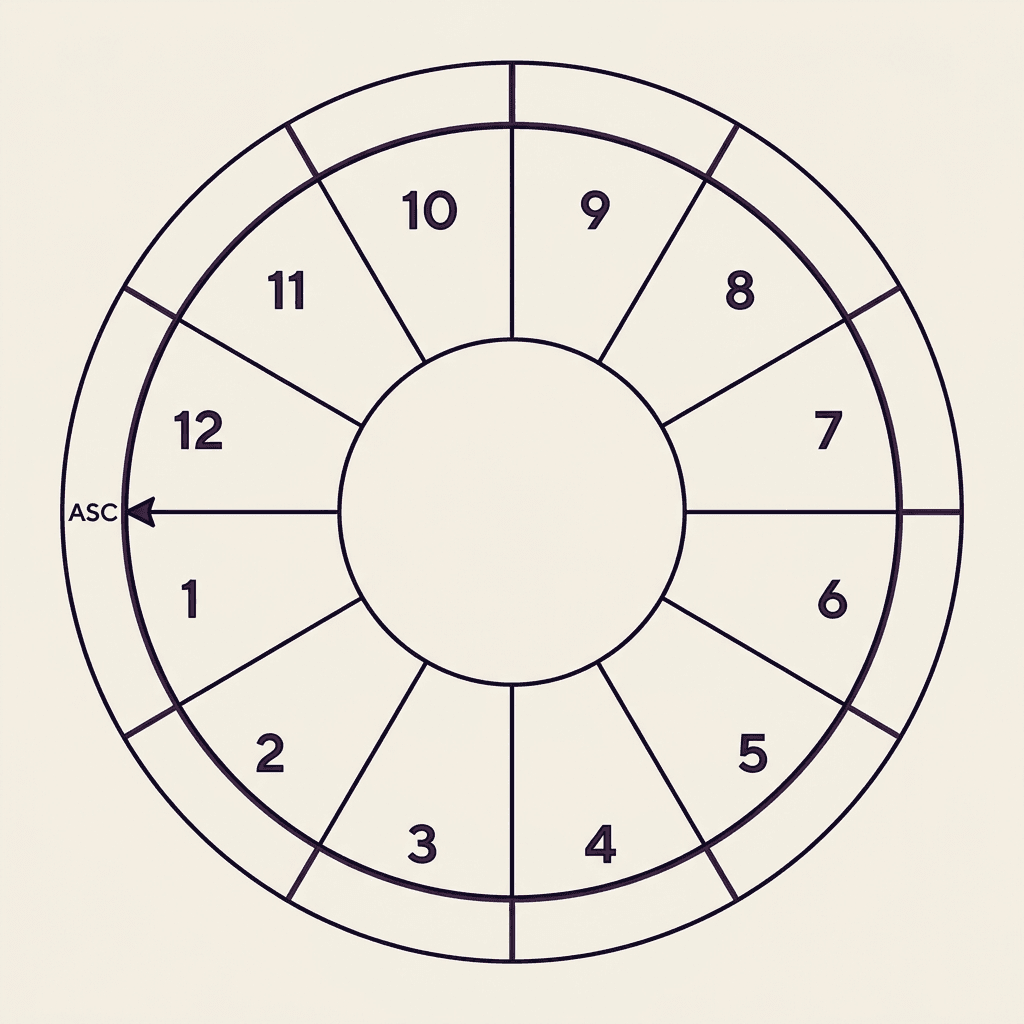
Whole sign houses are the oldest house system on record, used by every major Hellenistic astrologer from the 1st century BCE through the Roman period.
In whole sign houses, whichever zodiac sign is rising at birth becomes the entire 1st house. The next sign is the 2nd house, the next is the 3rd, and so on around the wheel. Every house is exactly 30 degrees. The Ascendant still matters — it marks where in the 1st house sign the horizon falls — but it does not divide the sign. Astrolium supports whole sign houses alongside seven other systems.
Origin and history
Whole sign houses emerged in the Hellenistic tradition sometime around the 1st or 2nd century BCE. Every practitioner we know by name from that period used it: Vettius Valens, Dorotheus of Sidon, Paulus Alexandrinus, Rhetorius of Egypt, and — despite later interpreters reading him otherwise — Claudius Ptolemy.
The system fell out of use gradually during the medieval period, probably around the 10th century CE, as Arabic and then European astrologers developed more mathematically elaborate alternatives. By the 20th century, whole sign houses were essentially unknown in Western practice. Most astrologers assumed Placidus had always been dominant.
The recovery happened through translation work. In the early 1990s, Robert Schmidt and Robert Hand founded Project Hindsight to produce the first systematic English translations of major Hellenistic texts. Reading those texts made clear that ancient astrology looked quite different from its modern descendants, and whole sign houses were central to the difference. Chris Brennan's Hellenistic Astrology (2017) consolidated the scholarship for a general audience and helped drive a significant revival in contemporary practice.
How it works
The calculation is straightforward. Find the Ascendant sign — say, 17° Scorpio. The entire sign of Scorpio becomes the 1st house. Sagittarius is the 2nd. Capricorn the 3rd. Every house spans exactly one sign, 30 degrees, no exceptions.
The Ascendant itself is still plotted on the chart — it shows the precise degree rising — but it has no bearing on house boundaries. A planet at 3° Scorpio and a planet at 27° Scorpio are both in the 1st house, even though one is far from the Ascendant degree and the other is closer to the 2nd house cusp in Placidus.
This means whole sign charts never produce intercepted signs. Every sign is a house, every house is a sign, and every planet has an unambiguous house placement. For Placidus charts at high latitudes, where interceptions can swallow entire signs, the simplicity is a practical advantage.
The Midheaven (MC) in whole sign houses is a sensitive point but does not necessarily sit on the 10th house cusp. At some latitudes the MC falls in the 9th or 11th house sign. Hellenistic practitioners treated the MC as a career and public-life indicator regardless of which house it technically occupied.
When practitioners use it
Whole sign houses are now the default system for most practitioners working within the Hellenistic revival. The practical argument is consistency: the techniques built around whole sign houses — annual profections, bonification and maltreatment, the lots — all presuppose sign-based houses. Using Placidus with those techniques produces house placements that the original calculations never intended.
Practitioners switching from Placidus to whole sign often find that planets which felt ambiguous in their Placidus chart settle into clear house themes. A planet that straddled a cusp in one system lands cleanly in a house in the other.
The whole sign vs Placidus question is not purely historical. Many modern astrologers use whole sign for natal work and Placidus for timing techniques that developed within the medieval tradition, though the Hellenistic camp generally argues for consistency throughout.
In Astrolium
Whole sign houses are fully supported in Astrolium's chart engine. Select it from the house system panel; all house-dependent calculations update immediately. The natal chart view shows the Ascendant degree within the 1st house sign and places the MC as a separate sensitive point. Switching between whole sign and Placidus mid-session is a single click.