This is Astrolium's chapter-length guide to reading a natal chart from scratch. It assumes nothing and ends with you reading your own chart competently. The framework is 6 steps in a fixed order: the one working astrologers actually use, drawn from Chris Brennan's Hellenistic tradition, Liz Greene's modern psychological school, Robert Hand's predictive work, and Bernadette Brady's chart-pattern lineage.
To follow along with your own chart, run the free chart generator. Birth data in, full natal wheel out, in under 4 seconds. For the engine the framework runs on, see the natal chart feature. For the $11 per month Pro plan with the client roster and natal readings across the 4 schools, see pricing.
What a natal chart is
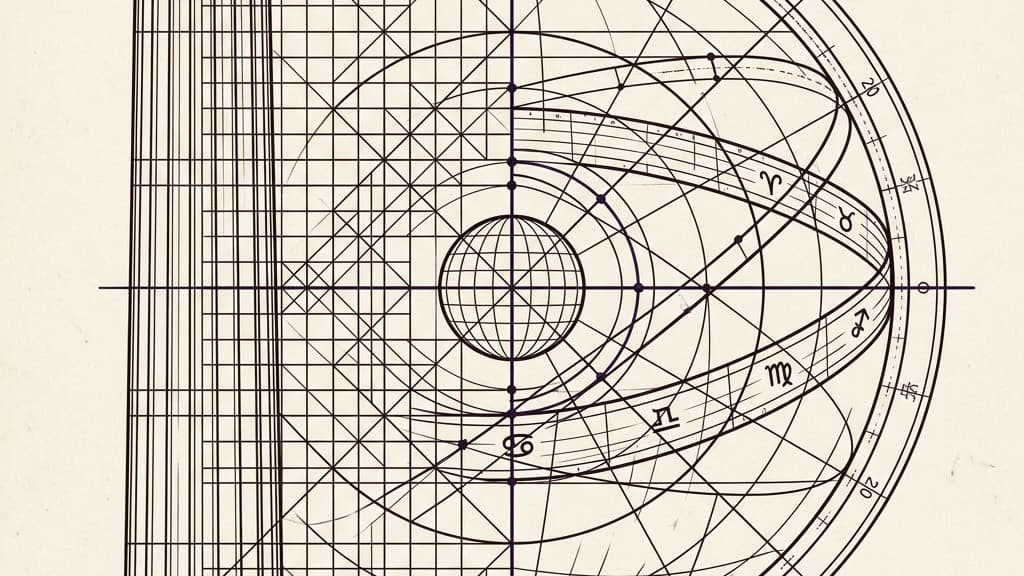
A natal chart is a 2-D map of the sky as seen from your exact birthplace at the moment you were born. It shows the positions of the 10 classical planets across 12 signs and 12 houses, plus the angles (Ascendant, Midheaven, Descendant, Imum Coeli) where the four chart axes cross the ecliptic. Reading it well treats those positions as a coherent description of a life, not a list of paragraphs. The standard order moves from chart ruler to Sun, Moon, Ascendant, then through personal planets to social and outer planets, with house emphasis read against sign emphasis and aspect patterns last. The wheel is not metaphor; it is an astronomical record calculated to the arc second from Swiss Ephemeris. Astrolium casts the chart, draws the wheel, runs the aspect grid, names the chart ruler, and ships a written reading drafted by the AI assistant. Free, no account required.
The wheel you are looking at is not metaphorical. It is the projection of an actual sky, calculated to the arc-second from the IAU ephemeris, frozen at the minute and second of your birth, observed from the latitude and longitude of the hospital or house you came into. Mars actually was where the chart says Mars was. The Moon actually had risen 9 degrees past the eastern horizon. The chart is, in the strictest sense, an astronomical record.
What turns that record into a reading is doctrine. There are several doctrines: Hellenistic, modern psychological, evolutionary, Vedic, Uranian, traditional, others. They disagree on details. They agree, more than you would expect, on the fundamentals. That the planets, signs, houses, and aspects mean something. That the something has shape across a life. That a competent reader can describe that shape with enough specificity to be useful.
This guide teaches the shared core. Once you can read the core, picking a school is a matter of which lineage of detail feels true to you.
The five things on the wheel
A natal chart has five layers. Learn them in this order; they build on each other.
Ten planets anchor the wheel: Sun, Moon, Mercury, Venus, Mars, Jupiter, Saturn, Uranus, Neptune, Pluto. The 7 classical planets (Sun through Saturn) are what every tradition uses. The 3 modern planets (Uranus, Neptune, Pluto) are discoveries of 1781, 1846, and 1930. They are included in modern and evolutionary readings, excluded or de-emphasized in strict Hellenistic and Vedic practice. Each planet is a kind of force: the Sun is identity and vital purpose, the Moon is feeling and habit, Mercury is mind and speech, Venus is value and affection, Mars is action and conflict, Jupiter is meaning and expansion, Saturn is structure and limit, Uranus is rupture and individuation, Neptune is dissolution and longing, Pluto is depth and compulsion.
Twelve signs divide the wheel from Aries through Pisces, 30 degrees each, totalling the 360-degree zodiac. The sign a planet occupies colours how that planet expresses. Mars in Aries acts directly; Mars in Pisces acts diffusely. Each sign has an element (fire, earth, air, water), a mode (cardinal, fixed, mutable), and a classical ruler (Mars rules Aries and Scorpio, Venus rules Taurus and Libra, etc.). Modern astrology adds the outer-planet rulerships (Pluto for Scorpio, Uranus for Aquarius, Neptune for Pisces); Hellenistic astrology does not.
Twelve houses divide life into 12 areas: self (1st), resources (2nd), communication and siblings (3rd), home and family (4th), creativity and children (5th), service and routine (6th), partnership (7th), shared resources and depth (8th), worldview and travel (9th), career and public role (10th), community and friendships (11th), the unconscious and the unseen (12th). The Ascendant (the degree rising on the eastern horizon at birth) is the cusp of the 1st house. The houses rotate with the Earth's daily turning, which is why they depend on birth time and birthplace.
Five major aspects describe the geometric angles between planets. Conjunction (0°, planets together), opposition (180°, planets across from each other), square (90°, tension), trine (120°, ease), sextile (60°, opportunity). Aspects are how the chart speaks to itself. A Venus-Mars conjunction joins love and action; a Saturn-Sun square pits structure against identity. The orb (how close to exact the angle is) matters: a 1° square is loud, an 8° square is faint.
Four angles finish the structure: the Ascendant (eastern horizon, 1st house cusp), the Midheaven (highest point, 10th house cusp), the Descendant (western horizon, 7th house cusp), and the Imum Coeli or IC (lowest point, 4th house cusp). The angles are the chart's most personal coordinates. They are why birth time matters: a 4-minute error in birth time shifts the Ascendant by 1 degree of zodiacal longitude.
These five layers (planets, signs, houses, aspects, angles) are the entire vocabulary. Everything else in the chart is built from them.
Reading in order: a 6-step framework
A natal chart contains roughly 80 to 120 distinct symbolic elements depending on how you count. Reading it well is the art of attending to those elements in an order that produces a coherent story rather than a list of facts.
The 6-step framework below is what working astrologers reach for. It is built around what is most structural and what is most personal. Start with the structure, narrow to the texture, finish with the long-period influences.
- Sect. Determine whether the chart is diurnal (Sun above the horizon at birth) or nocturnal (Sun below). This decides which planets are benefic and malefic by default, and shifts the entire interpretation.
- Ascendant sign. Identify the sign rising on the eastern horizon. This names the chart's ruler, the planet ruling that sign, which becomes the protagonist of the chart.
- Sun, Moon, ASC trio. Read the Sun, the Moon, and the Ascendant together. They are the chart's three primary coordinates: identity, feeling, and appearance.
- Aspects to the Big Three. Note every major aspect to the Sun, Moon, and Ascendant. These are the loudest patterns in the chart, the ones the person lives day to day.
- Houses. Walk through the 12 houses. Which are occupied by planets? Which are empty? Which house holds the chart's ruler? This tells you where in life the chart's themes play out.
- Outer planets. Read Uranus, Neptune, and Pluto last. They move slowly, so they describe generational themes more than personal ones, except when they aspect the Big Three tightly.
The order matters because the chart is hierarchical. Sect changes the meaning of every benefic and malefic. The Ascendant changes the house structure. The Sun-Moon-ASC trio is the engine the rest of the chart serves. If you read in this order, the chart unfolds. If you start with Pluto, you will get lost.
Step 1: sect, day chart or night chart
Sect is the first question a Hellenistic astrologer asks, and the question modern astrology forgot for 1,500 years before Project Hindsight pulled it back out of the Greek manuscripts in the 1990s. Chris Brennan's Hellenistic Astrology devotes almost 70 pages to it, because the rest of the technical doctrine depends on it.
The rule is simple. If the Sun is in houses 7 through 12 (above the horizon at birth), the chart is diurnal, a day chart. If the Sun is in houses 1 through 6 (below the horizon), the chart is nocturnal, a night chart. Sun on the Ascendant or Descendant is a boundary case usually rounded to whichever side the Sun has just crossed.
Sect changes the interpretation of half the chart. The benefics (Venus and Jupiter) and malefics (Mars and Saturn) swap which member of their pair is dominant:
- Day chart. Jupiter is the greater benefic (helping more), Venus is the lesser benefic. Saturn is the greater malefic (harming more), Mars is the lesser malefic. The luminary of sect is the Sun.
- Night chart. Venus is the greater benefic, Jupiter is the lesser benefic. Mars is the greater malefic, Saturn is the lesser malefic. The luminary of sect is the Moon.
The practical consequence: a person born at noon (diurnal) with a tight Saturn-Sun square is dealing with Saturn at its most challenging. A person born at midnight (nocturnal) with the same Saturn-Sun square is dealing with Saturn at its more workable form. Same aspect, different volume.
Modern astrology often skips sect entirely. Hellenistic astrology refuses to. Astrolium auto-computes sect and tags every chart so the rest of the reading respects it.
Step 2: the Ascendant sign
The Ascendant is the single most important point in the chart. The sign rising at your birth names the chart's ruler (the planet that rules that sign), and the chart's ruler is the protagonist of the entire reading. Robert Hand makes this the first move in every chart he reads.
If your Ascendant is Aries, your chart ruler is Mars. Wherever Mars sits, in its sign, its house, the aspects it makes, becomes a central thread of how your life expresses. If your Ascendant is Cancer, your chart ruler is the Moon, and the Moon's placement is the engine. Pisces Ascendant? Jupiter (Hellenistic) or Neptune (modern), or both with Jupiter taking precedence.
Some quick character sketches of the 12 rising signs:
- Aries rising. Direct, kinetic, born forward. Mars rules; check where Mars sits.
- Taurus rising. Settled, sensory, slow. Venus rules; the body and the senses are the chart's surface.
- Gemini rising. Verbal, restless, plural. Mercury rules; speech and movement are how the chart leads.
- Cancer rising. Receptive, protective, tidal. The Moon rules; mood and lineage shape the chart's presence.
- Leo rising. Visible, warm, performative in the truest sense. The Sun rules; the chart is an act of self-disclosure.
- Virgo rising. Precise, useful, attentive to the body's signals. Mercury rules.
- Libra rising. Diplomatic, aesthetic, oriented toward the other. Venus rules.
- Scorpio rising. Watchful, intense, holding much in reserve. Mars rules (Hellenistic) or Pluto (modern).
- Sagittarius rising. Roaming, hopeful, philosophical. Jupiter rules.
- Capricorn rising. Structural, ambitious, weight-bearing. Saturn rules.
- Aquarius rising. Detached, inventive, principled. Saturn rules (Hellenistic) or Uranus (modern).
- Pisces rising. Permeable, devotional, often artistic. Jupiter rules (Hellenistic) or Neptune (modern).
This is a sketch, not a horoscope. The Ascendant tells you the shape of the foyer; you have to walk through the rest of the house to see what is in it.
Step 3: the Sun, Moon, Ascendant trio
The Sun, Moon, and Ascendant are the chart's three primary coordinates. They are what people mean when they ask "what's your sign" (the Sun) and "what's your rising" (the Ascendant) and what your dating profile leaves out (the Moon).
Read them together, not separately. The trio is a system.
- The Sun is identity, vital purpose, the what is this life for question. The sign tells you the style; the house tells you the arena.
- The Moon is feeling, habit, the what does this person need question. The sign tells you the texture; the house tells you where the need plays out.
- The Ascendant is appearance, encounter, the how does the world meet this person question. The sign tells you the surface; the chart's ruler (named by the ASC sign) is the engine driving the rest.
A useful exercise: write one sentence for each. A Sun in Capricorn person leads through building structures that outlast the builder. A Moon in Pisces person needs to feel the world before deciding what to do with it. A Libra rising person meets the world by negotiating. Stack the three sentences. The composite is a recognizable description of a person.
Now read the aspects between them. Sun conjunct Moon (the new moon) is unity of identity and need. Sun opposite Moon (the full moon) is tension between them, often productive. Sun square ASC means the identity has friction with the way it appears in the world. These three-way relationships among the Big Three are usually the loudest patterns in the chart. Liz Greene's The Astrology of Fate spends much of its argument on how the trio synthesizes into a single psychological gestalt; her reading is the modern bridge between the chart and the inner life.
Step 4: the major aspects to the Big Three
After the Big Three, the next layer is everything that aspects them. The Sun has a conjunction to Mars? Action and identity fuse. The Moon squares Saturn? Feeling and structure conflict. The Ascendant trines Jupiter? The world meets the chart with surprising generosity.
The 5 major aspects, in plain English:
- Conjunction (0°, ±8° orb for Sun and Moon, ±6° for others). Two planets in the same degree. They blend. Sometimes harmonious, sometimes overwhelming, always present.
- Opposition (180°, ±7° orb). Two planets across the wheel. Tension, mirror, polarity. The classic married-couple aspect: the two sides talk through each other.
- Square (90°, ±6° orb). Two planets at a right angle. Friction, blockage, the productive kind of stuck. Squares are where growth happens because the chart cannot resolve them comfortably.
- Trine (120°, ±6° orb). Two planets in the same element. Ease, flow, gift. Trines are pleasant, sometimes too pleasant: gifts that go unused.
- Sextile (60°, ±4° orb). Two planets two signs apart. Opportunity, mild support, available cooperation. The aspect that requires you to choose it.
A working aspect list for a natal chart is usually 8 to 15 major aspects. Astrolium computes and ranks them by tightness; an aspect inside 1° is loud, an aspect at 5° is faint background.
A note on orb policy. The orbs above are the modern Western defaults. Classical Hellenistic uses much looser orbs (sometimes 15°) and only counts aspects within the same sign. Vedic uses planet-specific orbs and very different aspect doctrines entirely (planets aspect by house position, not by zodiacal degree). Astrolium lets you pick the orb policy per school.
Step 5: the houses
The 12 houses are the where of the chart. Each house is an area of life, and the planets in that house tell you which forces operate in that area. The house ruler (the planet that rules the sign on the house cusp) tells you how the area is structured.
A quick tour of the 12 houses, with the classical and modern emphases:
- 1st house. Self, body, presence. The chart's ruler lives here in temperament. Planets in the 1st are loud in personality.
- 2nd house. Resources, possessions, value. Money is the modern reading; the older reading is what you have and rely on.
- 3rd house. Mind, siblings, the daily commute. Speech, writing, short journeys.
- 4th house. Home, family of origin, the private inner world. The father in Hellenistic, the mother in some modern, the parental ground in any case.
- 5th house. Creativity, children, romance, play. The house of joy in traditional terms.
- 6th house. Work, service, daily routine, the body's discipline. Illness and craft both live here.
- 7th house. Partnership, marriage, the other. Open enemies in traditional terms.
- 8th house. Shared resources, sex, death, depth, taxes and inheritance. The house of transformation in modern.
- 9th house. Worldview, long journeys, higher education, religion, foreign cultures.
- 10th house. Career, public role, reputation. The Midheaven sits at or near the 10th cusp.
- 11th house. Community, friendships, allies, hopes. The house of good fortune in classical terms.
- 12th house. The unseen, the unconscious, hospitals, prisons, monasteries. Self-undoing in traditional terms, the hidden inner life in modern.
When you walk the houses, three things to track:
- Empty houses. A house with no planets in it is not unimportant; it is just structured by its ruler. The ruler of the 7th in the 10th is partnership shaped through career.
- Stelliums. Three or more planets in one house concentrate the chart's energy there. A 4th-house stellium is a person whose chart presses on home and lineage.
- The chart ruler's house. Find the planet that rules the Ascendant. Whatever house it sits in is a major theatre of the chart.
There are about a dozen house systems in active use, and the choice matters more than beginners expect. The two most common are whole-sign houses (Hellenistic default; each sign is one house, starting from the Ascendant's sign) and Placidus (modern Western default; uneven divisions based on time of day). Vedic uses whole-sign or the Sripati system. Astrolium supports 23 house systems and lets you toggle per chart; for a first reading, whole-sign is the most stable starting point.
Step 6: the outer planets
Uranus, Neptune, and Pluto move slowly. Pluto takes 248 years to complete one orbit, Neptune 165, Uranus 84. As a result, everyone born within a few years of you has these planets in the same sign. They describe generations more than individuals. Bernadette Brady's Predictive Astrology makes the case that the outers really start to bite when they station near a natal angle; that is when the slow timing of a life turns suddenly fast.
Read them last. Their personal weight in a chart depends on whether they aspect the Big Three (Sun, Moon, Ascendant) tightly. An outer planet within 2° of the Sun or Moon is personal; the same outer planet at 7° of any inner planet is generational background.
When they are personal, they are loud:
- Uranus on the Sun. Identity ruptures and rebuilds across the life. The person is not the same at 30 as at 20.
- Neptune on the Moon. Feeling dissolves into something larger: devotion, addiction, art, longing.
- Pluto on the Ascendant. The presence itself transforms repeatedly. The person comes back from somewhere.
Hellenistic astrology de-emphasizes the outers because they were not visible to the unaided eye and were not part of the tradition until the 19th and 20th centuries. Modern astrology centres them. Evolutionary astrology, in particular, builds its readings around Pluto's natal position and the soul-aspirations it implies. Vedic astrology generally excludes the outers entirely.
If you are reading a chart for someone in their 20s or 30s, the outer planets are most relevant during their first Saturn return and during the Uranus opposition in their early 40s.
Common patterns
After reading the layers in order, look for the larger shapes. Astrology has a vocabulary for chart patterns that involve three or more planets in a recognizable geometric configuration.
A stellium clusters three or more planets in the same sign or same house. The energy of that sign or area dominates the chart. A Virgo stellium is a person organized around precision and service. A 4th-house stellium presses on home and lineage.
The T-square sets two planets in opposition with a third planet square to both. Tension with a clear apex; the apex planet is the one carrying the pressure. The classic generative-stress pattern. Many high-achieving charts have at least one. In client work, name the apex out loud: the client is usually already living it.
A grand trine links three planets in trine to each other, all in the same element. Gift, talent, ease, sometimes too much ease, so the talent goes unused. A grand trine in fire is creativity and confidence; in earth, practical skill; in air, mind and speech; in water, emotional depth and intuition. In client work, the question is what wakes the gift up.
The kite adds a fourth planet opposite one of the three trined planets in a grand trine. The opposition gives the grand trine a focus; the gift now has a place to go. In client work, the opposition is usually where the client is uncomfortable, and the discomfort is the point.
Yod (or "Finger of God"). A planet at the apex of two quincunxes (150°) from two other planets that are sextile each other. Often associated with a sense of called destiny in modern readings; treated more cautiously in traditional ones.
Mystic rectangle. Two oppositions linked by sextiles and trines. Structurally stable, often associated with productive synthesis between opposing forces.
You will see one or two of these in most charts. They are not deterministic (a grand trine does not guarantee anything), but they organize the reading. The pattern tells you which planets are speaking to each other most loudly.
Practical exercises
Reading charts is a practiced skill. These exercises, in order, will move you from beginner to competent inside about a year of weekly practice.
Start with your own chart, in writing. Run your chart on Astrolium's chart generator. Walk through the 6 steps in order. Write a paragraph for each: sect, ASC sign, Big Three, aspects to Big Three, houses, outer planets. Do not look anything up beyond what is in this guide. The paragraphs will be rough. That is fine.
Next, cast three charts of people you know well. Friends or family members who consent to be studied. Walk the same 6 steps. Compare what you wrote to what you know about them. Note where the chart was right, where it was wrong, where it was right in a different way than you expected. This calibrates your reading.
Then move to public figures. Cast charts for 5 figures whose lives are well documented. Bach, Bowie, Joan Didion, Steve Jobs, anyone with a Wikipedia page and a reasonably clear birth time. Walk the 6 steps. Compare your reading to the documented life. This is how you learn to read charts you have never seen the person behind.
The final exercise is the silent chart. Get a chart from a friend without knowing whose it is. Walk the 6 steps in writing. Then ask. Astrologers call this practice "silent reading"; it forces you to read what is in the chart rather than what you already know about the person.
By the time you have done all five exercises across 50 to 80 charts, you will be reading the structure with reasonable confidence. The texture takes longer.
The four schools
This guide has occasionally pointed at "Hellenistic" or "modern" or "Vedic" without distinguishing them carefully. Here is the short version.
Modern psychological astrology was built in the 20th century, mostly by Liz Greene, Stephen Arroyo, and Howard Sasportas. It uses the 10 planets including the outers, focuses on the chart as a map of inner life and individuation, and draws on Jung. Most consumer-facing astrology books are in this lineage. Greene's The Astrology of Fate (1984) is a representative text. Best for self-understanding, working with archetypes, and talking about the inner life.
Hellenistic astrology is the Greek-language tradition practiced from roughly the 1st century BCE through the 7th century CE, reconstructed by Project Hindsight starting in 1993. It uses the 7 classical planets, sect, lots, whole-sign houses, and time-lord predictive techniques like profections and zodiacal releasing. Chris Brennan's Hellenistic Astrology: The Study of Fate and Fortune (2017) is the modern reference. Best for serious traditional practice, predictive work, and time-lord techniques. See the Hellenistic astrology guide for the long version.
Evolutionary. A modern school built around Pluto's natal position and what it implies about the soul's path across lifetimes. Jeffrey Wolf Green is the founder; Steven Forrest writes in a parallel evolutionary tradition. Less focused on prediction, more focused on what the chart is for in a karmic sense. Best for: clients interested in soul-purpose framings.
Vedic (Jyotish). The Indian astrological tradition, parallel to Hellenistic for at least two millennia. Uses the sidereal zodiac (offset by about 24° from the tropical zodiac most Western astrology uses), planet-aspect doctrines, dashas (time-lord systems unique to the tradition), and a different set of houses. Best for: practitioners trained in the tradition; the techniques are not directly portable. See the Vedic astrology guide for the full treatment of sidereal charts, nakshatras, and the dasha system.
Most working astrologers settle in one school for the bulk of their practice and borrow from the others. Hellenistic and modern are the most common combination in Western practice today. Brennan, Greene, Hand, and Brady, the four authors cited at the top of this guide, together cover most of what a working Western practitioner needs.
Where to go next
A few suggestions, depending on what kind of reader you are turning into.
For more structure. Read Brennan's Hellenistic Astrology alongside this guide. The technical core matches what you have just learned, with the historical and textual depth filled in.
For more depth. Read Greene's The Astrology of Fate or Demetra George's Ancient Astrology in Theory and Practice. Greene for the modern psychological tradition, George for the practitioner-oriented Hellenistic.
For predictive work. Read Hand's Planets in Transit and Brady's Predictive Astrology: The Eagle and the Lark. Then run the Saturn return guide, the profections guide, the zodiacal releasing guide, and the secondary progressions guide on Astrolium. The whole stack runs together on the predictive timing feature. Predictive astrology layers on top of natal reading; you need this guide first.
For more practice. Use Astrolium. Every natal chart runs in under 4 seconds, every Big Three is highlighted, every aspect is ranked by tightness, and the 6-step framework is built into the default natal view. The natal chart feature describes the engine; the chart generator is the free preview; the $11 per month Pro plan gives you unlimited charts and a client roster for when your practice grows.
For single-placement drilldowns. Run the rising sign calculator for the first move in any reading, the mercury sign calculator for cognitive style, the venus sign calculator for love language and value, and the mars sign calculator for drive and conflict style.
The natal chart is a description, not a prescription. It describes the shape of the life you are inside, the structures and tensions and gifts you started with. What you do with the description is the part the chart does not contain. That part is yours.