
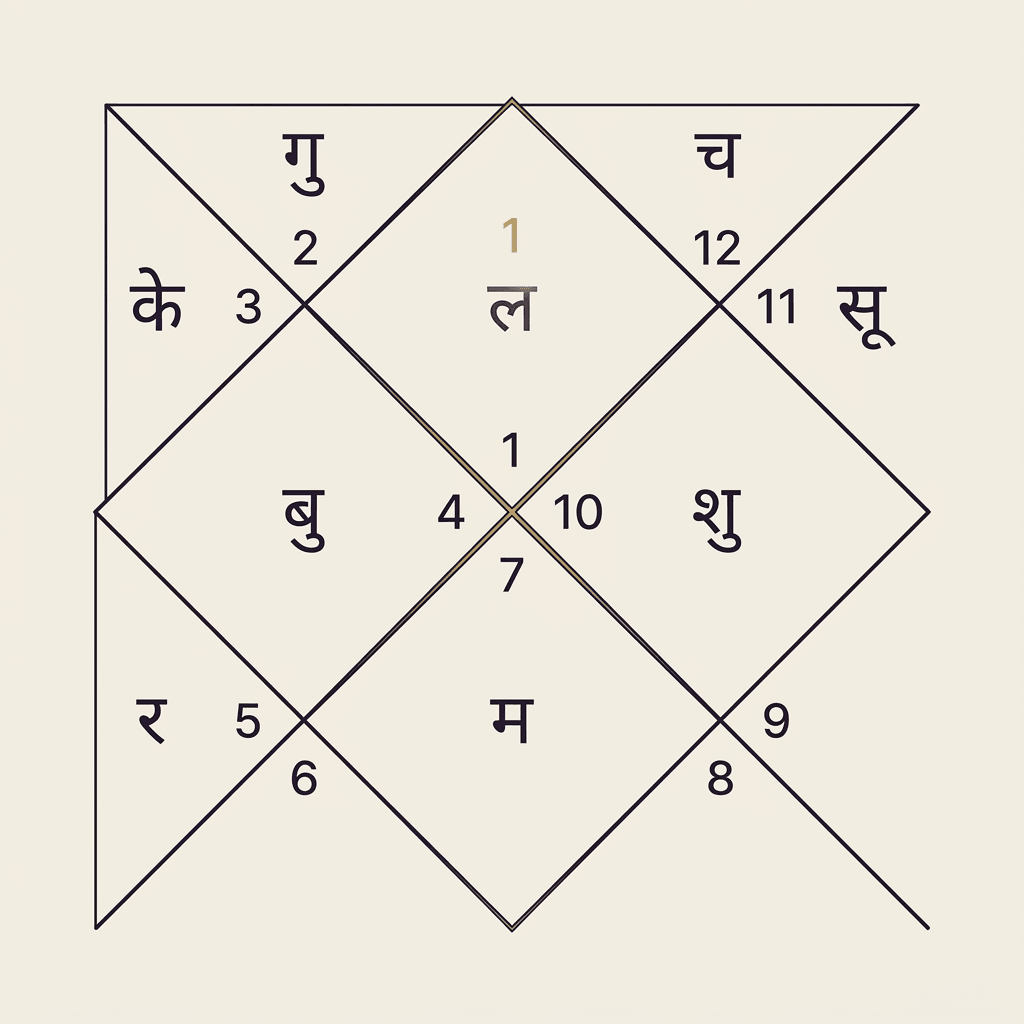
Astrolium's Vedic astrology guide covers the foundation you need to read a Jyotish birth chart: the sidereal zodiac and why it produces different signs than Western charts, how the 27 nakshatras work, and how the Vimshottari dasha system turns a static chart into a timeline. To follow along, run the Vedic birth chart calculator with your birth date, time, and place.
Vedic astrology, or Jyotish (Sanskrit for "science of light"), is India's classical astrological tradition, sharing roots with Hellenistic astrology around the 1st century BCE but developing distinct doctrines and predictive methods across two thousand years. Three features set it apart from Western practice. First, it uses the sidereal zodiac anchored to the fixed stars rather than the tropical zodiac anchored to the spring equinox, producing a roughly 24-degree gap (the Lahiri ayanamsa, adopted by the Indian Calendar Reform Committee in 1955, places Spica at exactly 180 degrees sidereal). Second, it weights the Moon sign (janma rashi) and the 27 nakshatras (lunar mansions of 13 degrees 20 minutes each) above the Sun sign. Third, it uses the Vimshottari dasha system, a 120-year cycle of nine planetary time-lord periods (Venus 20, Saturn 19, Rahu 18, Mercury 17, Jupiter 16, Moon 10, Mars 7, Ketu 7, Sun 6), as its primary predictive tool. Astrolium's Vedic birth chart calculator generates your Jyotish chart with Lahiri sidereal and current dasha periods.
What is Vedic astrology
Jyotish, the Sanskrit word often translated as "science of light," is India's classical astrological tradition. It shares roots with Hellenistic astrology from roughly the first few centuries BCE, when Greek astronomical knowledge moved east along trade routes, but developed its own doctrines, planetary weightings, and predictive methods over the following two thousand years.
Three things set Jyotish apart from Western practice at the most practical level. First, it uses the sidereal zodiac rather than the tropical one, so most people find their Sun sign shifts one sign earlier when they look at their Vedic chart for the first time. Second, it places far more weight on the Moon sign, called janma rashi, than on the Sun sign. Third, it uses the dasha system, a set of planetary time-lord periods, as its primary predictive tool rather than transits.
The result is a tradition that reads a birth chart somewhat differently at every layer. House lordship, planetary dignity, the role of the nodes (Rahu and Ketu), and the specific meaning of each planet's position all follow their own logic that cannot simply be translated from Western interpretations.
The sidereal zodiac and ayanamsa
The tropical zodiac used in Western astrology starts at 0 degrees Aries every spring equinox, regardless of where the stars actually are. The sidereal zodiac stays anchored to the fixed stars, which means it drifts backward relative to the seasons at a rate of about 50 arc-seconds per year, a phenomenon called precession of the equinoxes.
Over roughly 26,000 years, the two zodiacs complete one full rotation relative to each other. At the time Hellenistic and Vedic astrology were both being formalized, around the 1st century BCE, the two zodiacs nearly coincided. By 2026 they differ by approximately 23 degrees 50 minutes, a value called the ayanamsa. The Swiss Ephemeris, the calculation standard behind most Jyotish software, implements Lahiri and a dozen other ayanamsa definitions.
The most commonly used ayanamsa in Jyotish is the Lahiri ayanamsa, adopted officially in 1955 by the Indian government for national almanac purposes. It anchors the sidereal Virgo-Pisces axis to the star Spica, placing Spica at exactly 180 degrees sidereal longitude. Astrolium uses Lahiri as the default. Because the gap is nearly 24 degrees, anyone born with a Western Sun between roughly the 1st and 24th of any month will find their Vedic Sun in the previous sign.
Rashi and nakshatra
The 12 sidereal signs are called rashis. Each is 30 degrees wide, and they carry the same names as their Western counterparts (Mesha for Aries, Vrishabha for Taurus, and so on), though a planet's position in a rashi often differs from its Western sign by about 23 degrees.
Cutting across the rashis is a finer grid: the 27 nakshatras. Each nakshatra spans exactly 13 degrees 20 minutes of the sidereal zodiac. Nine nakshatras fill each of the three segments of 120 degrees, which maps directly onto the nine planets of the Vimshottari dasha system. Every nakshatra has a planetary lord, and that lord governs the dasha period associated with it.
The Moon's nakshatra at birth, called janma nakshatra, anchors everything. It determines your current dasha period and how far into that period you are at birth. It also carries its own quality: Ashwini (ruled by Ketu) is associated with speed and new beginnings; Rohini (ruled by Venus) with fertility and beauty; Jyeshtha (ruled by Mercury) with seniority and intensity. A planet placed in a nakshatra takes on some of its quality, sharpening or softening the planet's natural expression.
The Vimshottari dasha system
The Vimshottari dasha is the system Jyotish practitioners use most. It divides life into consecutive planetary periods totaling 120 years: Sun 6 years, Moon 10, Mars 7, Rahu 18, Jupiter 16, Saturn 19, Mercury 17, Ketu 7, and Venus 20.
Each mahadasha (major period) contains sub-periods called antardashas, and those divide further into pratyantardashas. The sequence is always the same. What changes from chart to chart is where you enter the cycle. If your Moon occupies 20 degrees of its nakshatra at birth and that nakshatra spans 13 degrees 20 minutes, you have passed roughly 75 percent through that nakshatra, so you begin life about three-quarters through the dasha of that nakshatra's lord.
In practice, a Rahu mahadasha lasting 18 years feels entirely different from a Moon mahadasha lasting 10. The dasha lord acts like a primary filter on the whole period: whatever that planet signifies in your chart, by house lordship and placement, comes to the front. A Jupiter dasha for someone with Jupiter in the 7th house, ruling the 9th, can produce a marriage, foreign travel, and a religious or philosophical shift all within the same period. The dasha system is one reason Vedic practitioners often find Western transit-based timing less precise for long-range life prediction.
How to read your Vedic chart in Astrolium
Astrolium's Vedic birth chart calculator generates your rashi (D-1) chart in Lahiri sidereal with whole-sign houses, the most common Vedic house system. It shows your janma rashi (Moon sign), your Ascendant (lagna), your current mahadasha and antardasha period, and the nakshatra placement of every planet. It is a single-shot read that saves nothing.
Inside the app, the Jyotish workspace goes further. The Kundli renders in North or South Indian style, with the D9 Navamsa, D10 Dashamsha and D12 Dwadashamsha available from the same calculation and a Compare view that follows one graha across all 4 charts, which is how vargottama stops being a claim and becomes something visible in a column. Each planet carries its nakshatra and pada, its dignity, combustion and the Graha Drishti it gives and receives, and the drishti panel states that it is always computed on the D1 rather than following the varga on screen. Named combinations appear as D1 combinations with supportive themes and challenges kept apart and a provenance label on each: classical tradition, modern interpretation, or disputed interpretation.
Timing sits on a second screen: the three-level Vimshottari sequence of mahadasha, antardasha and pratyantardasha, Gochara for a chosen date counted from the natal Moon with the from-Lagna column marked as house position only, and Sade Sati with its rising, peak and setting phases and Saturn's retrograde re-entries spelled out as dates. Charts near a dasha boundary get a warning naming how many minutes of birth-time error would change the mahadasha lord.
Be clear about the edges of that release. One ayanamsa, Lahiri. Mean nodes only. Whole-sign houses, with Bhava Chalit offered as a labelled equal-from-Ascendant column rather than a second system to read the chart in. No remedies, by decision. No kundli matching, no dosha verdict, no panchanga or muhurta inside the workspace: those live on this site as free calculators, including kundli matching, Manglik dosha and panchang today.
Start with your lagna, the Ascendant sign, which plays the same structural role as in Western charts: it defines your rising sign, your chart ruler (lagna lord), and the house framework. Then look at your janma rashi and janma nakshatra, since Vedic readings place the Moon at the center of personality description in a way Western charts do not. Finally, check your current dasha period. The planet running your dasha right now is the lens through which everything else is filtered. If you are in a Saturn mahadasha, even a strong Jupiter placement will express more quietly than usual.
The guide to how to read a natal chart covers the general chart-reading framework across all schools. This guide focuses on what is specific to Jyotish. For the Hellenistic parallels and a comparison of house systems across traditions, see the Hellenistic astrology guide. For the Jyotish annual return (the year-ahead chart cast each birthday), use the Varshaphal calculator, and for the Sade Sati window, the Sade Sati calculator. For the named Jyotish combinations practitioners scan for in any reading, see the Vedic yoga analysis tool.