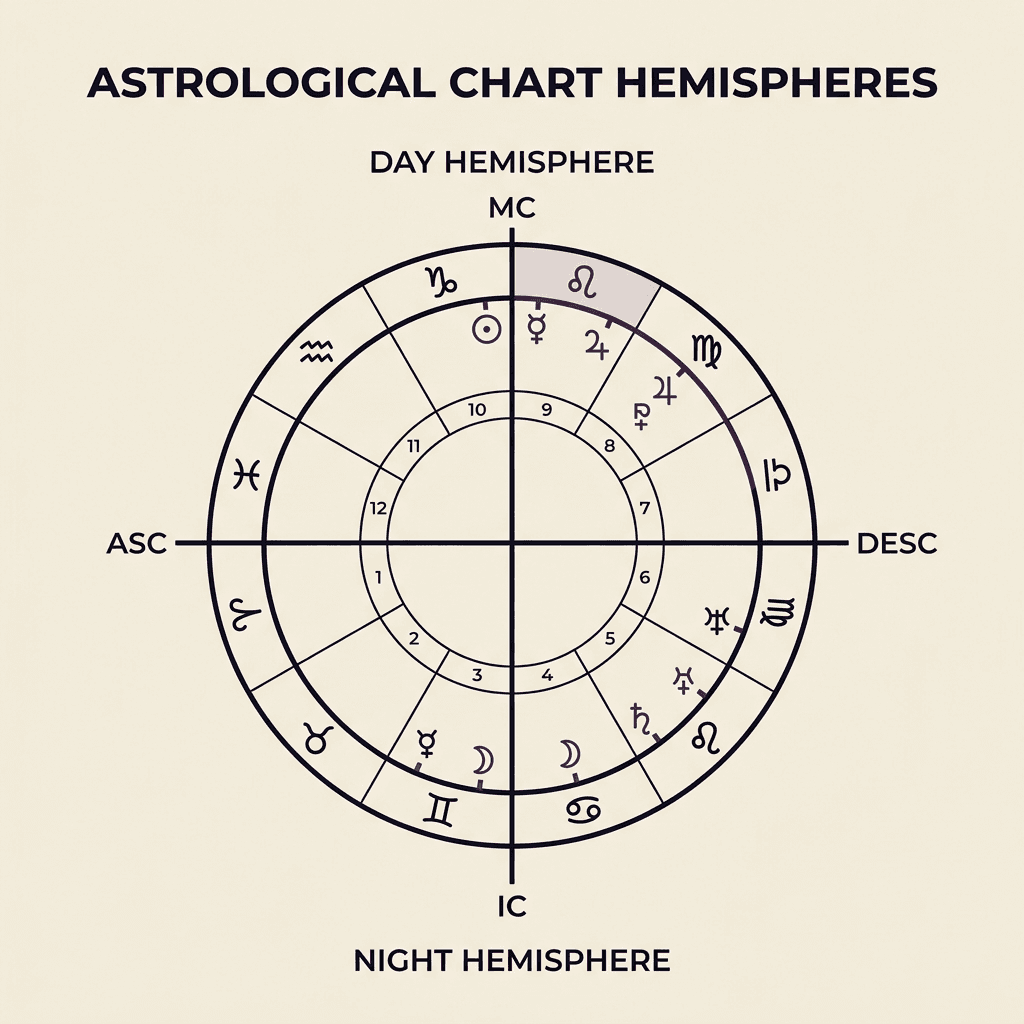
Sect is the single binary that runs beneath nearly every Hellenistic delineation technique: a chart is either diurnal (born during the day, Sun above the horizon) or nocturnal (born at night, Sun below it), and that fact changes which planets are in their preferred condition.
Sect (from the Greek hairesis, meaning "faction" or "alignment") divides the 7 classical planets into two teams: the diurnal sect (Sun, Jupiter, Saturn) and the nocturnal sect (Moon, Venus, Mars). In a day chart, the diurnal planets are said to be in sect (effectively in favor) and perform better. In a night chart, the nocturnal planets hold that position. Mercury shifts sect based on its position relative to the Sun. Hellenistic astrologers treated sect as the primary filter on planetary performance. Astrolium marks each planet's sect status automatically in every chart.
How the sect system works
The Greek word hairesis carries associations with faction and affiliation, the same root as "heresy," in the sense of a chosen allegiance. In astrological context, it describes which planetary team a planet belongs to and whether that team is currently "on duty."
The two teams:
Diurnal sect: Sun, Jupiter, Saturn. These three planets, in Hellenistic doctrine, prefer daylight conditions: the brightness, heat, and active quality of a diurnal chart.
Nocturnal sect: Moon, Venus, Mars. These prefer the cooler, moister, receptive conditions of a night chart.
Mercury: neither. Mercury takes its sect from its relationship to the Sun. When Mercury rises before the Sun and sets before it (oriental), it is counted as diurnal. When it rises after the Sun and sets after it (occidental), it is counted as nocturnal.
A chart is diurnal when the Sun is in any of the 6 houses above the horizon (houses 12 through 7, moving counterclockwise from the Ascendant). A chart is nocturnal when the Sun is in houses 6 through 1, below the horizon.
When a planet is in sect (meaning its sect matches the chart sect) it is said to be in favor. When it is out of sect, it is not. This is separate from essential dignity (rulership, exaltation, triplicity, term, face) but interacts with it. A planet can be accidentally dignified by sect and essentially debilitated by detriment at the same time, and the two factors are weighed together.
Why sect was so important to Hellenistic astrologers
Vettius Valens gave sect more weight than almost any other factor in determining whether a planet would produce its significations easily or with difficulty. The reasoning is physical: the diurnal planets (Sun, Jupiter, Saturn) are hot and dry in elemental quality; a day chart reinforces those conditions. Placing a diurnal planet in a nocturnal chart makes its natural qualities work against the chart's conditions, like putting a heat source in a cold room.
The malefics (Saturn and Mars) show this most clearly. Saturn, when out of sect (in a night chart), tends to produce its difficult significations: loss, delay, isolation, without the mitigating quality of purposefulness that an in-sect Saturn carries. Mars, out of sect (in a day chart), tends toward impulsive and poorly timed action rather than decisive, effective force.
The benefics feel sect too but in a gentler way. An in-sect Jupiter does more of what Jupiter does well; an out-of-sect Jupiter still benefits the chart but with more inconsistency or overextension.
Sect in practice
The first thing a practitioner trained in traditional methods does when looking at a new chart is check whether it is diurnal or nocturnal, and by how much. A Sun 10 degrees below the Ascendant in the 12th house is barely nocturnal; a Sun 20 degrees into the 6th house is strongly nocturnal. The degree of submersion matters.
From there, sect shapes virtually every delineation decision. Which triplicity rulers are active (the Hellenistic triplicity system assigns different rulers for day and night charts; see the guide on essential dignities)? Which planets are being read with the expectation that they will perform easily, and which with the expectation of friction? Where are the Hermetic Lots placed? The Part of Fortune formula reverses between day and night charts; so does the Lot of Spirit.
In timing work, sect also matters for profections. The annual profected Ascendant activates the planet ruling the profected sign; knowing whether that planet is in or out of sect for the natal chart gives a quick read on whether the profected year is likely to run smoothly or with effort.
One thing sect does not do: it does not override everything else. An out-of-sect malefic with strong essential dignity is still capable of good outcomes. Sect is a filter, not a verdict.
In Astrolium
The Astrolium natal chart view marks each planet's sect status (in-sect or out-of-sect) alongside essential dignity scores, giving practitioners the two most important Hellenistic performance indicators at a glance. Sect-aware formulas are applied automatically to the Part of Fortune and Lot of Spirit calculators. For the broader Hellenistic context, the Hellenistic astrology guide covers how sect interacts with triplicity rulers and house lords.