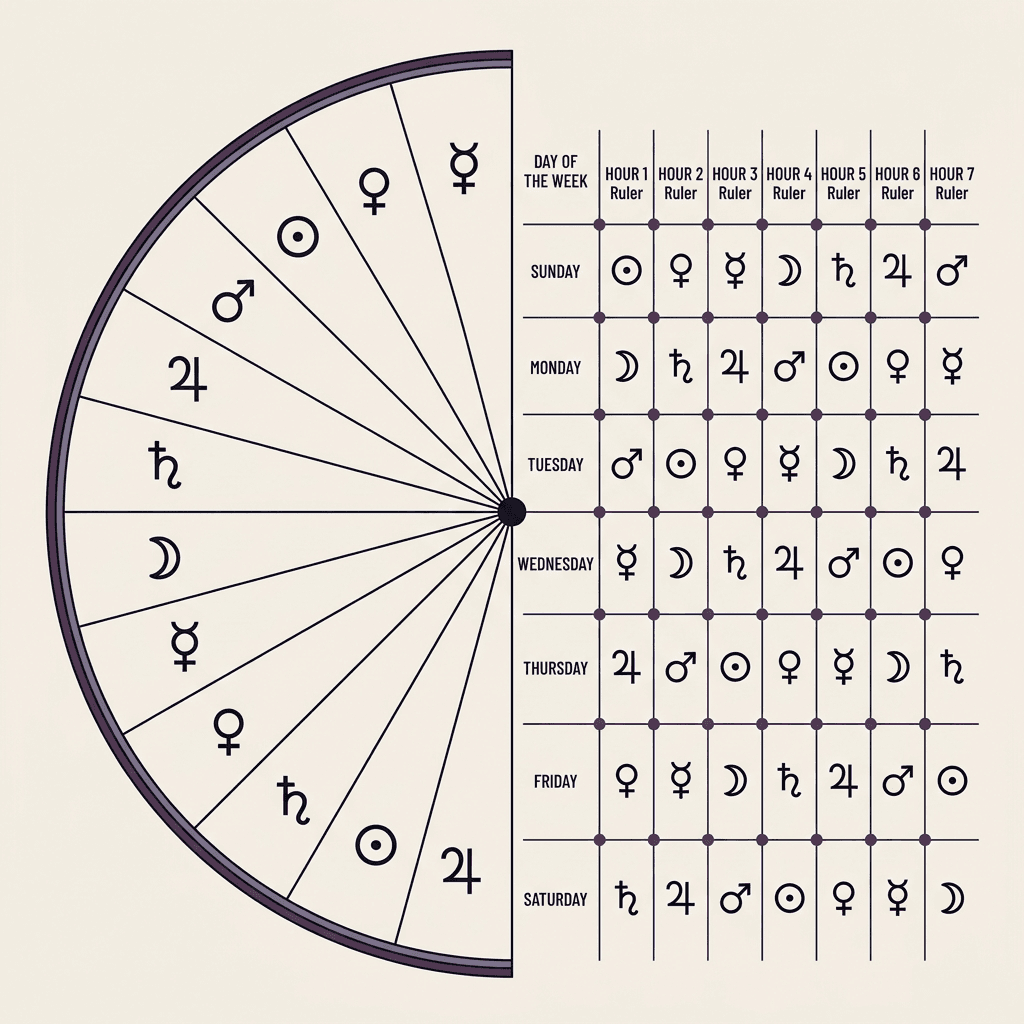
Planetary hours divide each day and night into twelve unequal sections, each governed by one of the seven classical planets in a fixed repeating sequence. The system is old enough that the seven-day week's names derive from it.
Planetary hours are an ancient timing system where each day is split into twelve day-hours (sunrise to sunset) and twelve night-hours (sunset to sunrise), with each hour assigned to one of the seven classical planets in Chaldean order: Saturn, Jupiter, Mars, Sun, Venus, Mercury, Moon. The system appears in Vettius Valens's 2nd-century Anthologies and is the basis for the modern seven-day week naming convention. Astrolium calculates current planetary hours for any location in real time.
The Chaldean order and where it comes from
Saturn, Jupiter, Mars, Sun, Venus, Mercury, Moon: this is the Chaldean order. It ranks the seven classical planets from slowest apparent motion to fastest as seen from Earth. Saturn, with its roughly 29-year orbit, moves most slowly through the zodiac. The Moon, cycling through all twelve signs in 27 days, moves fastest.
The connection to the weekday names is structural, not symbolic. Assign each hour of the day to the next planet in the Chaldean sequence, starting with Saturday's first hour at sunrise under Saturn. The 25th hour (the first hour of the next day) falls on the Sun, which is why the day after Saturday is Sunday. The 25th hour after Sunday's start falls on the Moon: Monday. Continue the count and you get Mars (Tuesday, from Tiw/Tyr, the Norse Mars-equivalent), Mercury (Wednesday/Mercredi in French), Jupiter (Thursday/Jeudi), Venus (Friday/Vendredi), then back to Saturn.
The naming divergence between English and Romance languages is because English kept the Norse planetary deity names while French, Spanish, and Italian kept the Latin planetary names directly. The underlying assignment is identical.
How to calculate a planetary hour
The day is split into two unequal halves at sunrise and sunset. The daylight span from sunrise to sunset is divided by 12 to produce twelve day-hours, each of the same fractional length. The span from sunset to the following sunrise is divided by 12 to produce twelve night-hours. At the equinoxes, both halves are approximately 60 minutes. In midsummer at higher latitudes, daytime hours can exceed 90 minutes while nighttime hours are under 30.
The first hour of the day (from sunrise) belongs to the planetary ruler of that weekday. From there, the Chaldean sequence continues without interruption through all 24 hours and across the midnight boundary into the following day. This is why knowing the day of the week is enough to reconstruct the entire hour sequence without a calculator, though a calculator is faster.
To find the current hour manually: determine the day's ruler, count forward in Chaldean order from sunrise, and check where the current time falls in the divided day.
How electional practitioners use planetary hours
Electional astrology (the practice of choosing a time to begin an action based on chart conditions) uses planetary hours as one of its primary fast-moving factors. The hour ruler adds a tonal quality to the moment that interacts with the slower factors (rising sign, Moon placement, planet aspects).
The general rules from Renaissance practice, as compiled by William Lilly and Christopher Warnock:
- Sun hour: formal presentations, dealings with authority figures, visibility-seeking actions
- Venus hour: creative work, romantic approaches, social events, artistic commitments
- Mercury hour: contracts, writing, travel bookings, negotiations, anything involving communication
- Moon hour: beginning a journey, domestic matters, agricultural timing, anything requiring public reception
- Saturn hour: real estate transactions, long-term commitments, endings and separations. Saturn hours are considered unfavorable for new starts in most applications
- Jupiter hour: financial commitments, legal filings, expansion of a business
- Mars hour: competitive actions, surgery (contested), confrontation; generally avoided for cooperative ventures
The hour works alongside the day ruler. A Venus hour on a Friday (Venus's day) is a doubly Venus-flavored moment. A Mars hour on a Venus day is mixed. The practitioner weighs these combinations against the rest of the elected chart: house ruler placement, Moon condition, and the planet ruling the matter in question.
Planetary hours are one of the few traditional timing tools that remain accessible without a full chart: a practitioner answering a client's question about when to send an email or sign a document can give a useful answer in two minutes from the current time and the weekday alone.
In Astrolium
The Astrolium planetary hours calculator computes current and upcoming planetary hours for any city, updates in real time as the day progresses, and shows the full 24-hour hour-ruler grid for any date. The electional astrology feature integrates planetary hours with chart-based timing to produce a combined election score. The horary guide covers how hour rulers interact with the chart of the moment in question charts.