Astrolium casts the horary chart the moment you understand the question, runs the 7 considerations before judgement automatically, and routes significators by house using Regiomontanus and classical rulers. The chart of the question is radical or it is not, and Astrolium tells you which in 90 seconds.
The horary workspace is live on the $29 per month Adept plan and costs one AI credit per question. For a free single-chart preview, run the horary calculator. For the full reading method (Lilly, Cornelius, Frawley), read the horary astrology guide. For the related electional work, see electional astrology and the void-of-course moon tool. For plan limits, see pricing.
What a horary chart actually is
Horary is the oldest branch of judicial astrology and the most fascinating one. There is no birth time, no client biography, no rectification. The question is the chart. The chart is the question. William Lilly's Christian Astrology (1647) remains the working manual; Geoffrey Cornelius's The Moment of Astrology (1994) is the modern philosophical defence; John Frawley's The Horary Textbook (2005) is the strictest practitioner manual on the contemporary shelf.
Three claims define the technique. One: the moment of the sincere question contains the answer. Two: the chart is radical (fit to be read) only if certain conditions hold. Three: the significators meeting by aspect within the relevant time window means yes; them missing means no.
The 7 considerations before judgement
Lilly listed them in Chapter XXVI of Christian Astrology, and Frawley refined them into the working checklist most modern horary astrologers run. Astrolium runs all 7 automatically, with the classical reasoning in a tooltip on each.
- Ascendant in the first 3 degrees of a sign. Too early. The matter is not yet manifest. Wait, ask again.
- Ascendant in the last 3 degrees of a sign. Too late. The matter has moved past judgement. Often a sign the question was already answered before it was asked.
- Moon void of course. No perfection. The Moon will form no further Ptolemaic aspects before leaving its current sign. The classical reading is "nothing comes of it." Astrolium's void-of-course tool runs the same calculation as a standalone.
- Saturn in the 1st house. Corruption of the querent's view. The reading is unstable; the astrologer is unable to see straight.
- Saturn in the 7th house. Corruption of the astrologer. The 7th is the astrologer's house in horary. Saturn there warns the astrologer is mis-reading.
- Moon in via combusta. Between 15 Libra and 15 Scorpio. The classical "burnt path." Readings drawn here tend to mislead.
- Malefic in the 7th, or lord of the 7th retrograde. Same idea. The judgement itself is corrupted.
Lilly treated these as cautions, not bars. Frawley treats them as bars. Astrolium gives you the toggle: strict (Frawley) refuses to judge a non-radical chart; permissive (Lilly) flags the issue and lets you proceed with the caution recorded.
Significator routing
Once the chart is radical, the read begins by identifying significators.
The querent is always Lord 1, the planet ruling the sign on the Ascendant. The Moon is co-significator of the querent in every horary chart, regardless of sign. The quesited depends on the question:
- 2nd house: money, movable property
- 3rd house: siblings, short journeys, communications
- 4th house: the father, real estate, the foundation
- 5th house: children, pleasure, speculation
- 6th house: health (in horary), servants, small animals
- 7th house: the partner, the open enemy, the other party
- 8th house: death, inheritance, the partner's resources
- 9th house: long journeys, the church, higher learning
- 10th house: career, the mother (in some traditions), reputation
- 11th house: friends, hopes, allies
- 12th house: hidden enemies, prison, self-undoing
Astrolium routes the significators automatically once you select the question type from a 12-option list. The human astrologer confirms or overrides; the routing is structural, the assignment is judgement.
How perfection works
Two significators perfect when they form an applying Ptolemaic aspect (conjunction, sextile, square, trine, opposition) before either leaves its current sign. Applying matters: only future aspects count. Separating aspects are past, and the past is not the question.
Astrolium scans forward 30 days from the question time and lists every perfecting aspect between the querent's significator, the quesited's significator, and the Moon. The Moon's translation of light (carrying the testimony from one significator to the other by forming aspects with each in turn) is flagged. Collection of light (a third planet receiving aspects from both significators) is flagged separately.
If no perfection appears within the relevant time window, the answer is no. If a perfection appears but with a mutual reception by sign or exaltation, the answer is yes-with-effort. If a perfection appears clean and tight, the answer is yes.
Frustration, prohibition, refranation
Three classical bars to perfection that horary depends on:
- Frustration. Significators are heading toward perfection, but one changes sign before the aspect completes. The match-up was almost there; it dissolves. The matter almost-happens and then doesn't.
- Prohibition. A third planet aspects one significator before the other can. The third party gets there first. In love horary, this is usually the romantic rival.
- Refranation. A significator turns retrograde before the aspect completes. The party changes its mind. Astrolium flags station dates on every applying aspect within the search window.
These are not metaphors. They are mechanical bars to perfection that the classical texts treat as load-bearing.
What the workspace looks like
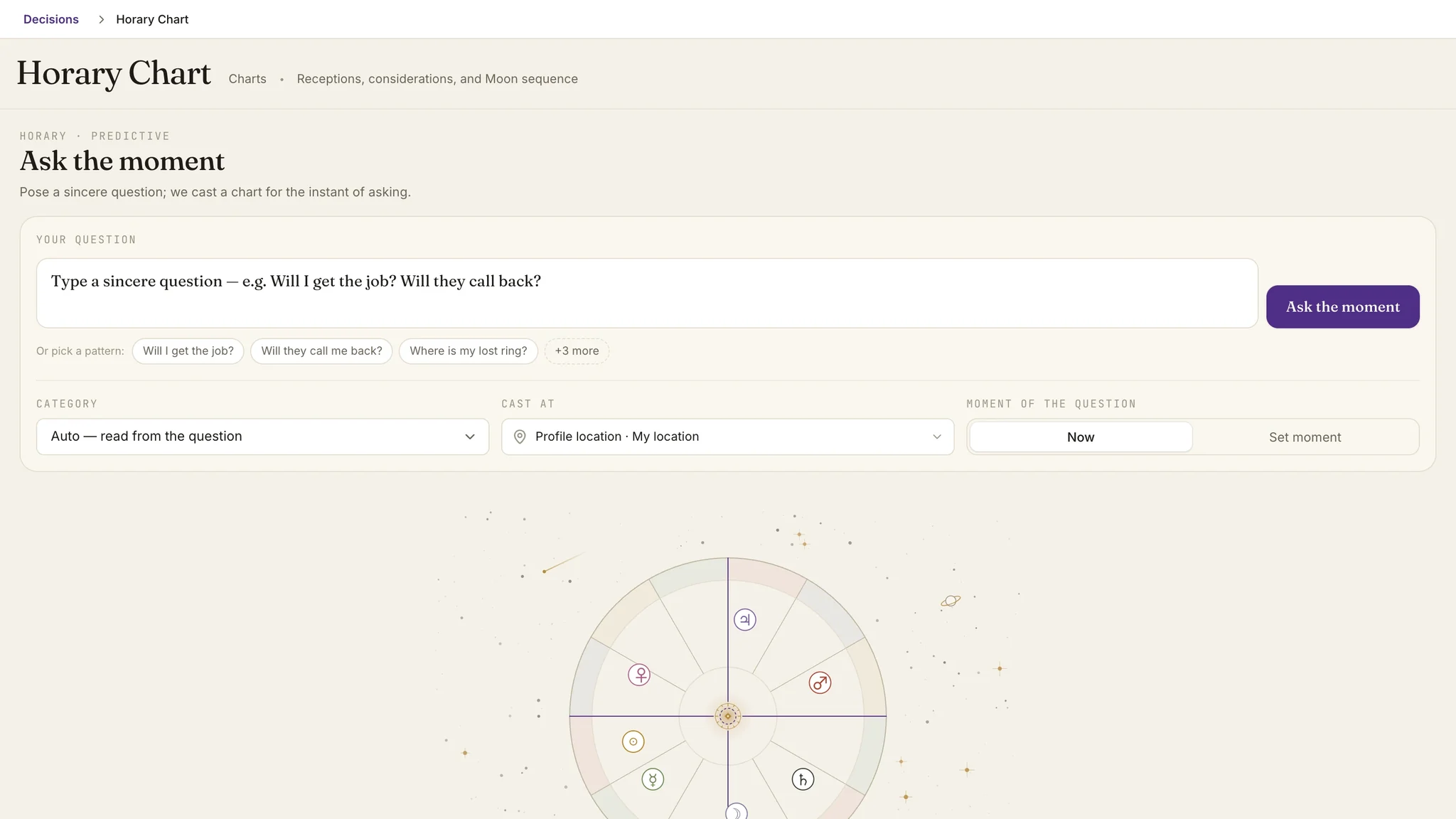
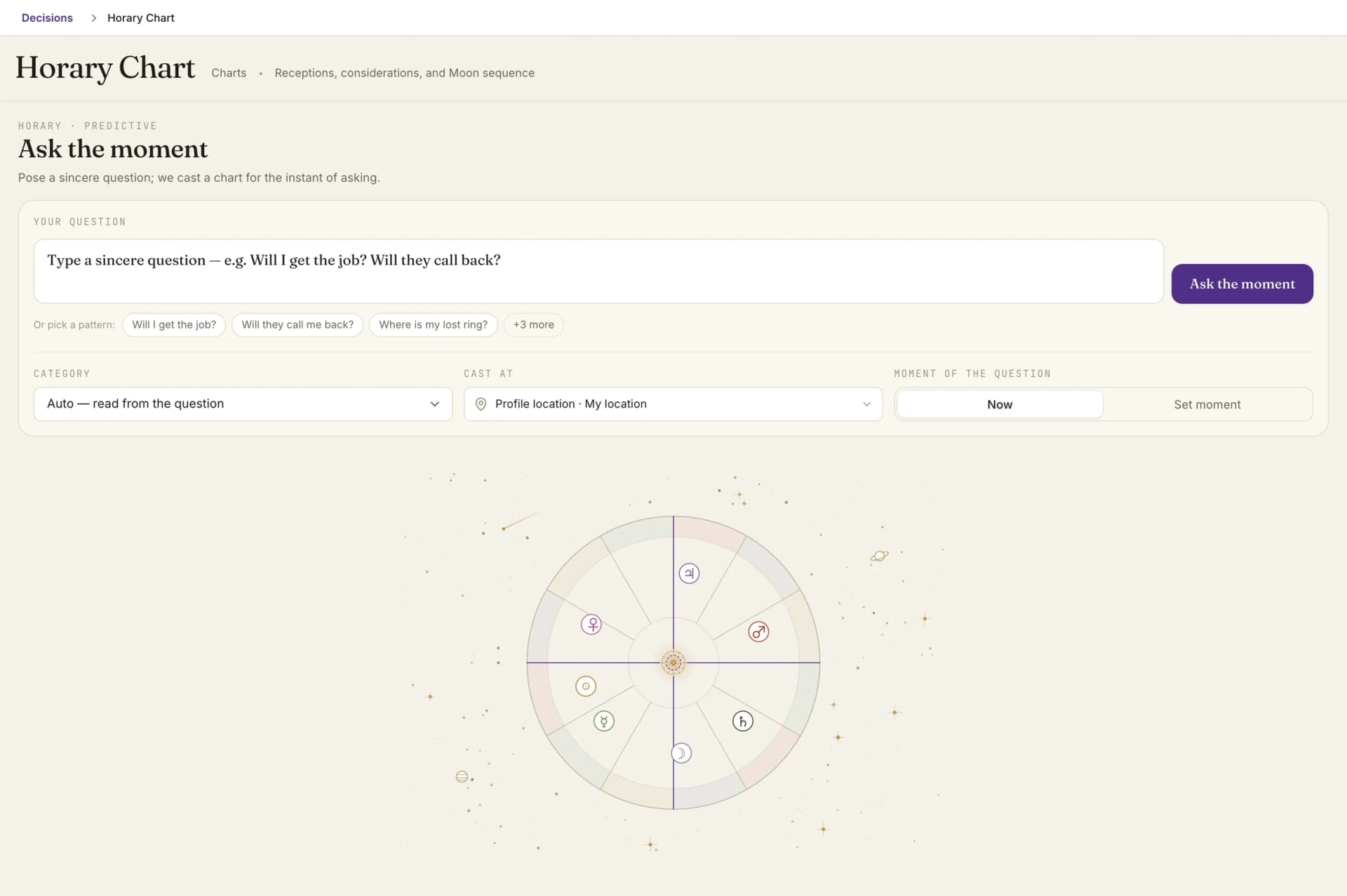
The cast screen is one question field, a set of stock patterns to start from ("Will I get the job?", "Where is my lost ring?"), the place you were asked in, and a category selector that defaults to reading the category out of the question itself. Regiomontanus is stated on screen rather than buried in settings. A note under the button says what the tradition says: cast once for a genuine question, and do not recast it.
Press the button and the wheel is drawn in a short staged animation while the chart is cast. Practitioners who have reduced motion turned on get the chart without it.
Location has its own small piece of work behind it. Where the place a question was asked in is ambiguous, Astrolium offers ranked suggestions rather than picking one silently, and a client's saved current residence is offered as one of the options alongside your own profile location.
The reading that comes back is laid out in panels. Radicality scores the considerations, marks each as present or clear with a severity, and closes with a recommendation: proceed, proceed with caution, or do not judge. Planetary hour shows the day ruler and the hour ruler and flags whether they agree with the Ascendant, the old radicality test. Significators names the querent, the quesited and the Moon as co-significator, with turned-chart houses where the question calls for one. Receptions lists essential dignity, accidental condition, and mutual or one-way reception between the two. Judgment gives the answer as likely yes, likely no, unclear, or ask again later, with a confidence band, the mechanism that produced it (translation of light, collection, prohibition, frustration), and a timing estimate that names its own basis. When the chart does not support a defensible timing, it says so instead of inventing one.
Antiscia contacts are computed and listed, with the orb stated, and the panel says plainly when there are none.
The question you asked stays beside the reading. Save files the chart into your Chart Library with its moment, place and category; Export produces a PDF.
When Astrolium declines to cast
A question that is not a horary question gets refused before the credit is spent, with the reason named.
The interface distinguishes six of them: conditional questions, questions about something already settled, two questions in one, a request for a verdict rather than an outcome, an election dressed as a horary, and a natal-scope question about a whole life period. Each refusal states why the doctrine excludes it, offers a reframing, and then admits its own limits. The conditional check keys on the word "if", which is blunter than the doctrine, and the panel says so. The value-judgment check is over-broad upstream and catches ordinary factual questions, and the panel says that too.
You are never stuck. Cast the chart anyway proceeds with the wheel, radicality, significators and perfection, and no AI verdict, keeping the moment of asking exactly as it was. Where the question really was an election, a chip opens it in electional instead.
Sky knows a horary when it sees one
Ask Sky a question in chat that reads as a horary, and it will cast the chart there rather than telling you to go and find the module. The reply comes back as a judgment card with the cast moment, the place, the answer, a confidence percentage, the key factors, and a timing line. If the chart is not radical, the card says so above the judgment. A footer states the obvious: symbolic astrology, not a probability.
Two chips follow it. Open in Horary takes the reading into the module. Refine wording re-asks with different phrasing. The card is explicit about the fact that a chat cast is not saved to your Chart Library until you open the module and cast it there.
Versus what you have now
By hand from Lilly: ~30 minutes per chart for the considerations, significator routing, and perfection search. A single arithmetic error compounds across the reading. No record of outcomes unless you keep a separate notebook.
Solar Fire or Astro Gold: Horary chart template exists but the considerations check is manual. Significators are assigned by hand from a chart whose rulerships you may or may not see at a glance. Perfection search is left to the astrologer's mental ephemeris.
Astrolium: Question-time stamp to the nearest minute, settable by hand. The considerations scored automatically with a recommendation on the end. Significators, receptions and dignities laid out. Perfection search with translation and collection of light flagged. A judgment with a confidence band and a stated timing basis. One credit, and the chart filed in your Chart Library with the question attached.
Three ways practitioners use this every week
-
The "should I take the job?" question. Querent calls. You stamp the moment, cast, find the chart radical, route Lord 1 and Lord 10 (career), and see Mercury (Lord 10) applying to Mars (Lord 1) within 4 degrees in a fixed sign. The job is real, it commits, and it lands. The conversation moves to whether the querent wants what the job is.
-
The "where are my keys?" question. A genuinely classical use case Lilly devotes pages to. The keys are signified by the planet ruling the relevant house (often the 4th for things at home, the 5th for things in a child's room). Astrolium routes the significator, you read its sign and house placement, and you tell the querent: south side of the house, near a watery thing, low to the ground. Frawley reports an 80% hit rate on this kind of question when the chart is radical.
-
The relational "will she call?" question. Saturated in the literature for good reason. The chart of the question often answers it cleanly. Querent (Lord 1) is air; quesited (Lord 7) is fire; Moon translates between them in 6 days. She calls in 6 days. You record the prediction; you record the outcome. Over 50 questions, your judgement gets calibrated.
Cross-link
For the free single-question preview, run the horary calculator. For the full reading method with Lilly, Cornelius, and Frawley, read the horary astrology guide. For the related techniques of picking a future moment, see electional astrology. For the void-of-course moon as a standalone check, see the dedicated tool. For the comparison against Solar Fire's horary template, see Solar Fire vs Astrolium.