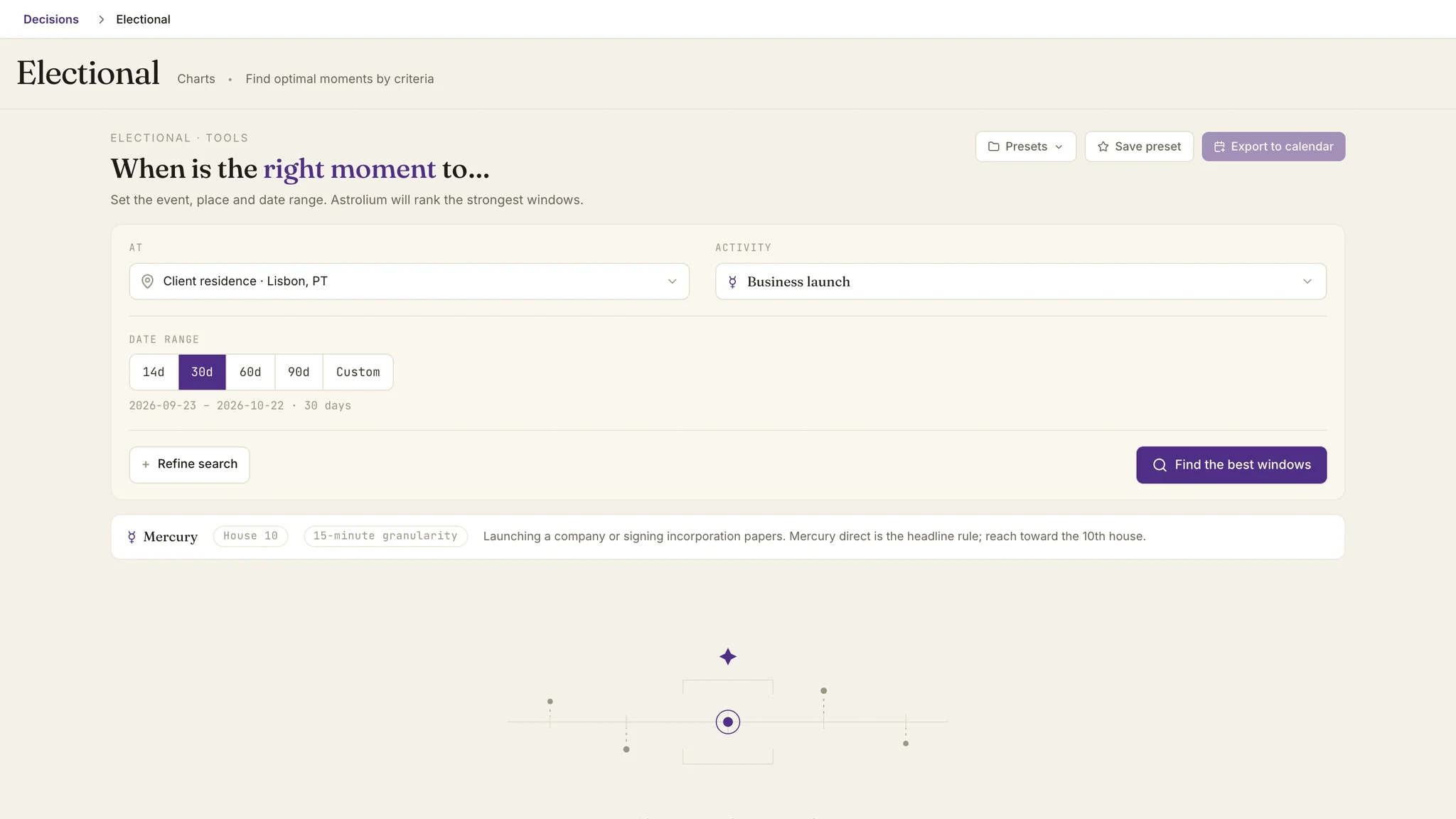
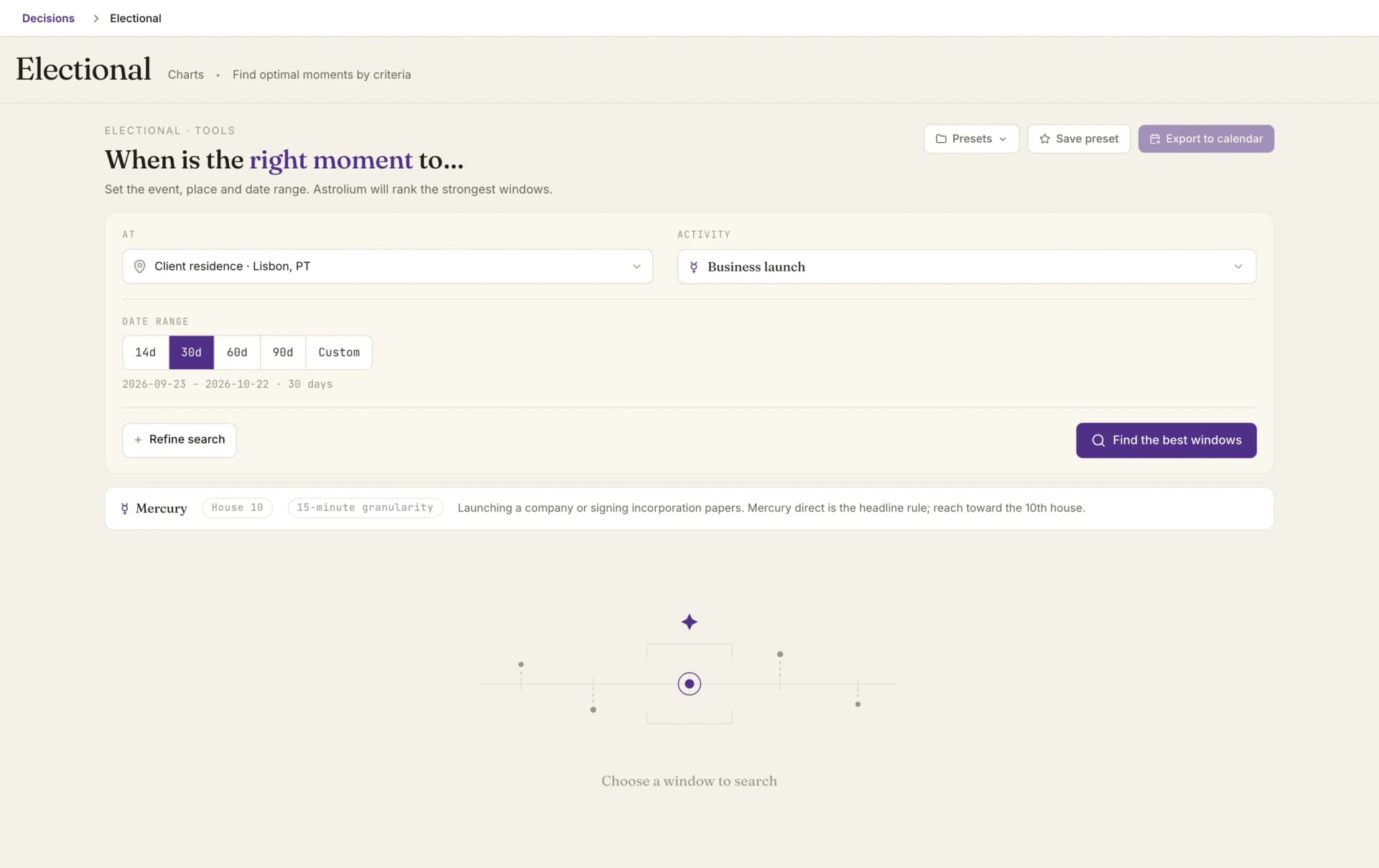
Astrolium searches up to 120 days for the moments that best fit a specific venture, ranks them by score, and shows you the rules it applied. Weddings, business launches, surgeries, contracts, exams, planting. Electional turns a target month into a defended hour. The module is live on the $29 per month Adept plan.
For the related question-chart technique, see horary astrology. For the planetary hours and void Moon engines as standalone tools, see the void-of-course Moon tool. For the underlying timing stack, see predictive timing. For plan limits, see pricing.
What electional astrology actually is
Electional is one of the four classical branches of astrology (natal, mundane, horary, electional) and the only one that actively designs the chart. The astrologer's job is to find the moment when the relevant significator is strong, the Moon is helpful, the angles are clean, and the malefics are out of the way. The chart you elect is the chart the venture will live with.
Three foundational texts. Dorotheus of Sidon's Carmen Astrologicum (1st century CE) is the earliest Greek source on electional doctrine. Lilly's Christian Astrology Book IV (1647) is the working manual most practitioners still reach for. The modern adapters (Rachel Pollack, John Frawley, Anne Massey, and the late Joanne Wickenburg) translated the classical rules for 21st-century cases, with the muhurta tradition running in parallel for Indian practitioners.
Lilly's 5 rules, expanded
These are the doctrine the module implements. Astrolium names the significator of the matter for the activity you picked, lists what the election is favouring and what it is avoiding, and scores every candidate against a rubric you can open on screen. Windows arrive graded from excellent down to poor, and a caution day or a hard stop is marked as such rather than merely scoring low.
Rule 1. Fortify the significator of the matter. Every venture has a significator. Marriage is Venus and the 7th house. A business launch reaches toward the 10th house with Mercury direct as the headline rule. Surgery is Mars (the cut) and the relevant body-part sign. Travel is the 3rd house (short) or 9th (long) and the Moon. The chosen significator must be in a good sign (its own domicile, exaltation, or triplicity), in a good house (preferably angular), and well-aspected (a sextile or trine from a benefic).
Rule 2. Strengthen the Moon. The Moon is the universal significator of the body, time, and movement. In every election it must be considered. A void-of-course Moon means the venture will move without traction, "nothing comes of it" in Lilly's phrase. The Moon should be applying to a benefic, in a good sign, and not at a critical degree (29th, 0th).
Rule 3. Avoid the malefics on the angles. Saturn or Mars on the Ascendant, IC, Descendant, or MC corrupts the foundation of the chart. A wedding chart with Saturn on the Descendant produces a marriage with Saturn on the partner. The angles are where the chart meets the world. Keep them clean.
Rule 4. Match the angles to the venture's nature. A wedding wants Venus or the Moon angular. A business launch wants Jupiter (expansion) or Mercury (contracts) angular. A surgery wants Mars angular and the Moon out of the relevant body sign. The angular planet sets the chart's voice.
Rule 5. Match the day and the hour. The Chaldean planetary hours run in order from sunrise: the day's ruler takes the first hour, then the next planet in the sequence Saturn, Jupiter, Mars, Sun, Venus, Mercury, Moon. A Venus hour on a Friday afternoon is the classical wedding window. Where the tradition names a planetary day for an activity, Astrolium puts it in the favouring list, so Friday for Venus work and Thursday for Jupiter work show up as a reason rather than as folklore.
Three working use cases
The wedding chart
The case astrologers get asked most. The bride and groom have picked a season (often "next September") and want to know the specific day and hour. Astrolium's wedding preset prioritizes Venus (sign and aspects), the 7th house (sign on the cusp, ruler placement, planets inside), and an applying lunar aspect to Venus or Jupiter.
A search across a 30-day window in September returns a ranked list with a daily-quality calendar beside it. The astrologer reviews the strongest few, picks based on the couple's birth charts (avoiding the bride's natal Saturn on the wedding 7th, for example), and the final hour is locked. The chart of the marriage lives with the couple for as long as the marriage does, which is the case for electing carefully in the first place.
The business launch
A founder wants to incorporate a company. The chart of incorporation is the chart of the business. Astrolium's launch preset prioritizes Jupiter (expansion, philosophical mission) or Mercury (contracts, communication) on the Ascendant or MC, the Moon applying to a benefic, and the 10th house's ruler in a strong condition.
Frawley's worked examples in The Real Astrology Applied are useful here: tech ventures favour Mercury launches, consumer ventures favour Venus, finance ventures favour Jupiter. The classical doctrine is not arbitrary; it tracks the venture's nature. Override the launch default to 1-hour steps for a quarter-long search and the founder usually has two or three moments they can actually hit. The astrologer picks the strongest of those.
The surgery date
Avoid the Moon in the sign ruling the body part being cut. Aries rules the head, Taurus the throat, Gemini the lungs and arms, Cancer the chest, Leo the heart, Virgo the gut, Libra the kidneys, Scorpio the reproductive organs, Sagittarius the thighs, Capricorn the knees, Aquarius the calves, Pisces the feet. The classical doctrine, repeated from Ptolemy through Lilly, is that the Moon on the body-part sign brings haemorrhage and slow healing.
Beyond the body-part rule: Mars (the cut) wants to be strong but not on an angle. The Moon should not be void. The surgery activity asks which body area before it runs, and the rule it adds is exactly the classical one: avoid the Moon in the sign that rules that part. A 14-day search at the surgery default of 5-minute steps, run around the surgeon's available dates, is the usual shape. Astrolium runs the search; the surgeon and the astrologer pick.
What the search actually does
The activity carries its own sampling resolution, because a surgery window wants minutes and a launch across a quarter does not. Weddings, contract signings and surgery are scanned in 5-minute steps; business launches and exams in 15-minute steps; travel and courtship hourly; planting and harvesting every four hours. Under Refine search you can override that to 1 hour, 4 hours or 1 day when a long range does not need the fine grid. The same panel narrows the search by hour of day and weekday, and adds requirements such as a waxing Moon, a dignified significator, or an angular placement.
The range caps at 120 days. A search usually takes about 10 to 15 seconds and says so while it runs, rather than leaving a spinner to imply something faster.
Results come back in three connected views: a ranked list of windows, a calendar of daily quality, and a timeline. Each window carries a score as a percentage, a grade, the Moon's sign and phase, the significator's condition, and the rule matches behind it. Where per-body positions are available for a window, they are shown; where they are not, the panel says so.
What the workspace looks like
The composer is one line of plain language. For a client, at a place, doing an activity. The activity picker is searchable and holds more than thirty entries across eight categories, each with its own doctrine written out: a wedding favours a dignified Venus on an angle and a Moon applying to a benefic; contract signing wants a clean direct Mercury; a property transaction wants Saturn sound and unafflicted in the fourth. Surgery asks for a body area, travel asks for a scope.
Set the date range, refine the hours and weekdays if the client has constraints, and search. A Rules in play panel states the significator, its category and house, and the two lists: favouring and avoiding.
The results carry an Excluded periods section of their own. A void-of-course Moon, Mercury retrograde, an eclipse window, Venus or Mars retrograde, each with a plain-language reason and a severity from low up to a hard stop. Practitioners who elect against the bad moments first work from that list rather than from the ranking.
From a window you can open the moment in the transits biwheel, download it as a calendar file, or copy a summary to the clipboard. Elected windows can be exported together as a calendar file for the whole search. Save the configured search as a preset and it loads for the next client, with that client's natal overlay applied on load.
Versus what you have now
By hand from Lilly: ~75 minutes per election for a 7-day window, mental scan only. Longer windows are typically not scanned. Mistakes in planetary hour computation are common.
Solar Fire or Astro Gold: Cast a chart for a date you guess; visually inspect; iterate. No search function. Planetary hours are correct when the software displays them but require manual cross-referencing for each candidate.
Astrolium: A window of up to 120 days at the resolution the activity sets, from 5-minute steps to 4-hour steps, with an override to 1 hour, 4 hours or 1 day. More than thirty activities with their own rules. Windows ranked and graded, with the rubric visible. Excluded periods listed separately with a severity on each. One click into the biwheel, a calendar file, or a copied summary. The search saves as a preset and re-runs for the next client.
Cross-link
For the method behind the rules, read the electional astrology guide. For the related question-chart technique, read horary astrology and the horary guide. For the void-of-course Moon as a standalone check, see the dedicated tool. For the planetary hours engine on its own, see planetary hours. For the comparison against Solar Fire's electional template, see Solar Fire vs Astrolium.