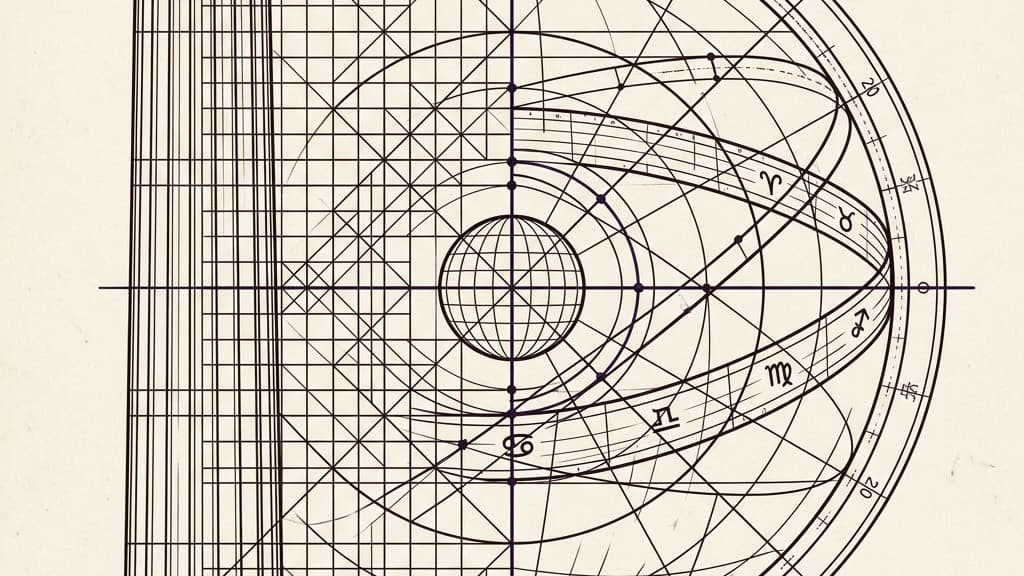
Astrolium's arabic parts guide covers the lots (sensitive points in a chart computed from the positions of 2 planets and an anchor) that gave hellenistic and medieval astrology much of its predictive resolution. Fortune, Spirit, Eros, Necessity, Courage, Victory, Nemesis: the 7 hermetic lots, the formulas that flip by sect, and how to read them in a working chart.
For instant computation, run the part of fortune calculator or the lot of spirit calculator. Both render in under 300 ms across 23 house systems. For the broader doctrinal context, see the hellenistic astrology guide. For the $29 per month Adept plan with all 7 hermetic lots pre-computed on every client chart, see pricing.
What are arabic parts
Arabic parts (called lots in the original Greek tradition) are sensitive points in an astrological chart computed by adding the positions of 2 planets and subtracting a third, usually the Ascendant. There are dozens of named lots. The Lot of Fortune is the most famous; the 7 hermetic lots (Fortune, Spirit, Eros, Necessity, Courage, Victory, Nemesis) form the standard working set. Each lot is computed sect-aware: the day formula and the night formula reverse the order of the two planet terms, so a chart with Sun above the horizon and one with Sun below produce different positions for the same lot. The point lands on a sign and a house and reads like any chart factor. Lots add resolution on questions the planets do not directly answer: natal Venus speaks to love in the abstract; the Lot of Eros speaks to lived erotic experience. Astrolium computes the 7 hermetic lots plus the Bonatti 97 free.
The mechanism is straightforward arithmetic on chart positions. Given any 3 points in a chart (typically 2 planets and the Ascendant), a lot is derived by adding the first 2 and subtracting the third, modulo 360 degrees. The resulting position lands somewhere on the zodiac and can be read like any other chart point: by sign, by house, by aspects to natal planets, by transits over the course of life.
What lots add to the natal chart is resolution on questions the planets do not directly answer. Natal Venus tells you something about love in the abstract. The Lot of Eros tells you something about the lived experience of erotic desire in this specific life. They are not redundant. A chart can have a beautifully placed natal Venus and a difficult Lot of Eros, and the reading splits accordingly.
Why two names: lots and parts
The technique is Greek in origin. The technical term in the hellenistic sources is kleros (κλῆρος), plural kleroi: "lot" or "allotment," in the same sense as a lot drawn at a lottery, the share that falls to you. Paulus Alexandrinus in the 4th century CE gives the first surviving systematic catalogue of the major lots in his Introduction.
When hellenistic astrology passed into Arabic during the 8th-12th centuries (through translators in Baghdad, the bayt al-hikma or House of Wisdom, and the Persian astrologers who synthesized it), the Greek kleros was rendered as juz' (plural ajza'), meaning "part" or "share." Latin translators in 12th-century Spain rendered this as pars, plural partes. English "part" comes from the Latin.
So "lot of fortune" and "part of fortune" are the same point. The naming distinction is roughly chronological: lots for the Greek-language hellenistic era (1st century BCE to 7th century CE), parts for the Arabic and Latin medieval continuation (8th to 17th century). Modern astrology mostly inherited the medieval Arabic naming because the Latin translations of Abu Ma'shar and others were what Renaissance Europe read.
For consistency with the hellenistic revival literature, we use lot throughout this guide. When citing medieval Arabic sources we use part. They are interchangeable.
How a lot is calculated
The general formula:
Lot = Anchor + Planet A − Planet B (mod 360°)
The 3 inputs are 3 ecliptic longitudes (positions on the zodiac measured 0° to 360° starting from 0° Aries). The anchor is almost always the Ascendant. Planets A and B vary by lot.
A worked example. Suppose your chart has:
- Ascendant at 15° Leo = 135°
- Sun at 8° Capricorn = 278°
- Moon at 23° Aries = 23°
For the Lot of Fortune in a day chart (Sun above the horizon), the formula is Ascendant + Moon − Sun:
Fortune = 135° + 23° − 278° = −120° → −120° + 360° = 240° = 0° Sagittarius
The lot lands at 0° Sagittarius. From here, normal chart-reading procedure: which house holds it (the 5th, counting whole-sign from Leo), what aspects does it make to natal planets, which sign rules it (Jupiter rules Sagittarius, so Jupiter becomes the lord of Fortune and its placement matters significantly).
If the same chart were a night chart (Sun below the horizon), the formula would reverse to Ascendant + Sun − Moon:
Fortune (night) = 135° + 278° − 23° = 390° → 390° − 360° = 30° = 0° Taurus
Same chart positions, opposite sect, Fortune lands 180° away. The sect-sensitivity is not a small detail. Half of online calculators use the day formula on every chart, which silently puts Fortune in the wrong sign for every night chart they touch. Astrolium computes sect automatically and applies the correct formula.
Sect: the formulas that flip
Sect is the diurnal-nocturnal split: a chart is diurnal if the Sun was above the horizon at birth (between the Ascendant and the Descendant going through the Midheaven), nocturnal if below.
The general rule for sect-sensitive lots: in a day chart, you add the luminary or planet associated with day-team significations and subtract the one associated with night-team. In a night chart, the order reverses. The 7 hermetic lots are all sect-sensitive in this way.
For the Lot of Fortune, the underlying logic: Fortune is about the body and the contingent material life. In a day chart, the Moon (lunar, embodied, receptive) is added and the Sun (solar, active) subtracted, putting the lot in a Moon-flavored relationship to the chart. In a night chart, the situation reverses; the Sun, which is "out of sect" at night, takes the receiving role.
For Spirit, the opposite: Spirit is about action and choice. In a day chart, Ascendant + Sun − Moon; in a night chart, Ascendant + Moon − Sun. Spirit and Fortune are exact mirrors of each other, which is why they sit at supplementary distances from the Ascendant on opposite sides of the chart. The geometry is built into the doctrine.
Once you know whether the chart is diurnal or nocturnal, the formula for every hermetic lot is determined. The other 5 hermetic lots derive from Spirit or Fortune and inherit their sect-sensitivity by the same mechanism.
The 7 hermetic lots: formulas and meanings
The standard set, as catalogued by Paulus Alexandrinus and used in the modern revival:
Lot of Fortune (⊗)
The body, sustenance, what happens to the native regardless of choice. The contingent, material side of life. Money in the sense of accumulated resources, not earned income. The vehicle in which the soul is carried.
- Day: Ascendant + Moon − Sun
- Night: Ascendant + Sun − Moon
By far the most-used lot in working practice. Its house placement is the chart's primary indicator for general fortune; its sign ruler (the Lord of Fortune) is one of the most important planets in the chart for any question about livelihood. Run the part of fortune calculator to compute Fortune in 30 seconds.
Lot of Spirit (sometimes Σ or ⊙ in modern notation)
Action, career, what the native chooses. The vocational compass. Where the soul directs effort.
- Day: Ascendant + Sun − Moon
- Night: Ascendant + Moon − Sun
Spirit is the input to zodiacal releasing for vocational timing. Reading Spirit's placement and its lord answers questions about career direction that natal Mercury, Mars, Saturn, or the 10th house alone do not fully answer. Run the lot of spirit calculator to compute Spirit with the correct sect formula.
Lot of Eros
Erotic love and desire. Whom the native is drawn to and what kind of intimacy the life supplies.
- Day: Ascendant + Venus − Spirit
- Night: Ascendant + Spirit − Venus
Note the sect-sensitivity is built around Spirit, not directly around Venus. Eros sits in a derived relationship to Spirit: love as something Spirit chooses or is chosen by. The classical sources are not coy about Eros; Paulus treats it as a standard chart point, not a specialized indicator.
Lot of Necessity
Constraint, what cannot be avoided, the limits of the life. The "fate" component in the older non-fatalistic sense: the structural givens.
- Day: Ascendant + Fortune − Mercury
- Night: Ascendant + Mercury − Fortune
Necessity reads what the native must contend with whether or not they choose to. Read alongside Fortune, it sharpens the picture of the material life: Fortune tells you the field, Necessity tells you the immovable features within it.
Lot of Courage
Boldness, military matters, the willingness to take risk. Often involved in charts of athletes, soldiers, and entrepreneurs.
- Day: Ascendant + Fortune − Mars
- Night: Ascendant + Mars − Fortune
Courage in the classical sources is not psychological courage but operational nerve: the capacity to act in the face of risk. The lord of Courage and its aspects describe what kinds of risks the native is structurally able to take.
Lot of Victory
Success, recognition, completion of effort. The reward, when there is one.
- Day: Ascendant + Jupiter − Spirit
- Night: Ascendant + Spirit − Jupiter
Victory derived from Spirit and Jupiter reads as: where Spirit's chosen direction meets Jupiter's blessing. A strong Lot of Victory in an angular house suggests recognition will arrive for the work, not just the work itself.
Lot of Nemesis
Undoing, hidden enemies, the failure mode of the life. The structural antagonist.
- Day: Ascendant + Fortune − Saturn
- Night: Ascendant + Saturn − Fortune
The hardest lot to read because it touches on what the chart resists examining. Nemesis read carelessly produces fatalistic interpretations; read carefully, it locates the recurring obstacle the native will need to address rather than route around.
Reading a lot in a chart
A lot, once calculated, is read like any chart point. The standard procedure:
- Locate the lot by sign and degree. Identify the sign and degree the lot occupies. The lot can fall anywhere from 0° to 30° of any of the 12 signs.
- Identify the house the lot occupies. Use whole-sign houses for traditional work. The house the lot occupies adds topical context. Fortune in the 10th reads differently from Fortune in the 4th.
- Identify the lord of the lot. The planet ruling the sign the lot occupies is the lord of that lot. The lord's placement and aspects are nearly as important as the lot's.
- Note aspects to the lot from natal planets. Conjunctions, sextiles, squares, trines, and oppositions from natal planets activate the lot. Apply sign-based aspect rules.
- Track transits to the lot. Hard transits (Saturn, Mars, the outer planets) to the lot or to the lord describe key activations across life. The lot is a transit target, not just a static point.
- Cross-reference with profections and zodiacal releasing. When the year-lord is the lord of an active lot, that lot's themes foreground for the year. When the L1 ruler in zodiacal releasing aspects the lot, the lot's themes shape the era.
The procedure scales to all 7 hermetic lots. For working practice, most astrologers compute Fortune and Spirit on every chart and add the other 5 when the question requires them: Eros for relationship questions, Courage for risk questions, Nemesis for the recurring-trouble questions clients often phrase as "why does this keep happening."
Lots in zodiacal releasing
The most consequential use of the lots in modern hellenistic practice is as the starting point for zodiacal releasing. The technique releases nested time periods from a lot, producing a timeline of eras (L1, 8-30 years), chapters (L2, months to years), seasons (L3), and weeks (L4).
ZR is almost always run from Spirit or Fortune:
- Spirit ribbon: career, action, public expression. Read for vocational timing.
- Fortune ribbon: body, material life, what happens. Read for body events, finances, circumstance.
The 2 ribbons run independently. A peak Spirit period can fall during a quiet Fortune period (the year the book is finished but does not sell yet); a peak Fortune period can fall during a quiet Spirit era (the inheritance during the retreat year). Astrolium displays both ribbons side by side in the predictive timing feature so you can switch contexts in 1 click.
ZR can also be run from the other hermetic lots. Brennan and George document releasing from Eros for relationship-life timing, from Courage for risk-taking patterns, and from Necessity for the structural constraints across life. These are specialty applications; standard practice releases from Spirit and Fortune.
The other lots
Beyond the 7 hermetic lots, the medieval Arabic tradition catalogued hundreds of additional parts for specific questions: Part of Marriage, Part of Children, Part of Death, Part of Travel, Part of Brothers, Part of Religion, Part of Slaves, and so on. Al-Biruni's Book of Instruction catalogues over 100 parts in detail; Bonatti and other Latin authors expanded the list further.
How useful these additional parts are depends on the school. The hellenistic revival has been cautious about most of them. The 7 hermetic lots have strong textual support in Paulus, Valens, and other Greek sources, while many of the later medieval parts appear to have been derived later, sometimes by mechanical analogy rather than from a coherent doctrine.
Working practice today: the 7 hermetic lots are universally accepted. Beyond those, the Part of Marriage (for marriage questions) and the Part of Children (for fertility) see common use because the topics are common. The rest are mostly specialty applications.
Astrolium computes the 7 hermetic lots in the free tools and exposes the full catalogue of 50+ named parts in the $29 per month Adept tier, with sect-aware formulas for every sect-sensitive part. All 7 lots recompute across 75 years of timeline in under 300 ms.
Two worked examples
Example 1: a Lot of Fortune that re-frames a chart
A native with the Sun and Mercury both in Capricorn in the 6th house, square Saturn in Aries in the 9th. Conventional reading: hard worker, possible health stress in routine, religious or academic frustration. Saturn-square-Sun says the life will demand structural effort and not always reward it.
Now add Fortune. Day chart, Ascendant in Leo at 12°, Sun at 18° Capricorn, Moon at 26° Pisces.
Fortune = 132° + 356° − 288° = 200° = 20° Libra
Fortune at 20° Libra falls in the 3rd house, ruled by Venus. Venus in this chart is in Aquarius, trine the Ascendant ruler the Sun in Sagittarius, and aspected favorably by Jupiter. The reading shifts: the native's contingent material life is supported by communication, writing, and short travel (3rd house signification), with Venus's lordship of Fortune giving an overall favorable signal that the Sun-Saturn square alone does not capture.
The original reading is not wrong. Adding Fortune adds a layer the Sun-Saturn pattern hid.
Example 2: a Lot of Eros that resolves a Venus paradox
A native with Venus in Pisces in the 5th house, conjunct Jupiter, trine Moon. Conventional reading: warm, romantic, abundant capacity for love. And yet the native reports recurring difficulty finding partners; the textbook Venus does not match the lived experience.
Compute Eros. Day chart, Ascendant in Scorpio 0°, Spirit at 22° Libra, Venus at 14° Pisces.
Eros (day) = 210° + 344° − 202° = 352° = 22° Pisces
Eros at 22° Pisces falls in the 5th (same house as Venus, encouraging) but conjunct Neptune (if read with moderns) or in the bound of Mars (in the classical bound system), and square the Lot of Fortune in Gemini.
The square from Eros to Fortune is the missing piece. Eros's themes (what the native desires erotically) are at odds with Fortune's themes (the conditions of the material life). The native may desire what circumstance does not supply, or vice versa. Reading Venus alone misses the conflict. Reading Eros against Fortune locates it.
Common mistakes
- Using the day formula on every chart. The 7 hermetic lots are sect-sensitive. Half of charts are nocturnal. Running the day formula on a night chart puts Fortune in the wrong sign. Astrolium auto-detects sect and applies the correct formula.
- Treating the lot like the planet. Fortune is not the Moon. Spirit is not the Sun. The lots are derived points with their own significations. The lord of the lot ties the lot back to the natal planets, but the lot itself reads independently.
- Ignoring the lord. The lord of a lot is often more important than the lot itself. A weakly placed Fortune in a strong sign whose lord is exalted in the 10th tells a different story from a strongly placed Fortune whose lord is in detriment in the 12th.
- Computing parts for every topic. The 7 hermetic lots have doctrinal weight. The 100+ medieval parts mostly do not. Adding 30 parts to a reading produces noise, not signal.
- Skipping aspects to the lot. A lot tightly aspected by Saturn or Jupiter natally reads very differently from an unaspected lot. Treat aspects to lots as you would aspects to planets.
- Forgetting transits to the lot. Saturn crossing a natal lot is an event. Most working software does not track transits to lots. Astrolium does; see predictive timing.
What to read next
For the doctrinal context in which lots sit, read the hellenistic astrology guide. For the predictive technique that releases from Fortune and Spirit, read the zodiacal releasing guide. For the year-by-year time-lord technique, see profections. For Saturn returns, which transit lots as well as natal planets, see the saturn return guide.
For instant computation, run the part of fortune calculator and the lot of spirit calculator. Both ship with sect-aware formulas, no signup. For the full 7-lot panel pre-computed for every client chart on your roster, see the $29 per month Adept plan inside predictive timing.