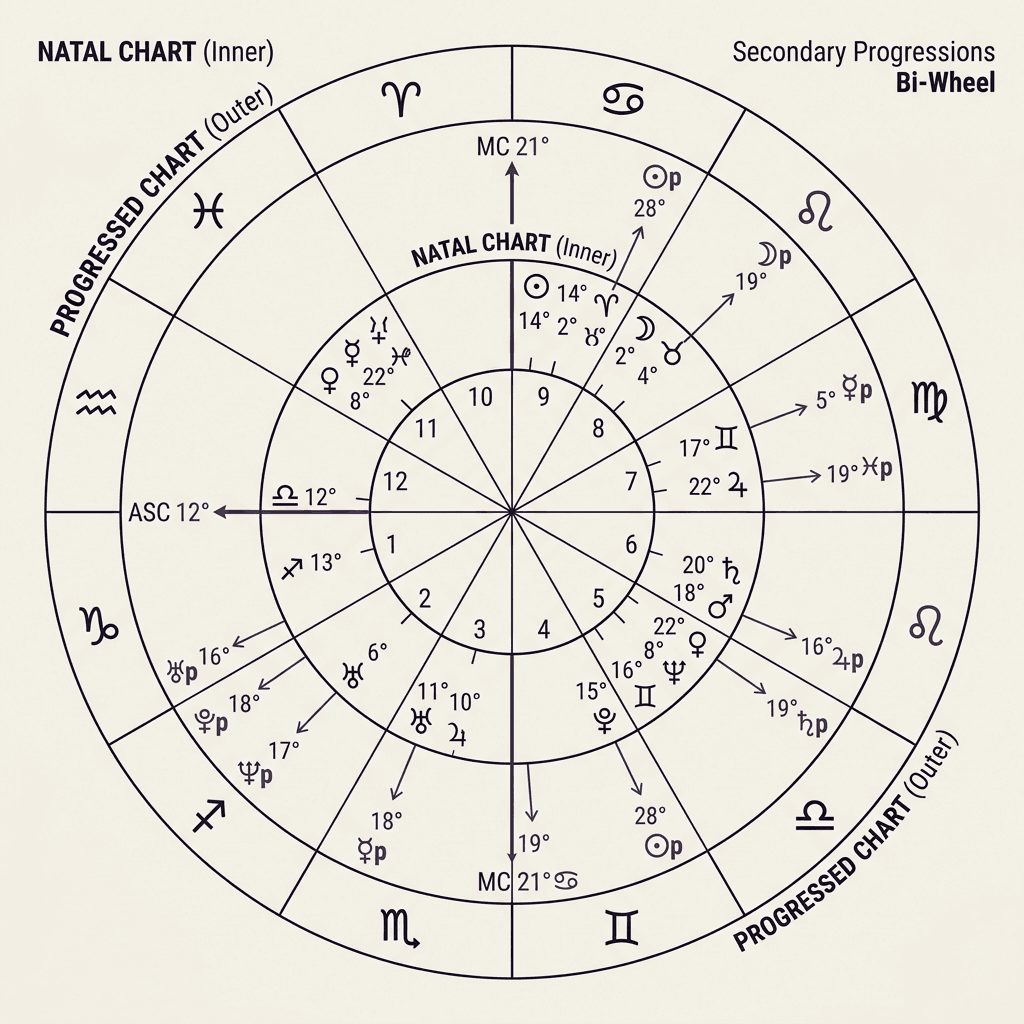
A progressed chart shifts the natal chart forward in time by equating each day after birth with one year of life, tracking how the chart's symbols evolve as a person grows.
A progressed chart is built from secondary progressions: the birth chart's planetary positions are advanced one day in the ephemeris for each year of life. Someone born on April 2, 1990 who is 35 years old has a progressed chart drawn from April 37, 1990 (that is, planetary positions from May 7, 1990). The Sun moves roughly 1 degree per year; the Moon moves through all 12 signs in about 27 years. Astrolium calculates secondary progressions and solar arc directions together so you can compare both methods in one view.
Origin and history
The day-for-a-year principle is old. Ptolemy described it in Tetrabiblos as one basis for directing the chart forward through time. The specific technique called secondary progressions (using actual ephemeris positions rather than symbolic arithmetic) became the dominant form in modern Western astrology during the 20th century, when Dane Rudhyar and other humanistic astrologers emphasized its value for tracking inner psychological development.
Secondary progressions are distinct from primary directions, which are based on the Earth's rotation in the hours after birth (one degree of Right Ascension per year of life), and from solar arc directions, which move every natal planet forward by the same number of degrees the progressed Sun has traveled from its natal position. All three methods use the day-for-a-year equivalence in different ways.
The method is called "secondary" because in the traditional hierarchy, primary directions came first. But in modern practice the terms have flipped: secondary progressions are now the more commonly used system. Many practitioners run both secondary progressions and solar arc directions together, using one as a check on the other.
The technique sits within the broader predictive toolkit alongside zodiacal releasing, transits, and profections. Each method operates on a different time scale and emphasizes different chart factors.
How it works
The calculation is straightforward. Take the date, time, and place of birth. Count forward one day in the ephemeris for each year of life. The resulting planetary positions for that progressed date are the progressed planets.
For someone aged 40, you look at the ephemeris 40 days after the birth date and pull those planetary positions. Those become the progressed chart. It is then read against the natal chart. The two charts are usually displayed as a bi-wheel, with natal planets on the inner ring and progressed planets on the outer.
The progressed Sun moves about 1 degree per year. It takes 30 years to travel through one sign. If someone was born with the Sun at 15 degrees Aries, their progressed Sun reaches Taurus around age 15 and Gemini around age 45. These progressed Sun sign changes are considered significant shifts in life focus.
The progressed Moon moves much faster: about 12-13 degrees per year, completing a full cycle through all 12 signs in roughly 27-28 years. Each progressed Moon sign lasts about 2.5 years. Practitioners track the progressed Moon as a timer within the slower progressed backdrop.
Mercury, Venus, and Mars can also produce meaningful progressions. In a 90-year life, Mars will travel at most 90 days of ephemeris time, which is rarely more than a few signs from its natal position. Mercury and Venus stay close to the Sun by nature, so their progressions are limited in range but can change their relationship to the Sun. Mercury turning direct or retrograde by progression is considered a significant shift in how the person thinks and communicates.
The progressed Ascendant and Midheaven advance as well, based on the progressed chart's calculation. These angles change more rapidly than the progressed outer planets and can shift house cusps over a lifetime.
Solar arc directions differ from secondary progressions in one key way: every planet and angle in the chart moves forward by the same number of degrees as the progressed Sun. This keeps all the chart's internal relationships intact while advancing the whole chart uniformly. Solar arcs tend to produce sharp event timing because they move at a steady 1 degree per year regardless of a planet's actual speed.
How practitioners use it
Secondary progressions are read for long-term inner development. The progressed Moon is the primary timer: practitioners track which natal house it currently occupies and what natal planets it is aspecting. A progressed Moon conjunct natal Venus reads differently from one conjunct natal Saturn, but both mark a period of heightened focus on that planet's themes for the 2-3 months around the exact contact.
Progressed Sun sign changes are among the most discussed events in popular progressions work. When the progressed Sun enters a new sign, many practitioners describe a shift in the client's conscious orientation and self-expression. This is not a sudden event; the change is felt gradually over the years on either side of the exact ingress.
Practitioners watch for planets changing direction by progression. A natal retrograde Mercury turning direct by progression is often described as a point where communication and thought become more externally oriented. A natal direct Venus turning retrograde by progression can coincide with a period of re-evaluation in relationships or values.
In client work, progressions are usually read alongside transits. Transits show external events and timing; progressions track the internal arc. A transiting Saturn square natal Sun carries different weight depending on whether the progressed Sun is also under stress or in a flowing configuration.
The secondary progressions guide covers house-by-house interpretation of the progressed Moon and tracks major progressed Sun sign changes for any birth chart.
In Astrolium
The Astrolium progressed chart calculator generates a progressed bi-wheel for any date, placing progressed planets in the outer ring against the natal chart. The progressions feature adds solar arc directions in a second layer, so you can view secondary progressions and solar arcs side by side. Both methods share the same timeline slider, letting you step through years one at a time and watch the progressed planets move. The predictive timing feature integrates progressions with transits and zodiacal releasing periods in a single display.