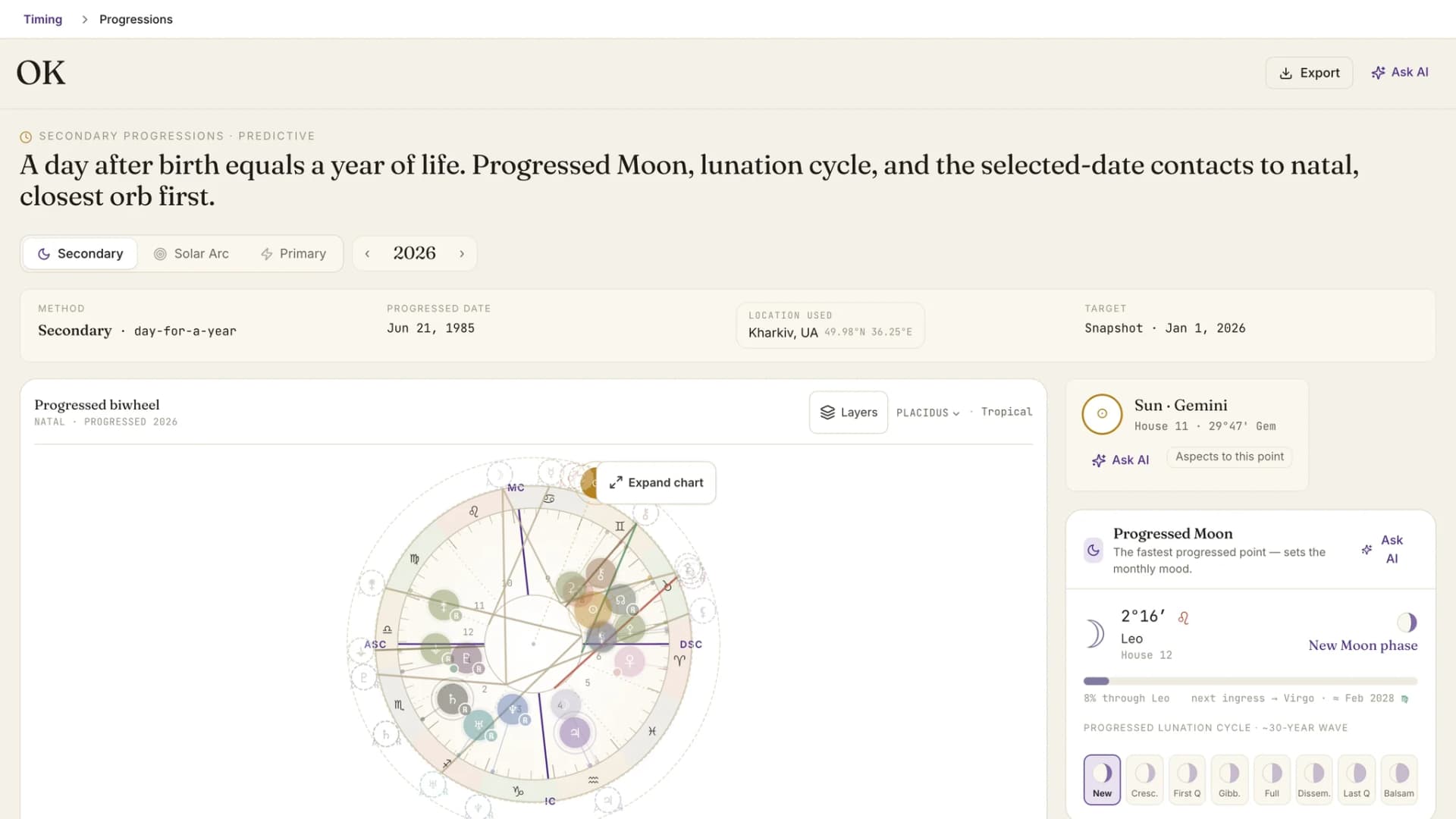
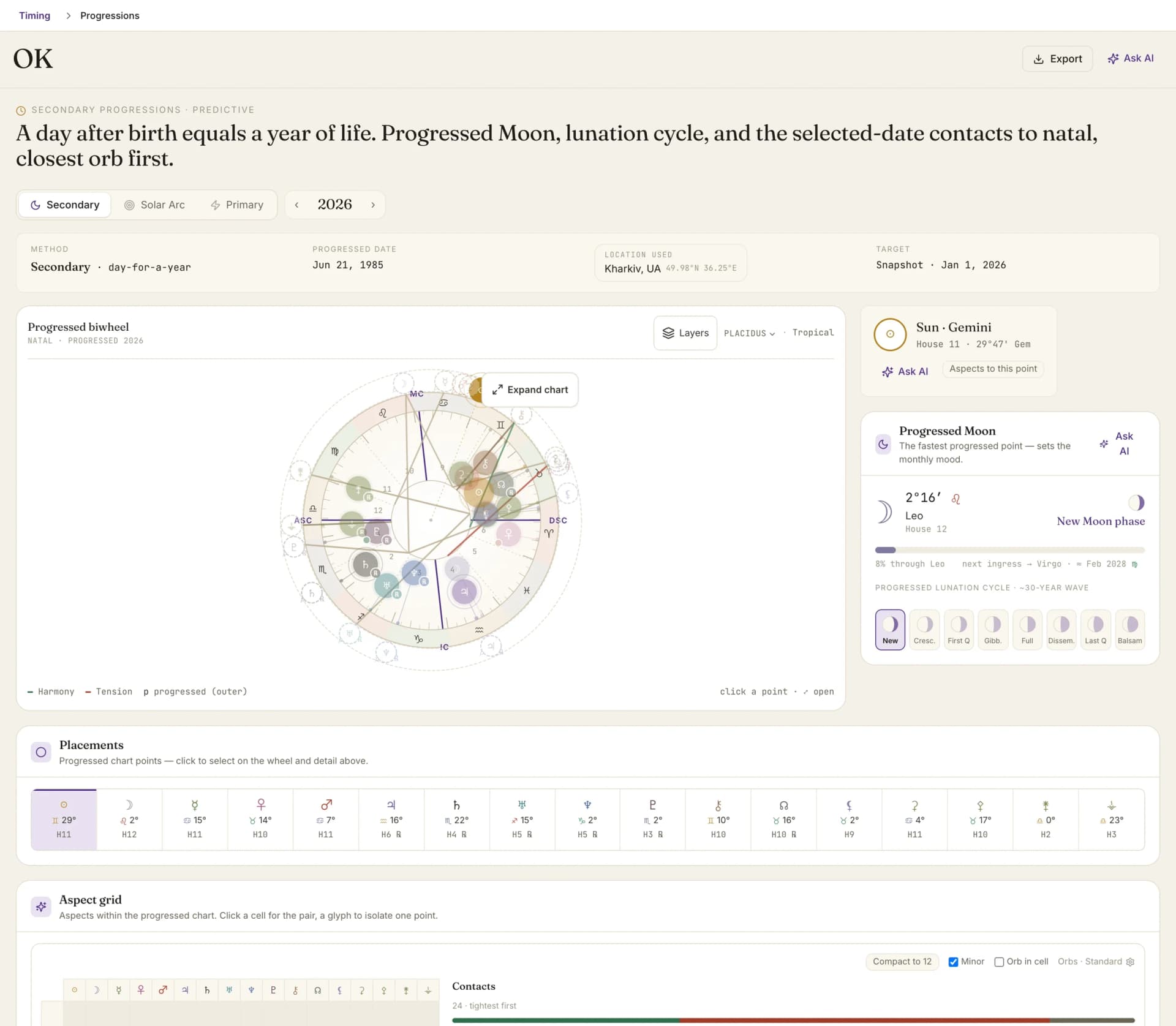
Astrolium runs progressions the way working astrologers actually use them: secondary progressions and solar arc directions on the same scrubber as transits, with the progressed Moon's house ingresses flagged automatically. The day-for-a-year math runs on the Swiss Ephemeris with arc-second precision across 1900 to 2100.
The free progressed chart calculator previews the technique without signup. The secondary progressions guide covers the full reading method. See predictive timing for how progressions stack against transits and profections on one ribbon, or jump to pricing — secondary progressions start on Pro ($11 per month), and the full suite with solar arc directions is on Adept ($29 per month).
What professional astrologers need from progressions
Most consumer tools render the progressed Sun and progressed Moon, label the sign change, and stop. That's not a progression reading. A progression reading is the whole progressed chart, the progressed Moon's current house, the exact aspects forming between progressed and natal points across the next five years, and (critically) those aspects laid over the simultaneous transits.
Robert Hand, Brady, and the bulk of the working professional field treat progressions as the slow inner clock and transits as the fast outer events. Reading one without the other is reading half the story. Astrolium puts them on one axis so the reading happens once.
Two methods, one ribbon
Secondary progressions
The day-for-a-year technique. Take the ephemeris position from 30 days after birth: that's your chart at age 30. The Sun advances roughly 1 degree per year. The Moon advances roughly 13 degrees per year, cycling through one sign every 2.5 years. The outer planets barely move at all across a lifetime, which is why secondaries are mostly read for the inner planets.
Placidus de Tito systematized the technique in the 17th century. The math has not changed since, but the visual layer has. Astrolium renders the full progressed wheel for any date between 1900 and 2100 in under 300 ms.
Solar arc directions
The sibling technique. Every planet and angle advances by the same arc: the progressed Sun's daily motion, roughly 1 degree per year. The whole chart moves in lockstep. The outer planets, which barely budge under secondary progressions, finally cover ground.
Solar arc surfaces exact aspect hits more often because Saturn, Uranus, Neptune, and Pluto actually move. Practitioners commonly use secondaries for the lunation cycle and Moon-based timing, solar arc for outer-planet aspect timing. Astrolium gives you both, on the same ribbon, with one toggle.
The progressed Moon — practitioner's bread and butter
If a practitioner can only read one progression, it's the progressed Moon's house ingress. The Moon moves through one progressed sign every 2.5 years and one whole-sign house every 2.5 years. Each ingress changes the inner weather: what the client cares about, the texture of the daily mood, the emotional question of the season.
Brady's reading goes like this: the progressed Moon entering the 7th house pulls partnership into focus for 30 months whether the client wants it there or not. The 10th-house ingress reorients toward public life. The 12th-house ingress quiets everything down and turns attention inward, often misread as depression when it's really integration.
Astrolium auto-flags every ingress on the ribbon. You can scrub forward five years and see at a glance when the next house change arrives. No counting on fingers, no separate report.
Progressions versus transits — the distinction that matters
Brady's formulation is the cleanest in the field: progressions = manifestation through us; transits = events on us. A Saturn transit is the boss firing you. A progressed Sun changing sign is your interior orientation shifting: you start caring about different things, your aesthetic turns over, the way you describe yourself in a sentence changes.
The two cycles speak to different layers. A career change at 33 typically has both: the progressed Sun crossed an angle (manifestation), and Pluto squared the natal Midheaven the same year (event). Reading one without the other tells you what happened or why, but not both.
Astrolium is the first working-astrologer tool that stacks progressions on transits on the same scrubber. The ribbon renders both in under 300 ms. You read them as one structure.
What the workspace looks like
Drop the client's birth data, click into the progressions tab, and the ribbon renders 30 years of timing. Scrub to any year between 1900 and 2100. The progressed wheel updates, the progressed Moon position recalculates, the progressed-to-natal aspect grid refreshes, all in real time.
What this replaces: opening Solar Fire, generating a progressed chart report, closing it, running a separate aspect table, manually noting the progressed Moon's current sign and house, then opening yet another report for transits and stitching everything by hand. Astrolium does that in 300 ms.
Every client on your roster sits on the dashboard. Each row shows the current progressed Moon house, the current progressed lunation phase, and the next major progressed-to-natal aspect. Especially useful before quarterly check-ins: you can see who's about to cross a house ingress this month without opening a single chart.
Versus what you have now
By hand: ~30 minutes per chart per session, separate spreadsheets for secondaries and solar arc, progressed Moon ingresses missed unless you're actively counting, no overlay with transits.
Solar Fire or Astro Gold: Progressed charts ship as static reports. The progressed Moon's ingress is buried in a table. Solar arc is a second report. Overlay with transits requires manual stitching across three windows.
Astrolium: Full progressed chart, both methods, ingress flags, and transit overlay on one scrubbable ribbon. 300 ms render. Dashboard view across the full roster.
Three ways practitioners use this every week
-
The mid-life check-in. Client in their early 40s asks why everything feels different. You scrub forward two years from their last reading and see the progressed Moon crossing into the 10th house, the progressed Sun about to square natal Saturn, and Pluto opposing natal Venus simultaneously. The "everything feels different" has a structural cause and a 30-month duration.
-
The pre-decision read. Someone considering a move asks if this is the year. You drop into progressions, find the progressed Ascendant changing sign in 8 months, the progressed Moon entering the 4th house two months after that. The chart is preparing for a relocation reading even before you bring up transits.
-
The retrospective. Client wants to understand why 2017 was the year their first marriage ended. You scrub backward, find the progressed Moon transiting the 7th house with the progressed Sun squaring natal Venus and Saturn transiting the descendant: three layers stacked. The conversation that follows isn't a verdict, it's a clarification.
Cross-link
Preview the technique through the free progressed chart calculator. For the deeper reading method, see the secondary progressions guide. For the full predictive stack, see predictive timing and the Saturn return guide. For the relationship version of the timing engine, see the synastry feature.