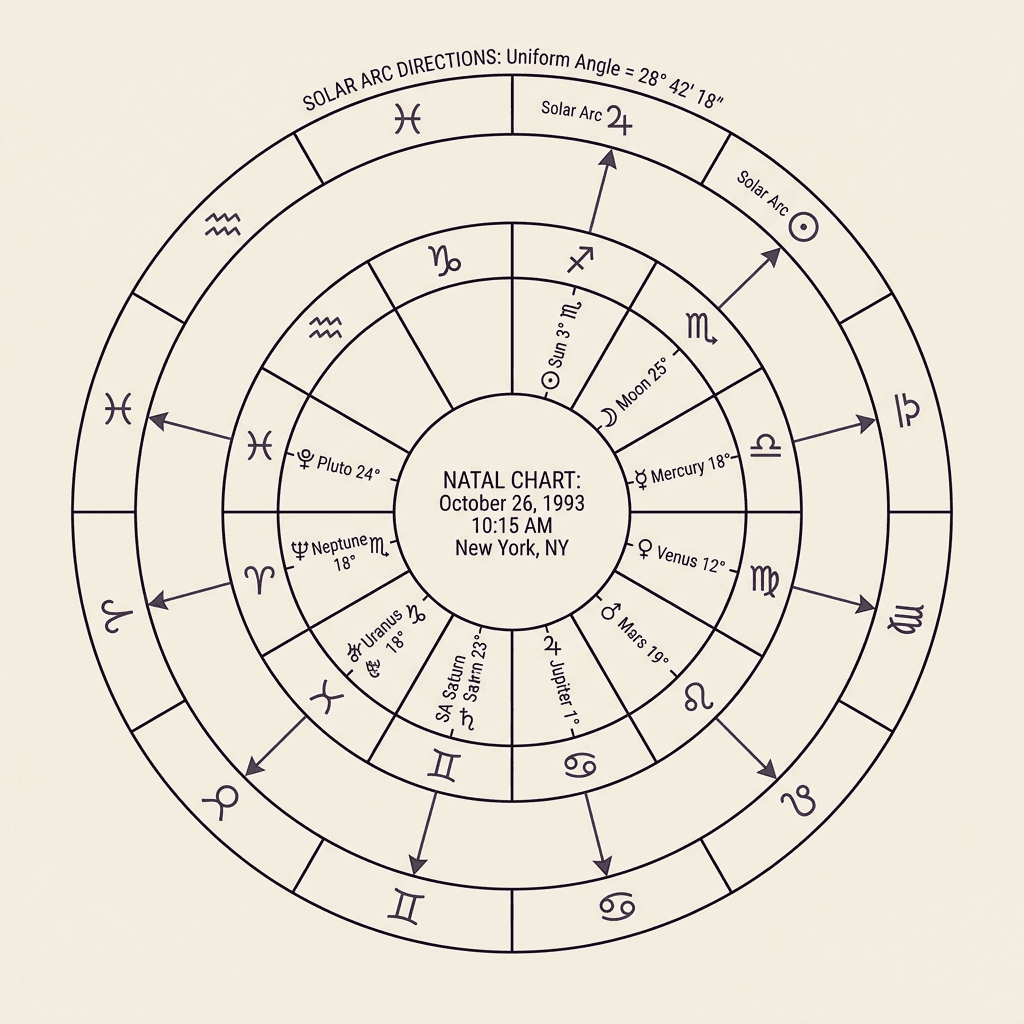
Solar arc directions take one measurement — how far the Sun has moved since birth — and apply it to every planet in the chart.
The solar arc is the difference in degrees between the natal Sun's position and the progressed Sun's position at a given age. That single number gets added to every planet, angle, and house cusp in the chart. The result is a complete directed chart that shows the same internal relationships as the natal but shifted forward in time. Astrolium calculates solar arc directions alongside secondary progressions in the same view.
Origin and history
The underlying logic is old. Ptolemy described moving house cusps by solar motion in Tetrabiblos, and medieval practitioners used solar-based primary directions for timing. The modern form of solar arc directions — where the arc is applied uniformly to all planets, not just house cusps — developed in 20th-century German astrology.
Hugo Müller articulated the technique in the early 20th century. Reinhold Ebertin, working within the cosmobiology tradition, used solar arc extensively in the mid-century. Noel Tyl was the figure who brought solar arc directions into mainstream English-language practice through his teaching and books in the 1970s and 1980s.
Tyl's argument for the technique over secondary progressions was pointed: in secondary progressions, outer planets like Saturn, Uranus, Neptune, and Pluto move only a degree or two over an entire lifetime. They produce aspects so rarely that they are effectively useless for timing. In solar arc directions, every planet moves the same arc — roughly 1 degree per year — so Saturn and Pluto generate aspects at the same rate as the Sun and Mercury. All 10 planets become active timing points.
How it works
The solar arc for any given age is calculated as: progressed Sun position minus natal Sun position. At age 30, the progressed Sun has moved roughly 30 degrees from its natal position (the actual value varies slightly because the Sun's daily motion is not exactly 1 degree — it ranges from about 57 to 61 arc minutes depending on the time of year).
That arc is then added to every natal planet and angle. If your natal Moon is at 14° Virgo and the solar arc at age 40 is 40°12', the directed Moon is at 24°12' Capricorn. When a directed planet reaches a conjunction, square, or opposition with a natal planet — using an orb of about 1 degree — the technique considers that a live aspect.
One consequence of uniform movement: all natal configurations survive intact in the directed chart. A natal Sun-Mars trine remains a trine between the directed Sun and directed Mars. The directed chart is the natal chart translated forward in time as a unit, not a chart where individual planets drift independently.
Hard aspects — conjunctions, squares, oppositions — carry the most weight. Most practitioners do not read trines and sextiles from directed planets as significant timing indicators.
When practitioners use it
Solar arcs are used for life-arc timing. A directed planet crossing a natal angle (Ascendant, Midheaven, Descendant, IC) typically marks a significant year. Directed Saturn conjunct the natal Sun reads differently than directed Jupiter in the same position, but both are considered strong timing signals.
The technique is usually read alongside transits. A solar arc direction that is exact without a confirming transit may not manifest as a discrete event; confirmation from a major transit to the same natal point raises the probability. Many practitioners treat solar arcs as identifying the year and transits as identifying the season or month.
The secondary progressions guide covers how solar arcs compare to day-for-a-year progressions in practice.
In Astrolium
The Astrolium progressions feature displays solar arc directed charts alongside secondary progressions. Enter any target date and the directed chart renders automatically. Aspect hits from directed to natal planets are listed by orb. The progressed chart tool lets you run solar arc directions for a client in seconds.