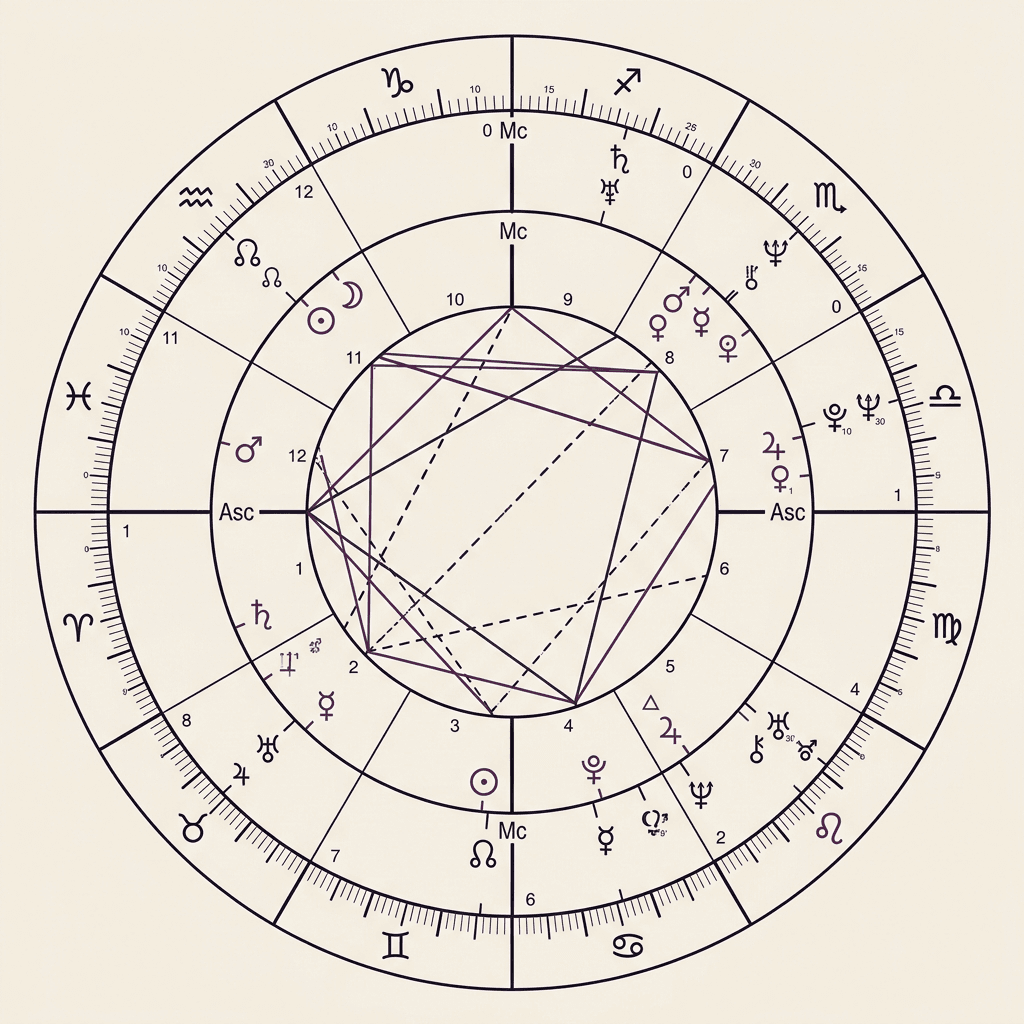
Synastry is the technique of overlaying two people's birth charts and reading the angles formed between one chart's planets and the other's — specifically what those angles say about the relationship between the two people.
Synastry compares two natal charts by calculating the aspects formed between all planets, angles, and points across both charts. A typical synastry reading examines 14 or more cross-chart contacts. Ptolemy referenced chart comparison in the Tetrabiblos; Carl Jung famously tested the technique with married couples in the 1950s. Astrolium generates a full synastry grid and bi-wheel in seconds from any two birth profiles.
What synastry is and where it comes from
The word comes from Greek: syn (together) + astron (star). First recorded in English around 1650-1660, it named the practice of reading how two people's natal stars interact. The idea is older than the word.
In Hindu astrology, comparing charts for marriage compatibility is an ancient practice with its own formalized system, Ashtakoot, which assigns point scores across eight compatibility categories. The Western tradition never codified the technique as rigidly, but Ptolemy's Tetrabiblos mentions chart comparison as relevant to evaluating partnerships. Centuries later, William Lilly used the technique in 17th-century England, particularly for questions about whether a proposed marriage would be harmonious.
The modern synastry method — overlaying two full birth charts and reading all cross-chart aspects — became widespread in the 20th century. Carl Jung tested it formally in the 1950s, analyzing the charts of 483 married couples and looking for statistically elevated rates of specific cross-aspects. His results were disputed and the study had methodological flaws, but it pushed synastry into mainstream practice.
How synastry works
Each person's natal chart contains ten planets (including Sun and Moon), plus chart angles (Ascendant, Midheaven) and any additional points the astrologer uses. In synastry, you calculate the angular distance between every planet in chart A and every planet in chart B. Those angles are the aspects.
The standard major aspects are conjunction (0 degrees), opposition (180 degrees), trine (120 degrees), square (90 degrees), and sextile (60 degrees). Most practitioners also read quincunxes (150 degrees) and semi-sextiles (30 degrees) in synastry, where cross-chart friction can manifest subtly.
Orbs — how many degrees of tolerance you allow before an aspect counts — vary by practitioner. Most allow 6-8 degrees for Sun-to-planet contacts and 3-5 degrees for planet-to-planet contacts across the charts.
The house overlays matter as much as the aspects do. When person A's Sun lands in person B's 7th house, that placement is read as a description of how A shows up in B's experience of partnership. Each planet from chart A illuminates the house in chart B where it falls, and vice versa. A thorough reading covers both the aspect grid and the house overlay picture.
Reading synastry in practice
Astrologers prioritize certain contacts over others. The Sun-Moon cross-aspect — person A's Sun conjunct or opposite person B's Moon — is historically the most heavily weighted single contact. The Moon-Ascendant contact is second for many practitioners. Venus-Mars contacts describe physical chemistry; Saturn contacts across the charts describe where one person structures, limits, or stabilizes the other.
What practitioners actually do:
- Print or display the bi-wheel with chart A inside and chart B outside.
- Scan for exact or near-exact aspects (within 1 degree of exactitude), noting whether they are applying or separating.
- Read the house overlays — where does each planet from chart A land in chart B's houses?
- Assess the overall tone: more harmonious aspects (trines, sextiles, positive conjunctions) versus more tense aspects (squares, oppositions, Saturn/Pluto contacts).
- Note which houses get multiple activations — if chart A drops three planets into chart B's 8th house, that house's themes dominate the relationship dynamic.
No synastry chart is all harmonious or all tense. The reading is about understanding the texture — where the relationship flows easily, where it generates productive friction, and where the real sticking points live.
In Astrolium
The synastry feature in Astrolium generates a bi-wheel and full cross-aspect grid for any two people in your account. You can add a partner or client chart from any saved profile. The synastry calculator is also available as a standalone tool for quick reads. For a deeper look at the relationship chart as its own entity, see the composite chart entry.