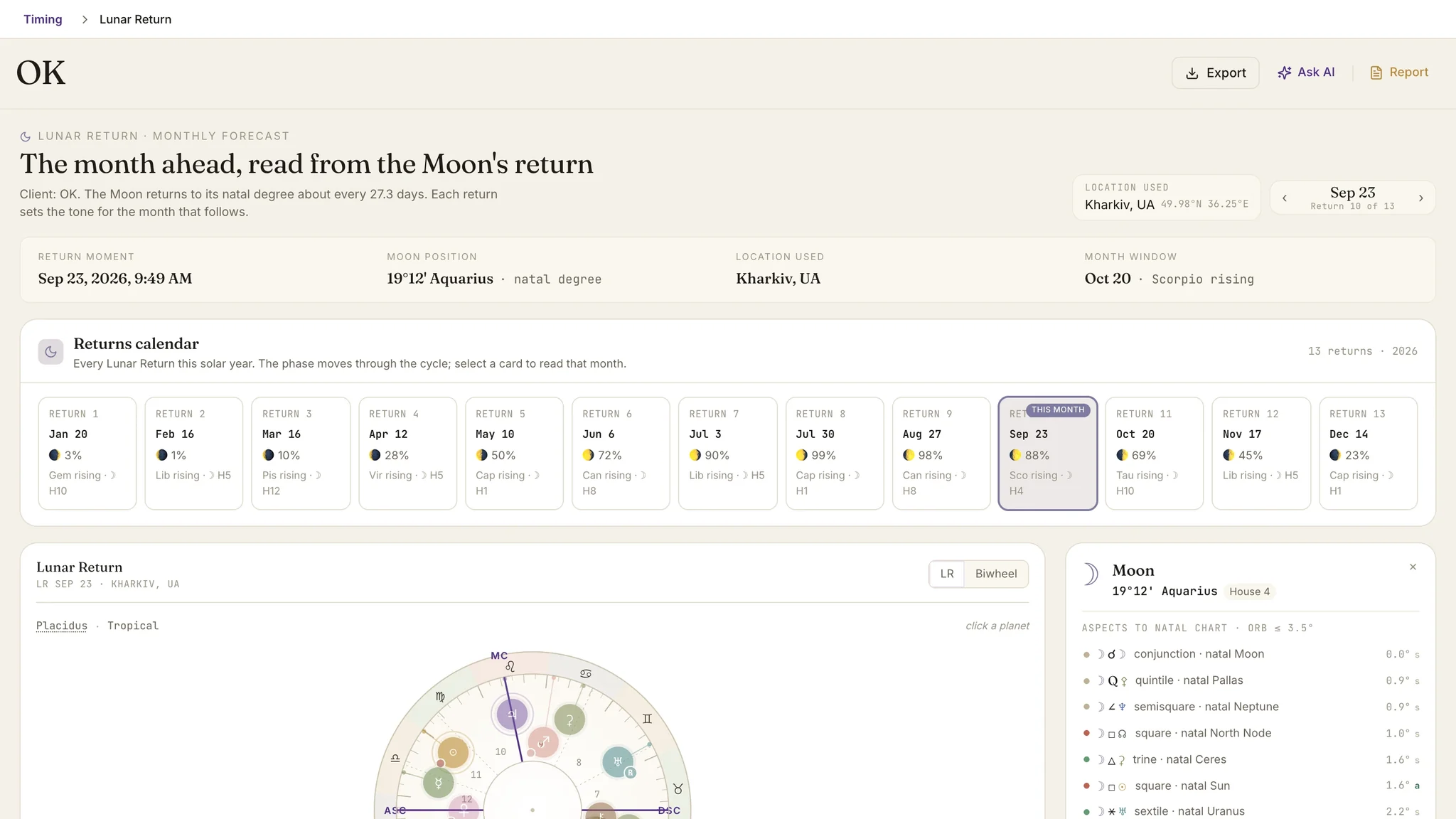
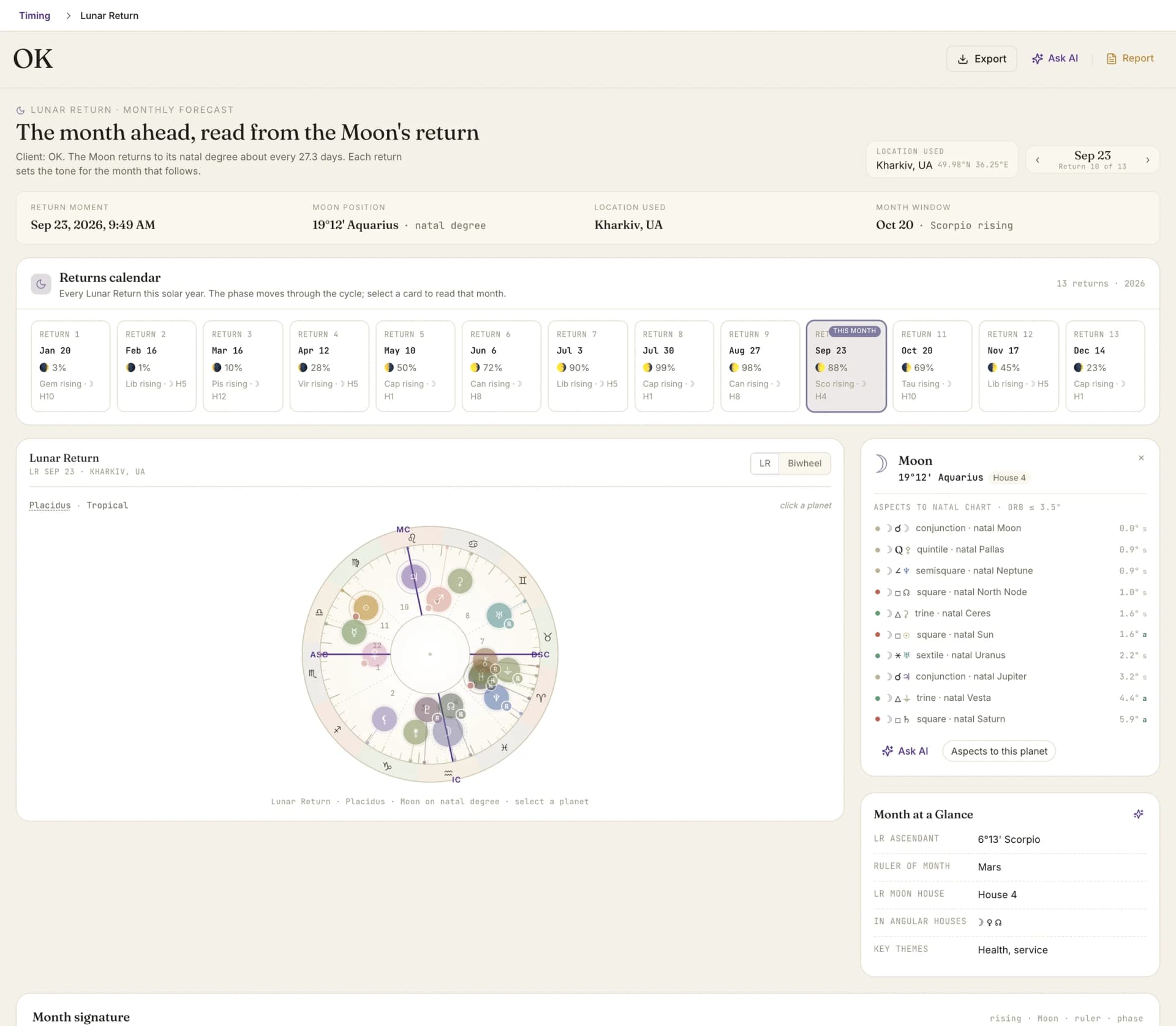
Astrolium computes the lunar return the way modern practitioners use it: the 27.32-day chart cast for the moment transiting Moon returns to its natal longitude, with the upcoming Moon's house emphasis and applying aspects flagged on the wheel. The math runs on the Swiss Ephemeris with arc-second precision across any location in the gazetteer.
The free solar return chart calculator covers the annual sibling technique. The secondary progressions guide covers the slow lunar layer: progressed lunations across 2.5 years. See predictive timing for how lunar returns stack on the ribbon, or jump to pricing for the $29 per month Adept plan.
What professional astrologers need from the lunar return
The lunar return is the monthly retainer offering on most working astrologers' price sheets. Solar returns are the once-a-year reading clients schedule and pay for. Lunar returns are the monthly check-in that supports a $150 to $300 retainer. Reading the upcoming lunar return is the deliverable that keeps a roster of 30 VIP clients on monthly payment plans without exhausting the practitioner.
A solar return takes 90 minutes to read. A lunar return takes 15 to 20. Across a 30-client retainer roster, the lunar return is the business model: predictable monthly revenue, predictable monthly cadence, the practitioner delivering an actual chart-based reading instead of a vague check-in message.
You don't need a full retainer roster to start. A part-time or early-career practitioner reading lunar returns for a handful of clients gets the same auto-cast wheel and house-emphasis flags, and the Pro plan at $11 per month is the on-ramp before the returns suite on Adept makes sense.
Rudhyar's lunation theory
Dane Rudhyar systematized the modern reading of the lunar return in the 1930s as part of his broader lunation theory. The cycle starts at the new moon (sun-moon conjunction) and unfolds across 29.5 days through the full moon and back. The personal version of that cycle is the lunar return: the Moon returning to its natal longitude every 27.32 days, marking the start of a personal monthly phase.
Rudhyar's reading went like this. The lunar return chart governs the 27 days that follow. The Moon's house in the return wheel tells you which area of life the month will emphasize. Angular planets (anything within 5 degrees of the four angles) provide the texture of the month. Applying aspects from the return Moon to natal points tell you when the month's events arrive.
Astrolium reads all four layers automatically. Open a client's lunar return and the Moon's house, the angular planets, and the applying aspects are already flagged on the wheel.
The 27.32-day cycle, on the roster
The sidereal lunar month is 27.32 days. The synodic month (new moon to new moon) is 29.53 days. The difference matters: the lunar return cycle is shorter than the new-moon cycle, so 13 lunar returns fit in a calendar year while only 12 new moons do.
Across a 30-client roster, that means roughly 30 lunar returns per month to read. That's the workload. The retainer pricing works because the chart is auto-cast and the workspace is structured: the practitioner walks into a session knowing the Moon's house, the angular planets, and the applying aspects before they open the wheel.
Astrolium's roster view sorts by next return date. At the start of any week, you see which clients are due in the next few days. The dashboard surfaces the Moon's upcoming house and any angular outer-planet contacts. Reading the upcoming lunar return becomes a 15-minute workflow per client instead of 45.
Tropical or sidereal-anchored
Modern Western astrologers default to tropical lunar returns: the Moon returning to its natal tropical longitude. The sidereal-anchored school (Bernadette Brady, Pesavento) argues for precession correction so the Moon returns to its natal sidereal degree, accounting for the ~24 degrees of zodiac drift since the technique was systematized in the 1930s.
The difference compounds at roughly 50 minutes of arc per century. For a client born in 1990, the tropical lunar return and the precession-corrected lunar return arrive about 60 minutes apart. The angles can land in different signs, and the house structure of the month changes.
Astrolium ships both. The default is tropical (matching mainstream modern practice). The toggle is one click. The dashboard shows which method you're reading for each client, so you can run a practice on either school without ever wondering which method you used last cycle.
What the workspace looks like
Drop the client's birth data, click into the lunar return tab, and the chart for the next return renders. Switch location for a relocated return. Toggle precession correction. The wheel recasts in real time.
What this replaces: opening Solar Fire, computing the lunar return, exporting it, manually noting the Moon's house and any angular planets, then writing the session brief by hand. Astrolium does the prep in 300 ms.
Every client on the retainer roster shows their next return date, the upcoming Moon house, and the strongest applying aspect. Especially useful at the start of each week: you can see which 6 clients are due in the next 7 days and open all 6 charts in under a minute.
Versus what you have now
By hand: ~15 minutes per chart per session, no roster view, lunar returns missed unless you're actively tracking the cycle, relocated returns require manual coordinate entry.
Solar Fire or Astro Gold: Lunar return wheel renders. The 27-day transit overlay is a separate report. The roster view doesn't exist. Precession correction is buried in a settings dialog most users never find.
Astrolium: Wheel, applying aspects, and 27-day transit overlay on one screen. Roster view across the full retainer list. Precession correction one toggle away.
Three ways practitioners use this every week
-
The Monday session prep. Six retainer clients are due for their lunar return reading this week. You open the roster view, see the Moon's house for each, the angular planets, the strongest applying aspect. Across 90 minutes you've prepped all six sessions. The clients arrive Tuesday through Friday and the conversations are specific to their charts.
-
The mid-month crisis call. A retainer client calls 12 days into her cycle saying everything feels off. You open her current lunar return, find Mars angular and squaring her natal Sun, the Moon in the 12th house. The off-feeling has a structural cause and an end date — 15 days out, when the next return resets the chart.
-
The pre-travel briefing. A client is moving to Berlin for the next month and asks what the period looks like. You relocate the next lunar return to Berlin, find the Moon shifts from the 7th house to the 10th, two outer planets become angular. The month structurally reorganizes around public role and ambition. You write the briefing in 10 minutes.
Cross-link
For the annual sibling technique, see the solar return feature and the free solar return chart calculator. For the slower lunar layer — progressed lunations across 2.5 years — see the progressions feature and the secondary progressions guide. For the full predictive stack, see predictive timing.