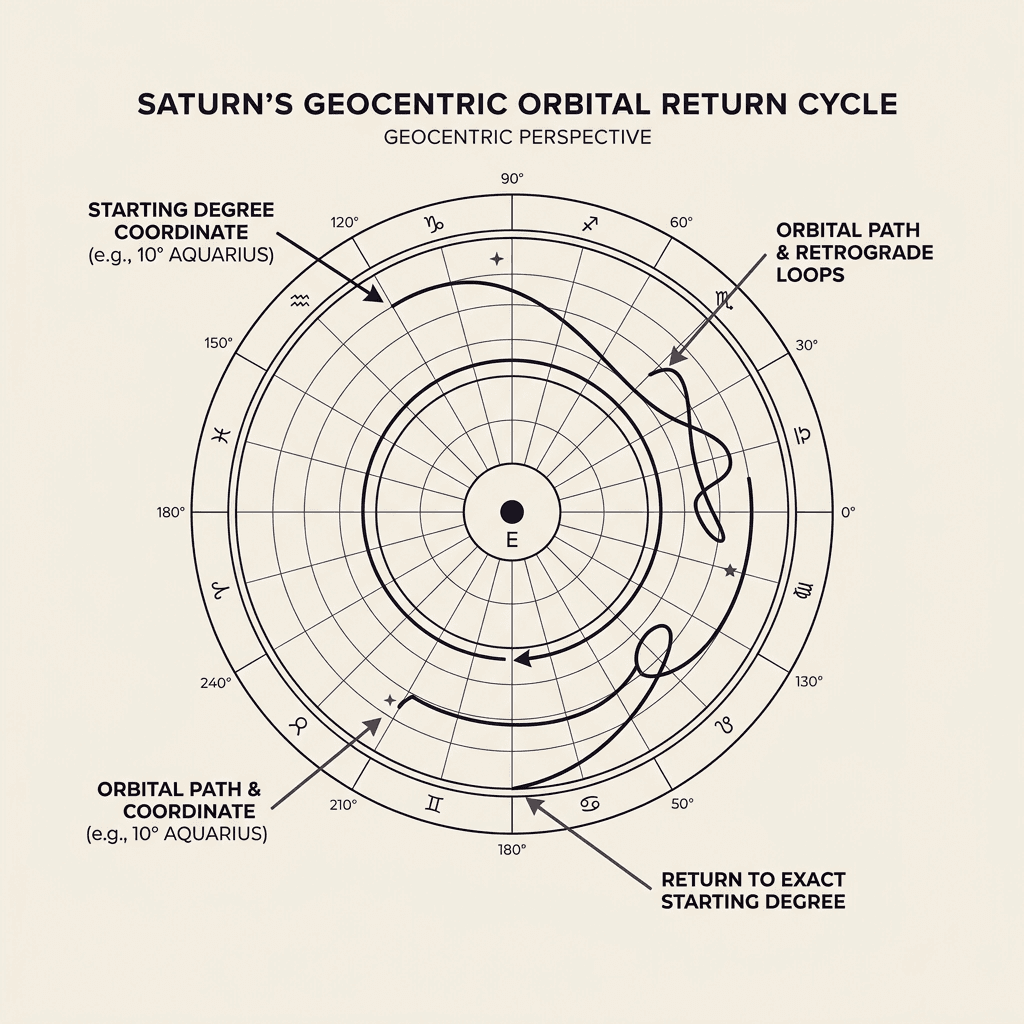
A Saturn return is a transit that occurs when Saturn completes one full orbit of the Sun and arrives back at the exact zodiac degree it occupied the moment you were born.
Saturn takes approximately 29.5 years to orbit the Sun, so the first Saturn return falls between ages 27 and 30. Most people experience three returns in a lifetime: the first at 27-30, the second at 57-60, and a third around 86-89. Astrolium calculates your exact Saturn return window from your birth data and plots it on your transit timeline.
What Saturn return is and why it matters
Saturn is the outermost visible planet in the pre-telescope sky, and ancient astrologers gave it authority over time, structure, and accountability. It moves slowly — about 12 to 13 degrees per year — so its return to its natal position is a genuinely rare event for a human life span.
The concept is simple: at the moment of birth, Saturn was at a specific degree of a specific zodiac sign. When Saturn transits back to that same degree, roughly 29.5 years later, it has completed one cycle. Traditional and modern astrologers alike treat this as a structurally significant threshold, a moment when the cumulative weight of choices and patterns gets assessed.
The first return carries the most cultural attention, partly because it coincides with the late 20s, a period already dense with external pressures — careers settling, relationships tested, the gap between who we planned to be and who we turned out to be becoming visible. The transit does not cause that confrontation, but it lands on top of it. The two tend to amplify each other.
Saturn is in one sign for approximately 2.5 years, so your return period runs for about that long — Saturn doesn't hit your natal degree once and leave. It crosses the degree, retrogrades back past it, and crosses it a final time. The three exact passes define the window.
How the calculation works
The return is calculated from your natal Saturn degree, which comes from your birth date, time, and place. Saturn moves an average of 2 minutes of arc per day, so the exact timing is precise to within a few weeks when you have a known birth time.
The 29.5-year figure is the sidereal orbital period — the time Saturn takes to complete one trip around the Sun relative to the stars. In practice, the return window spans roughly 2 to 3 years, centered on the first exact conjunction of transiting Saturn with natal Saturn.
Because Saturn retrogrades once per year, most people experience the return as three distinct passes:
- Saturn conjuncts the natal degree while moving direct (forward).
- It retrogrades and crosses the natal degree again going backward.
- It stations direct and crosses a final time.
The middle pass, the retrograde crossing, tends to be the most inward-facing phase. The final direct pass is often when visible changes land externally.
If Saturn is at 15 degrees of a sign in your natal chart, your first return window opens when transiting Saturn reaches roughly 10 degrees of that sign and closes when it clears 20 degrees. The exact center dates are the three exact-to-the-minute conjunctions.
Reading a Saturn return in practice
What an astrologer looks for first is the natal Saturn's sign and house placement. Sign gives the tone — Saturn in Scorpio returns with different pressure than Saturn in Sagittarius. House placement points to the life domain where the confrontation with structure is most acute.
An astrologer checks:
- The natal house containing Saturn and what that house governs.
- The sign Saturn rules from that house position and what those other houses signify.
- What planets, if any, are within 3 degrees of natal Saturn and will be activated along with it.
- What houses Saturn rules in the chart (it rules Capricorn and Aquarius in the traditional system).
The second Saturn return, around ages 57-60, operates differently. The urgency of the first return is replaced by something closer to a reckoning with legacy. Retirees, caregivers, people in leadership — the second return tends to consolidate rather than disrupt.
The third return, around age 87, has little modern literature. It falls outside most client rosters but appears in the charts of historically documented figures with confirmed birth data.
In Astrolium
The Saturn return calculator on Astrolium computes all three exact-pass dates from your birth data and overlays them on a 3-year transit timeline. The transit scanner shows which natal planets are simultaneously activated during the return window, so you can see the full picture rather than Saturn in isolation. The natal report covers natal Saturn's sign and house delineation as the foundation for the return reading.