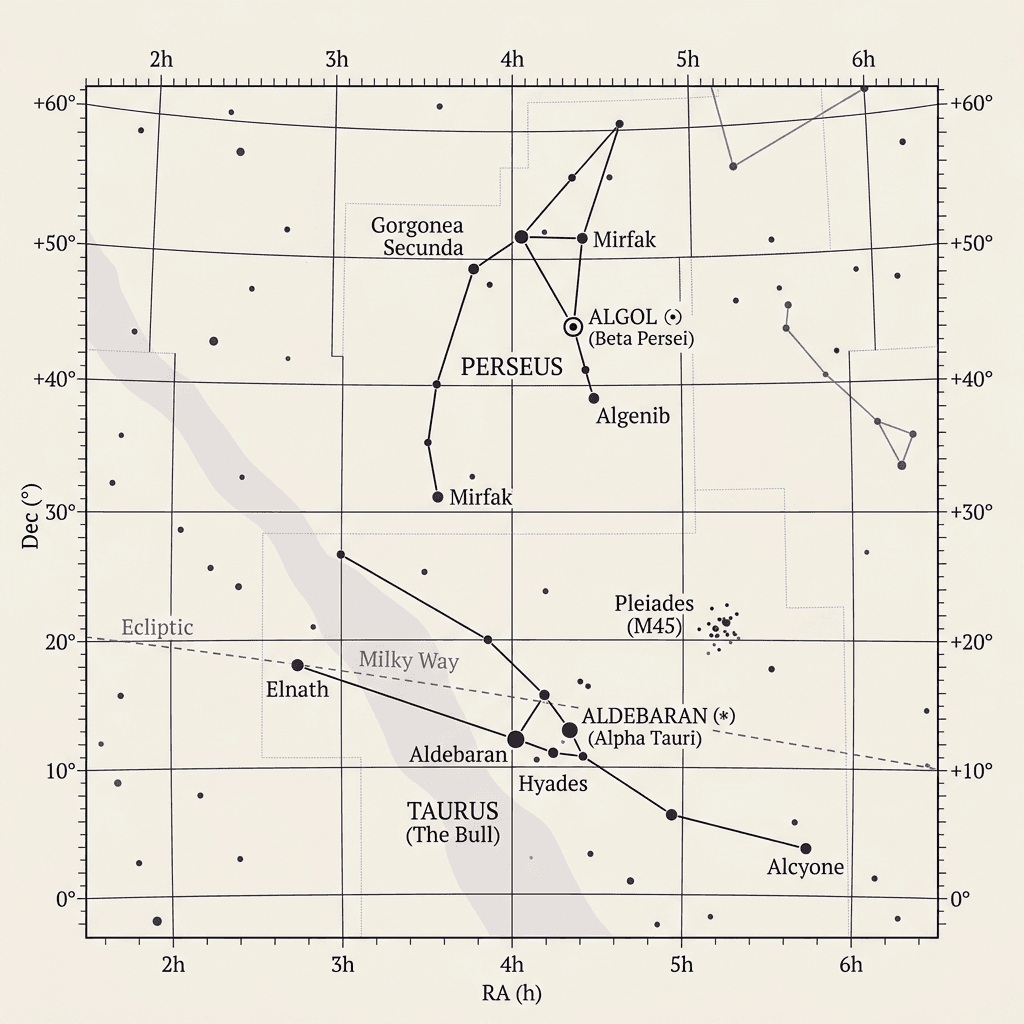
A fixed star is one of the bright stars beyond the solar system that the tradition projected onto the ecliptic and read as adding a sharp, specific tone to any planet that meets it within a 1 degree orb. They are "fixed" relative to the wandering planets only in a poetic sense; they drift along the ecliptic at about 50 arcseconds a year through precession. The 20 brightest and most often cited form the working set that Vivian Robson catalogued in 1923 and Bernadette Brady carried forward in 1998.
Fixed stars in astrology are the named bright stars (Algol, Regulus, Antares, Spica, Sirius, Aldebaran, and about 15 more) projected onto the ecliptic and read by 1 degree conjunction to natal planets or chart angles. Ptolemy first paired them with planetary natures; Robson tabulated 110 of them; Brady built the modern working framework. Astrolium ships every named star's current ecliptic longitude alongside every chart.
A short history
Fixed-star delineation runs back further than the houses do. Mesopotamian astronomers tracked named stars as omens centuries before the natal chart existed. Claudius Ptolemy in the 2nd century gave them planetary natures in Tetrabiblos Book I, Chapter 9: Aldebaran is of the nature of Mars, Regulus of Mars and Jupiter, Spica of Venus and Mercury. That pairing is the basis of every later reading.
The medieval tradition kept the catalogue alive. Guido Bonatti (13th century) used named stars in nativities and elections. William Lilly (1647) tested them in horary, especially the malefic stars conjunct the Ascendant or the Moon. After Lilly the practice faded with the broader collapse of traditional astrology in English-language practice.
The modern revival has two anchors. Vivian Robson's The Fixed Stars and Constellations in Astrology (1923) is the standard 20th-century reference — exhaustive, sometimes grim, the source of most "Algol is the most evil star" reputations. Bernadette Brady's Brady's Book of Fixed Stars (1998) modernized the technique by adding parans (stars rising, culminating, setting, or anti-culminating at the same moment as a planet, computed at the birth latitude) and by softening Robson's interpretations toward something a working astrologer can hand a client without alarm.
Diana Rosenberg's Secrets of the Ancient Skies (2012) is the third pillar: a 1,400-page atlas mapping the constellations and their stars to every degree of the zodiac, with research notes drawn from her decades of client files.
The canonical 20, with 2026 ecliptic longitudes
These are the brightest and most cited. Magnitude column is visual; longitudes are tropical ecliptic for May 2026 and drift roughly 50 arcseconds a year through precession, so they hold to the degree across most working careers.
| Star | Constellation | Mag | Ecliptic longitude (May 2026) | Ptolemaic nature |
|---|---|---|---|---|
| Algol | Perseus (caput) | 2.1 | 26° Taurus 28' | Saturn, Jupiter |
| Pleiades / Alcyone | Taurus | 2.9 | 0° Gemini 18' | Moon, Mars |
| Aldebaran | Taurus (eye) | 0.9 | 10° Gemini 09' | Mars |
| Rigel | Orion (foot) | 0.1 | 17° Gemini 17' | Jupiter, Saturn |
| Bellatrix | Orion (shoulder) | 1.6 | 21° Gemini 24' | Mars, Mercury |
| Capella | Auriga | 0.1 | 22° Gemini 18' | Mars, Mercury |
| Betelgeuse | Orion (shoulder) | 0.6 | 29° Gemini 03' | Mars, Mercury |
| Sirius | Canis Major | -1.4 | 14° Cancer 23' | Jupiter, Mars |
| Castor | Gemini | 1.6 | 20° Cancer 38' | Mercury |
| Pollux | Gemini | 1.1 | 23° Cancer 35' | Mars |
| Procyon | Canis Minor | 0.4 | 26° Cancer 09' | Mercury, Mars |
| Regulus | Leo (heart) | 1.4 | 0° Virgo 11' | Mars, Jupiter |
| Vindemiatrix | Virgo | 2.8 | 10° Libra 12' | Saturn, Mercury |
| Spica | Virgo | 1.0 | 24° Libra 14' | Venus, Mercury |
| Arcturus | Boötes | -0.05 | 24° Libra 38' | Mars, Jupiter |
| Antares | Scorpio (heart) | 1.0 | 10° Sagittarius 03' | Mars, Jupiter |
| Vega | Lyra | 0.0 | 15° Capricorn 33' | Venus, Mercury |
| Altair | Aquila | 0.8 | 2° Aquarius 11' | Mars, Jupiter |
| Fomalhaut | Pisces Australis | 1.2 | 4° Pisces 20' | Venus, Mercury |
| Achernar | Eridanus | 0.5 | 15° Pisces 41' | Jupiter |
Twenty stars; eight royal stars in this set (Aldebaran, Regulus, Antares, Fomalhaut are the four Persian royal stars; Sirius, Spica, Vega, Arcturus are commonly added in the modern catalogue). About half sit in Gemini through Cancer, a quirk of the current precessional moment that practitioners reading the same set 1,000 years from now will not share.
How to read a fixed-star contact
The strict tradition is conjunction only, 1 degree orb, with two refinements.
First, the star modifies the planet, not the other way around. A natal Sun conjunct Regulus at 0 degrees of Virgo within 1 degree carries Regulus's signal — public visibility, leadership themes, the classical warning that success without revenge is the condition. The Sun does not modify Regulus.
Second, the contact is read through Ptolemy's planetary nature pairing. Algol is Saturn-Jupiter. Spica is Venus-Mercury. The reading combines the natal planet's significations with the star's planetary signature. A Mercury conjunct Spica is a Mercury operating in a Venus-Mercury register: speech and writing that lands as graceful, articulate, sometimes lucky. A Mars conjunct Algol is a Mars operating with Saturn-Jupiter overtones, the classical violence reading sometimes warranted, more often a marker of a person who has stared at something terrible and held their ground.
The orb is the discipline. A planet 1 degree from a star reads. 2 degrees does not. The tradition is strict on this and it holds up: tighten the orb past 1 degree and the testimony becomes noise.
Parans are Brady's modern addition. A planet is in paran with a star when the planet is rising, culminating, setting, or anti-culminating at the same instant the star is. The four angles, the four diurnal events. Parans are computed at the birth latitude and produce a separate set of star-planet contacts that are not visible on the ecliptic chart but show up clearly on a diurnal-arc diagram. The Astrolium natal chart renders parans in the side panel for every star in the canonical 20.
When fixed stars actually matter in client work
Most charts have one to three fixed-star contacts within 1 degree. Many have none. The rule of practical use: do not lead with stars. Read the chart through houses, rulerships, sect, lots, and timing first. Then check the contacts as a final overlay. The star refines the reading where it falls; it does not replace the reading.
The cases where stars are usually the difference between a generic reading and a specific one:
- Algol at 26 Taurus / 26 Aquarius / 26 Leo / 26 Scorpio. A natal planet, Ascendant, or Midheaven on Algol benefits from a careful reading. Robson is alarmist on this star; Brady is moderating. The truthful reading is that Algol marks intensity, not catastrophe.
- Regulus at 0 Virgo. The royal star that precessed off Leo in November 2011. Reading Regulus on a chart cast after that date means reading it in Virgo, with Virgo's themes (work, service, integration) inflecting the leadership signal. This is a recent shift many practitioners still miss.
- Spica at 24 Libra. Often called the most fortunate star. Conjunctions with the Sun, Moon, or benefics tend to read as the technique describes — talents that find audiences, work that gets recognized.
- Antares at 10 Sagittarius. The royal star opposite Aldebaran, both at the 10 to 11 degree range of the mutable signs. Antares conjunctions read as Mars-Jupiter in expression, often correlated with cycles of obsessive engagement with a single subject.
- The Pleiades at 0 Gemini. "Something to weep about" in the old reading. A more accurate modern reading is that the Pleiades sensitize the planet they touch — high feeling, often early formative grief, sometimes mystical preoccupation.
How fixed stars fit alongside the rest of the toolkit
In the hellenistic astrology tradition, fixed stars belong to the natal layer, not the predictive timing layer. They do not move (within 1 degree) on the scale of a human lifetime; profections, zodiacal releasing, and transits do. Fixed-star contacts are read once, during natal delineation, and noted in the client file.
In horary astrology, the malefic stars (Algol, the Pleiades, Antares) conjunct the Ascendant, the Moon, or the significator of the matter are one of William Lilly's recurring testimonies that the matter is afflicted. Brady's modern horary practice uses the full catalogue. Both traditions agree: a malefic star on the Ascendant of a horary chart is usually a "do not judge" or a clear "no" by itself.
For natal chart reading at the desk, the working procedure is: cast the chart, read houses and sect, mark fixed-star contacts within 1 degree, weigh them in the final synthesis. That is the order the tradition uses and it remains the right order.
Common mistakes
Three errors are routine in client work and each is avoidable.
The first is treating Algol as a sentence rather than a signal. Robson's 1923 entry on Algol is the most quoted single passage in the fixed-star literature and is also the most alarming. A natal contact with Algol does not predict beheading; the catalogue is older than its readings of itself. Brady's Book of Fixed Stars (1998) is the corrective.
The second is reading sidereal longitudes against tropical chart positions. The canonical longitudes in published tables (Robson 1923, Brady 1998) are tropical. If your chart uses sidereal coordinates, you need the sidereal longitude of the star, not the tropical one, and the values shift by about 24 degrees of ayanamsa.
The third is widening the orb. The tradition is 1 degree, conjunction only. A 3-degree orb produces 6 to 8 star contacts on most charts and the signal collapses into noise. Hold the orb. The discipline is the technique.
Reading list
For working into fixed stars without spending years collecting out-of-print books:
- Bernadette Brady, Brady's Book of Fixed Stars (1998). The single best modern reference. 400 pages, the full catalogue with parans, with restrained interpretations a practitioner can hand a client.
- Vivian Robson, The Fixed Stars and Constellations in Astrology (1923). The historical reference. Read with the caveat that Robson's interpretations are heavier than modern practice supports.
- Diana Rosenberg, Secrets of the Ancient Skies (2012). The atlas. 1,400 pages organized by degree of zodiac with the constellations and stars at each position. The reference for unusual stars Robson did not catalogue.
- Ptolemy, Tetrabiblos Book I Chapter 9. The primary source for planetary natures of the stars. Short, readable, the technical root.
To read fixed-star contacts on every chart on your roster without a 1923 atlas in your lap, the Astrolium natal chart ships precession-corrected longitudes for every named star alongside the chart wheel. The hellenistic astrology guide covers the surrounding doctrine. The horary astrology guide covers the use of malefic stars in question charts.