This is the literal click-by-click workflow I run to take a client chart from "I have their birth data in front of me" to "I have a 12-month transit brief ready for the session" in 4 minutes. Today's case: T.R., a Leo-rising photojournalist born 3 March 1988 at 14:18 in Lisbon. Anonymized composite, real chart, real workflow, drawn from my 200-client log. The Brennan-school protocol I follow stacks profections, ZR, and transits in that order; the technique-frame is in the predictive timing feature.
The client and the question
T.R. booked a session in late April. The intake form said: "I have an offer to leave my staff job and freelance. The contract closes in 6 weeks. What does the chart say." That is the question the chart actually has to answer. Not "what is my year about" in the abstract, but "should I sign the contract by mid-June or not."
Her chart: Sun at 13°22′ Pisces in the 8th house. Moon at 27°06′ Leo, conjunct the Ascendant at 4°18′ Leo (so a 1st-house Moon, applying to the Ascendant within 3°). Mercury at 22°47′ Aquarius retrograde in the 7th. Venus at 8°03′ Aries in the 9th. Mars at 21°41′ Aquarius in the 7th, exact-degree conjunction with Mercury within 1°. Jupiter at 5°15′ Taurus in the 10th. Saturn at 28°50′ Sagittarius in the 5th. Uranus at 28°33′ Sagittarius (exact natal conjunction with Saturn within 17′). Neptune at 9°27′ Capricorn in the 6th. Pluto at 11°16′ Scorpio in the 4th.
A 7th-house Mars-Mercury conjunction is the chart of someone who works through other people: partnerships, agents, editors, the audience-facing other. A 1st-house Moon in Leo is the public-facing instrument. The 8th-house Sun is the depth signature, the camera-into-the-dark signature. T.R. photographs conflict zones for a living. The natal chart told me that before she did.
Step 1: Open the chart, set the active date
In Astrolium I open T.R.'s profile from the roster. The natal wheel renders in 24 ms. The right rail shows the transit scrubber, defaulting to today's date. I drag the scrubber to her birthday (3 March 2026, last birthday) so the 12-month brief covers the year she is currently inside. The scrubber recomputes the full transit overlay in under 80 ms.
Why start at the birthday and not at today? Profections turn on the birthday. Solar returns sit on the birthday. If I scan from today forward, I am scanning across a profection-year boundary, and the brief mixes two year-lords. Starting at the most recent birthday gives me the integral profection year as the frame.
Step 2: Get the year-lord, in one click
Astrolium auto-computes the profected year and its lord in the right rail. T.R. turned 38 on 3 March 2026. Profection: (38 − 1) mod 12 + 1 = 38 mod 12 + 1 = 2 + 1 = wait. (38) mod 12 = 2, + 1 = 3rd house. Actually the cleaner formula: year of life = age + 1, year of life mod 12, with the 1st house active when the result is 1. Age 38 = year of life 39. 39 mod 12 = 3. 3rd house active. Counting 3 signs from Leo Ascendant: Leo, Virgo, Libra. Libra is the profected sign. Venus is the year-lord.
Venus natally is at 8° Aries in the 9th house. So the year is a 3rd-house year (siblings, short trips, daily communications, writing, teaching) with Venus as the protagonist, and Venus sits in the 9th. That adds publishing, foreign travel, and the wider belief frame to the year's grammar. For a photojournalist whose work is travel and publishing, the year-lord's natal house is on-the-nose appropriate.
I write this on the brief: Year-lord Venus in 9th from Libra-profected 3rd. Year is publishing-and-foreign-travel about the photojournalism, not the personal life. That is the first bullet.
Step 3: Scan transits to the year-lord
The whole logic of the year is that the year-lord is the transit catcher. Whatever hits natal Venus this year is the year's news. In the Astrolium scanner, I filter the transit list to "aspects to natal Venus, ±2° applying," sorted by exact date. 12-month window from 3 March 2026 to 3 March 2027. The query returns in 60 ms.
For T.R., natal Venus at 8° Aries gets:
- Saturn at 8° Aries: exact conjunction, 14 May 2026 (first pass), retrograde return 22 Sep 2026, third pass 9 Feb 2027. Triple-pass Saturn conjunction to the year-lord. That is the headline event of the year. It lands in the window where she has to sign or not sign the freelance contract.
- Jupiter trine Venus from Leo: 11 July 2026 to 28 August 2026 (Jupiter at 8° Leo on 4 Aug). Soft window. Six weeks of opening, peaking in early August.
- Mars conjunct Venus from Aries: 19 March 2026 (one-day event). Pre-decision tension. Already passed by the time of our session.
- Eclipse pattern: solar eclipse at 12° Libra, 29 September 2026, opposition to natal Venus by 4°. Within orbs. Major year-marker.
Four lines on the brief. The Saturn triple-pass is the structural event. The Jupiter trine is the soft assist. The eclipse opposition is the visibility/contract-rupture risk. Mars already happened.
Step 4: Stack against ZR and check for convergence
ZR runs in parallel. For T.R., Lot of Spirit (day chart: Asc + Sun − Moon) = 4° Leo + 13° Pisces − 27° Leo. In absolute degrees: 124 + 343 − 147 = 320 → 320° = 20° Aquarius. Wait, sect check first. Sun at 13° Pisces in 8th, and Pisces is below the horizon for a 4° Leo Ascendant (Pisces is the 8th, definitely below). Sun below the horizon means night chart. For night charts, Spirit reverses to Asc + Moon − Sun = 124 + 147 − 343 = -72 + 360 = 288° = 18° Capricorn.
(This is exactly the kind of step I used to get wrong by hand. Astrolium handles the sect swap automatically. The lot lands at 18° Capricorn, in the 6th house.)
Spirit in Capricorn means L1 Capricorn for 27 years from birth. T.R. is 38, so still inside the Capricorn L1 (which runs until 2015 + a fraction... let me redo: birth 1988, +27 = 2015. So she is in L1 Aquarius now, 2015 to 2045, 30 years). Aquarius L1 is the era of network, alliances, the wider circle. For a photojournalist, that maps cleanly to the syndication-and-byline phase.
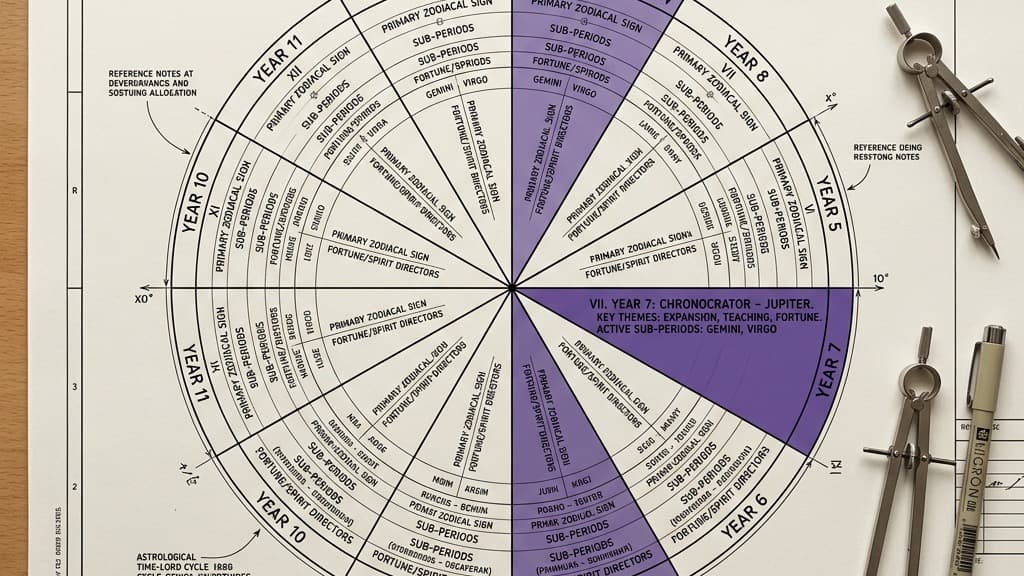
The L2 inside Aquarius lasts 30/12 = 2.5 years. Starting at Aquarius in May 2015, the L2 chain runs:
- Aquarius L2: May 2015 → Nov 2017
- Pisces L2: Nov 2017 → May 2020
- Aries L2: May 2020 → Nov 2022
- Taurus L2: Nov 2022 → May 2025
- Gemini L2: May 2025 → Nov 2027. Current. Ruled by Mercury.
Gemini L2 is ruled by Mercury, and Mercury natally is at 22° Aquarius retrograde, conjunct Mars. So the current L2 puts Mercury (the writing-and-deals planet) in the foreground, and Mercury is tied to Mars in the 7th of partnerships. The freelance contract, which is literally a partnership-Mercury document, is the L2's grammar.
Brief bullet: L2 Gemini (Mercury), current chapter is about the writing-deals-partnerships axis. The freelance contract is on-thesis for the chapter.
Step 5: Convergence test
The procedure that separates a thin transit read from a layered one is the convergence test. Where does the year-lord, the L2 lord, and a major transit point at the same week?
For T.R.:
- Year-lord: Venus.
- L2 lord: Mercury.
- Major transit: Saturn conjunct natal Venus, three exact passes in 2026-2027.
The Saturn pass dates land at 14 May 2026, 22 Sep 2026, 9 Feb 2027. Mercury, the L2 lord, makes its own significant transits in 2026: it stations retrograde at 26° Cancer on 29 July 2026, then again at 4° Pisces on 14 November 2026. Neither retrograde station lands inside ±10 days of a Saturn pass. So the L2 lord and the year-lord do not converge on the same week.
However: the Saturn pass on 14 May 2026 lands just 28 days before the 6-week contract deadline she mentioned (mid-June). The first exact Saturn conjunction to the year-lord arrives exactly at the moment the contract has to be signed.
Brief bullet: Saturn exact on Venus 14 May 2026, one month before contract deadline. The decision lands inside the Saturn structural pass.
Step 6: Write the brief
I write the 5-bullet brief I use for every session. For T.R.:
- Year-lord Venus in 9th from Libra-profected 3rd. The year is publishing-and-foreign-travel about the photojournalism.
- L2 Gemini (Mercury), current chapter through Nov 2027. Writing-deals-partnerships axis.
- Saturn conjunct natal Venus, 3 exact passes: 14 May, 22 Sep 2026, 9 Feb 2027. Structural year event.
- Solar eclipse at 12° Libra, 29 Sep 2026, opposition Venus. Visibility-and-rupture marker.
- Jupiter trine Venus from Leo, peak 4 Aug 2026. Soft window six weeks long.
That is the brief. Five elements, written in 6 minutes total. The actual scanning took 4, the writing took 2. The session itself ran 75 minutes; the brief produced 65 minutes of focused conversation with 10 minutes left for client questions.
Step 7: How the conversation went
I will not paraphrase the whole reading. The 30-second version: Saturn conjunct the year-lord is the planet of consequences sitting on the planet that protagonist-s the year. It does not say no to the contract. It says: read the contract clause by clause. The triple-pass structure means the decision is going to be tested twice more after she signs. If she signs in mid-June, the September retrograde pass and the February direct pass are the moments where the consequences become visible. Saturn on Venus in the 9th is, in plain English, "the conditions of your publishing partnerships are being rewritten across this year."
She asked what I would do. I told her: sign, but negotiate the clauses that touch on territorial coverage and contract length. Saturn in the 9th argues against open-ended commitments and for time-bounded ones. A 2-year contract is sign-able. A perpetual one is not.
She signed on 9 June, with a 2-year cap. The September retrograde pass is the renegotiation; the February direct pass is the renewal-or-exit decision. We will see in 2027.
Why the workflow saves time
By hand, this is a 90-minute prep job. Compute Venus's position, table out the transits to it across 12 months, look up the eclipse degrees, compute Spirit and Fortune lots with sect handling, sequence the ZR L2 chain, find convergence windows. Each step is a 6-to-12-minute task with its own error-prone steps.
In Astrolium, every step in this post is either a click or a pre-computed value in the right rail. The math is right because the math is the same Swiss Ephemeris code I used by hand, audited and benchmarked. What I am paying for is the bookkeeping. The 4-minute workflow above produces a brief that, by hand, used to take me 75 minutes to write. Across 200 clients a year, that is the difference between 250 prep hours and 14.
What is not in the brief
The brief has 5 elements. By design. Things I did not include for T.R.:
- Solar arc directions. Without exact birth time confirmed to under 4 minutes, I do not run solar arcs. T.R.'s time is rectified to ±90 seconds, but I still do not lead with solar arcs for first-year clients. They are a confirmation tool, not a discovery tool.
- Lunar returns. Once a month is too granular for a freelance-vs-staff decision. If she asks "what week in May" I can compute the May lunar return on demand. For the brief, monthly is too noisy.
- Synastry to a partner. She has no romantic partner involved in the decision. If she did, I would add a synastry layer with that person's transits to her year-lord.
- Asteroid pack. Across the 200-client log, asteroids beyond Chiron almost never earn brief space. T.R.'s Chiron is at 22° Cancer, unaspected to the year-lord within 5°. I left it out.
Five elements. The brief is the brief. Anything more is overload.
What you need to run this yourself
Three things: a chart engine that handles sect correctly (Astrolium does, Solar Fire does, AstroGold does), a transit scanner with the ability to filter to "aspects to a single natal planet within an orb across an arbitrary date range," and a ZR ribbon. Astrolium ships all three on the predictive timing timeline. For the underlying chart math, the Saturn return calculator uses the same engine. For the year-lord computation that this whole brief turned on, see the profections calculator. For the L1/L2 ribbon: zodiacal releasing.
For pricing, the $29 per month Adept plan unlocks the scanner across an unlimited client roster. For the longer narrative companion that frames why this 5-bullet brief format works, see the 200-client case study. For the encyclopedic guide on the technique stack behind the workflow, see the profections guide and the zodiacal releasing guide.
The workflow above is the one I use. It is not the only one that works. It is the one I have run 200 times and refined to 4 minutes per chart. If you build your own, the test is the same: pick a client whose major life-pivot date you already know, run the scanner backward across that date, and see whether the brief flags the pivot. If it does, the workflow is calibrated. If it does not, find the step that missed.