I started reading Human Design alongside Western astrology in 2022, not because I converted to the system but because three clients in a row brought their bodygraph print-outs to sessions and asked what it meant when their chart said "Manifesting Generator" and their natal Sun was in Pisces. Four years and roughly 180 mixed sessions later, HD lives in a specific slot in my workflow. Not on every chart, not as a primary lens, but reliably useful in maybe a third of consultations. This is when I reach for it, when I leave it on the shelf, and what the bodygraph gives a Western reading that the natal wheel alone does not.
I will not argue HD is "real" in the way Hellenistic astrology has 2,000 years of accumulated transmission. I do not think it needs to be. What it is, is a decision-making framework with a clean vocabulary that clients can use between sessions, and that is a different job than the natal chart does.
When HD adds something to a session
The session profile where HD actually helps is consistent enough that I can describe it. The client is in their late 20s to mid 40s, has done some Western astrology with another practitioner or a consumer app, and arrives stuck on a decision. Career pivot, end of a relationship, whether to take the offer. The natal chart shows the terrain. The transits show the weather. But the question "what should I actually do, mechanically, when this decision is in front of me" is one the Western chart does not have a great answer to, beyond "your Saturn-Mars square suggests you tend to push when you should wait."
Human Design answers that question with a four-word sentence per type. Wait for the invitation (Projector). Wait to respond (Generator). Inform before acting (Manifestor). Wait for the lunar cycle (Reflector). Plus an authority (Emotional, Sacral, Splenic, Ego, Self, Mental, Lunar) which is the internal check the client runs once the strategy says go.
For a stuck client this is immediately useful. Not because it is metaphysically true. Because it is a portable rule. They walk out with one sentence they can apply Monday morning, which most natal-chart insights do not give them.
What HD answers that Western astrology doesn't
Three things, in my notes:
One. A decision protocol the client can hold. I can describe a client's natal Mercury in detail and explain how their decision-making leans analytical or intuitive. The client nods and forgets within 48 hours. I can tell an Emotional Authority Generator that they are not allowed to give a yes or no in the same conversation where the question was asked (they have to sleep on it and feel the wave) and that sticks. The mechanic is concrete. The Western description was abstract.
Two. A relationship lens that is not psychological. Western synastry compares two psyches: your Venus opposes their Mars, your Moon trines their Saturn. HD compatibility compares two response systems: this Generator's Sacral hum is hearing this Projector's invitation, or it is not. The interesting case is where the synastry looks beautiful (lots of Sun-Moon contacts, smooth Venus aspects) but the HD compatibility is grinding: two undefined Solar Plexus centers, both clients picking up each other's emotional weather and amplifying it. That diagnosis is hard to make from synastry alone.
Three. A daily energy ticker that matches what clients feel. Transits to the natal chart are slow. Even Moon transits take a couple of days at the relevant aspects. HD transits cycle every six hours through gate activations, and clients who track them notice patterns that line up with their actual energy day to day. I do not think this is more "real" than transits — it is faster, that is all. Speed makes it useful for clients who need a daily reference.
The bodygraph in 60 seconds
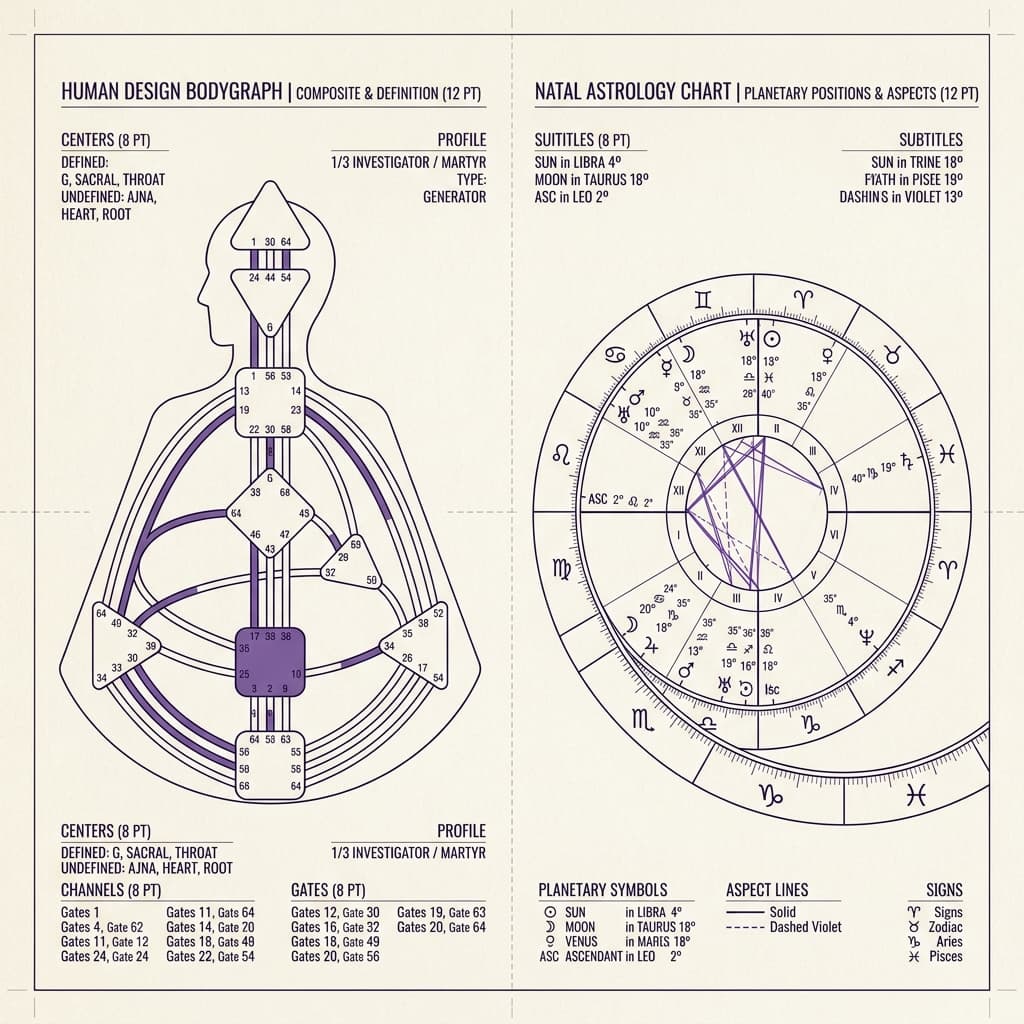
For a working astrologer who has not used HD before, here is what is on the bodygraph and what is on the Western chart side by side.
The bodygraph has nine centers (think of them as energy hubs), 36 channels (defined when two specific gates light up on either end), and 64 gates (numbered, each tied to an I Ching hexagram). The pattern of defined and undefined centers gives you type. The line under type gives you authority. The bodygraph also shows the same planetary positions as the natal chart but mapped onto the 64 gates instead of the 12 signs.
I cast the bodygraph for new clients up front with Astrolium's Human Design calculator. It takes the same birth data I already need for the natal chart and renders type, strategy, authority, profile, definition, the full gate and channel chart, and the planetary activations. Five seconds. The output sits beside the natal wheel in the client profile so I can flip between them mid-session.
The two charts look at the same person from a different angle. The natal chart says "Sun in Pisces in the 7th, Moon in Capricorn in the 5th, Saturn return last year, current profection year 8th house." The bodygraph says "Manifesting Generator, Emotional Authority, Gate 13 in conscious Sun, Gate 33 in unconscious Sun, profile 4/6, definition single." Neither is more accurate than the other. They are different vocabularies for similar territory.
Compatibility in HD vs synastry
I run both lenses on every couple's session now, where the clients are open to it. The combination is genuinely more useful than either alone. A worked example, anonymized:
A 41-year-old emotional-authority Generator and a 38-year-old splenic-authority Projector come in for a third session. Western synastry is mixed: warm Sun-Moon trine, but the Mars-Saturn square is doing what Mars-Saturn squares do. Composite is heavily 8th house. The presenting question is whether to move in together after 18 months of dating.
The HD compatibility lens, run through Astrolium's Human Design compatibility view, shows two specific things the synastry misses: the Projector has an undefined Sacral and is feeling the Generator's response energy constantly, which is exhausting for the Projector unless they have time alone to discharge it. And there are two electromagnetic channels between them (one person has the gate on one end, the other has the gate on the other end, completing the channel only when they are together), which is part of why the pull feels so strong.
The recommendation that came out of that session was not about whether to move in. It was: if you move in, the Projector needs a room of their own with a door that closes, and a daily 90-minute window where the Generator is out of the apartment. The synastry alone would have given me "watch out for the Mars-Saturn." The combined lens gave me a structural rule the clients could apply.
I do not always combine the two lenses. For first-session couples I lead with synastry, the vocabulary most clients arrive with. HD compatibility comes in by session three, when the relationship has enough texture that the structural mechanics matter more than the chemistry.
Daily transits in HD
I do not use HD transits in client sessions. They cycle too fast; a six-hour resolution does not match the cadence of a 90-minute consultation. But I do flag them for clients who want a daily reference between sessions, particularly clients who have an active journaling practice or who track their own energy carefully.
Astrolium's HD transit overlay shows the current gate activations on the bodygraph in real time and lets the client scrub forward to see what is coming. The clients who use it most are creatives: writers, designers, one psychotherapist who tracks their own state across the workday. They notice that certain channel activations correspond to days when their work flows and certain ones correspond to days when nothing wants to land, and they plan around it.
This is the part of HD where I am the most agnostic about mechanism and the most convinced about utility. Whether the gate activations are causally meaningful or whether clients are pattern-matching against a structured prompt, the effect on their week is the same: they organize the work around what they notice, and the noticing is more reliable when there is a daily structure to notice against.
Where I don't use HD
Three places, in my notes:
Predictive timing for the year ahead. Profections, Zodiacal Releasing, transits, returns: these are the right tools for "what is this year about." HD does not have a year-shaped predictive layer. The transit ticker is daily. The Cross of incarnation is lifetime. Nothing in HD answers "what is the texture of the next 12 months" the way profections and a solar return chart do for a Western reading.
Career questions where the natal Midheaven is doing real work. When a client's career question lands on a tight aspect to the Midheaven and they have a profection year highlighting the 10th, that is a Western question. HD type and profile are interesting context, but the operative information is in the natal chart and the time-lord stack.
First-session clients who arrived for traditional astrology. If the client is here for Hellenistic or psychological astrology specifically, leading with HD muddles the session. I introduce HD in session two if it is relevant and if they are curious. Not before.
A note on accuracy and source
The bodygraph calculation depends on the same Swiss Ephemeris positions the natal chart uses, plus the Human Design design calculation (88 degrees of solar arc before birth), plus the mapping of planetary positions onto the I Ching gates. Astrolium calculates all three using the standard formulas; the planetary positions match Jovian Archive's MyBodyGraph output and Genetic Matrix to the arc-second across the 50-some test charts I have cross-referenced.
The HD interpretation tradition is younger than Hellenistic astrology by about 1,985 years (Ra Uru Hu, 1987, Ibiza). I treat that the way I treat any 40-year-old system: useful for the questions it was built to answer, less authoritative than the older transmissions for the questions it was not. Most working astrologers I know use HD this way: as a complementary lens, not a competing one.
Closing: the surrounding tools that earn their keep
For the Western side of mixed sessions, the calculators I reach for alongside HD are the synastry calculator for couples work, the composite chart for the second-or-third couples session, the profections calculator for the year-ahead question, and the transit report for the predictive layer. The bodygraph sits beside them, not on top of them.
The honest summary after four years: HD is in roughly 30 percent of my sessions, leading in maybe 5 percent of them, and absent from the rest. That is the slot it has earned. For where it goes next, I am watching whether clients use the daily transit overlay between sessions; that is the leading indicator for whether HD becomes a year-round tool in my practice or stays where it is.