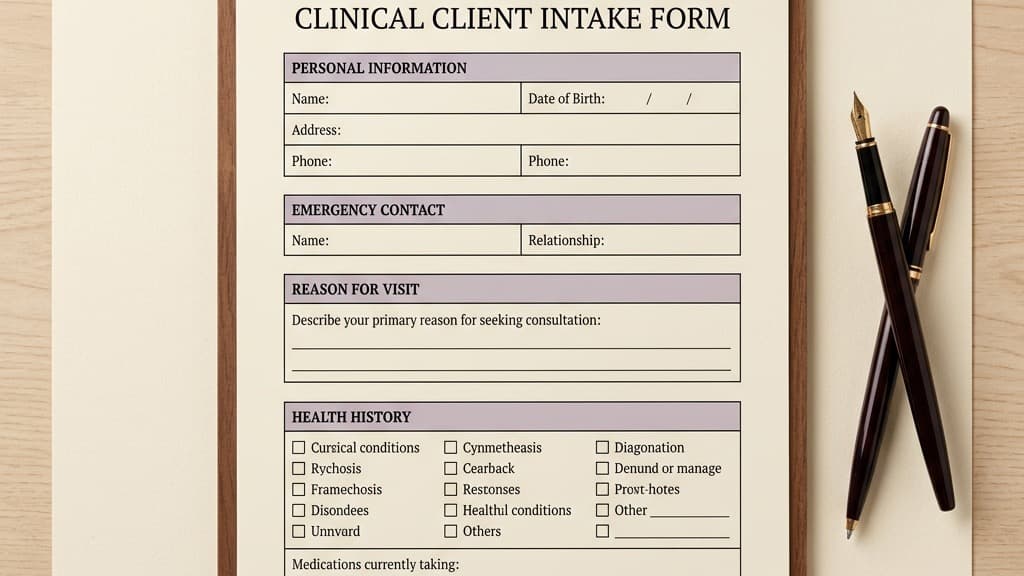
For my first 2 years of paid practice I had no intake form. I asked for birth data over email in whatever format the client typed, kept my notes in a paper journal, and trusted nobody would ever ask me about GDPR. Then in 2022 a client in Berlin asked, politely, for a copy of all data I held on her and the right to have it deleted. I had no system for either. The next month I built the intake form I still use, and last year I moved it onto Astrolium. This is the form, the 12 fields, and the reasons each one is there. See the CRM feature, the import tool, and the chart generator for the platform pieces.
The first thing to say: intake is not paperwork. Intake is the moment you set the contract for the session. If you collect the right information up front, your prep is faster, your session is better, and you are protected legally and ethically. If you do not, every session starts with a 10 minute negotiation about what we are even doing here. I learned that the slow way.
The 12 fields, in the order they appear
I have iterated this form across four versions. The current 12 fields are not the maximum I could collect. They are the minimum I need to do good work, and every field has earned its place.
1. Full legal name. Not the name they go by, the legal name. The reason is consent records: if you ever need to demonstrate that a specific person consented to your processing of their data, the name on the consent record has to match the name on whatever ID they can produce. About 30% of my clients use a different name day to day, and the form has a separate "name you prefer to be called" field for that.
2. Email address. The email is also the primary identifier in my CRM. Astrolium's CRM feature uses email as the merge key when the same person books a second session, which is how the system avoids creating duplicate profiles.
3. Phone number, optional. I ask for this but mark it optional. Half my clients leave it blank, which is fine. The ones who fill it in are usually US-based and prefer text confirmation. European clients almost never want SMS contact.
4. Birth date. This is where data quality starts mattering. I ask for the date in YYYY-MM-DD format with a hard-coded example, because I have received the same date written six different ways and reading "07/04/1985" as American or European has caused 3 chart reruns over the years.
5. Birth time. This is the field I spend the most time on. I ask three things: the time, the source (birth certificate, mother's memory, hospital record, rectified), and the confidence level (exact to the minute, within an hour, unknown). About 60% of my clients have a birth certificate time, 25% have a "my mother says around X" time, and 15% are unknown.
For the unknown cases I run the chart at solar noon and explicitly tell the client during the session that the houses and the Moon's degree are approximate. The natal chart guide has a section on what to do with unknown birth times.
6. Birth place, with country. Country is mandatory because of timezone disambiguation. There are 19 places called Springfield in the US alone, and "Cambridge" without a country could be in the UK, Massachusetts, or Ontario. Astrolium's import handles disambiguation interactively when the city name is ambiguous, but it is easier if the client tells me up front.
7. Time zone they were born in, optional. This is a backup field that 5% of clients fill in. Most do not know offhand. The reason I include it is that for births in places with disputed historical timezones (think Argentina in the 70s, or any of the dozen mid-century European DST oddities), the client's family memory of "the time on the clock that day" is often more accurate than the published historical rules. If the client knows their parents were on summer time at the time of birth, that is useful.
8. What they want from the session, free text. This is the most important non-data field. I give clients a 4 line text box and the prompt: "What brought you here, and what would make this session feel useful." Most clients write 2 to 4 sentences. The ones who write a paragraph have already done some of the work for me. The ones who write "I do not know, let us see what comes up" are telling me a different thing about how to structure the session, and that is also useful.
9. Previous astrology experience. Three radio buttons: never had a reading, had 1 to 3 readings, had more than 3 readings, plus an optional "what was useful and what was not" text field for the third bracket. This decides how much vocabulary I use. With a first-time client I avoid technical terms for the first 15 minutes. With an experienced client I lead with "your time-lord is Saturn in the 7th" and skip the warm-up.
10. How they found me. Five options: referral from a specific person, social media, web search, podcast or interview, other. The data is for me, not the client. I track it because it tells me where to invest time. Currently 58% of new clients come through referrals, 22% through web search (mostly via the Astrolium tools and free guides), 14% through Instagram, and 6% other. The split has changed twice in 3 years; tracking it lets me notice the changes.
11. Consent to data processing. A required checkbox with the specific text: "I consent to [practitioner name] storing my birth data and session notes for the purpose of conducting and following up on astrology consultations. I understand I can request a copy or deletion of this data at any time by emailing [address]." The checkbox is timestamped automatically. This is the field that protects me legally under GDPR and that protects the client by giving them a clear understanding of what they are agreeing to.
12. Recording consent, separate checkbox. I record some sessions for my own review. I never share recordings. About 40% of clients consent to recording, 60% do not. The split is fine; I do not push it. The separate checkbox is important because consent to recording is legally distinct from consent to data processing in most jurisdictions, and bundling them under one checkbox is a defective consent flow.
The fields I do not ask for, and why
Two omissions worth flagging.
I do not ask for gender. It is not relevant to the chart calculation, it is increasingly fraught to ask in a structured field, and I can pick up whatever pronouns and gender context I need from the free-text fields and the initial email exchange. If you want to ask, ask it as a pronoun field with a text input, not as a binary or even ternary radio button.
I do not ask for relationship status, profession, or any biographical context up front. Some practitioners do, and the argument is that more context allows faster prep. My argument against is that the chart is more interesting if I do not pre-frame the client's life, and biographical fields tend to invite confirmation bias in interpretation. I ask about life context inside the session, where I can read the client's body language and pace.
The intake form is a contract, not a biography. Keep it short.
GDPR and the practical version
I am based in the EU, so GDPR is the law that governs my data practices. Even if you are not, the GDPR framework is a useful design constraint because it forces you to be honest about what you are doing with client data. The practical version, written as a checklist I actually run:
- I store birth data and session notes only in Astrolium, which is hosted in the EU and encrypts at rest. I do not keep parallel notes in Evernote, Google Drive, or paper. This single-source rule is the most important data hygiene decision I have made; 90% of GDPR risk for solo practitioners is data sprawl across half a dozen tools.
- I retain client data for 5 years after the last session, then delete. The 5 year window is long enough to support returning clients, short enough that I am not sitting on an unbounded liability. Astrolium has a retention policy field on each client profile that schedules deletion automatically.
- I respond to data access or deletion requests within 30 days, which is the GDPR window. I have had 2 deletion requests in 18 months. Both were completed in under 10 minutes using the Astrolium client export and delete flow.
- I do not share client data with anyone. The third-party question matters because if you use Calendly for booking, Stripe for payments, and ConvertKit for newsletters, each of those is a data processor and each requires a separate consent flow under strict GDPR. The simpler your stack, the simpler the consent.
If you are based outside the EU you can adapt these rules, but I would argue you should adopt the same principles voluntarily. The client whose data you respect is the client who refers you.
The prep time math
Before the intake form, my first-session prep was 3 hours. After implementing the form, it dropped to roughly 90 minutes. The 40% reduction is real and the reason is concrete: with structured intake I do not spend the first 30 minutes of prep clarifying birth data, and I do not spend 20 minutes of the session itself negotiating what we are doing. Those are 50 minutes saved per first-time client, and across 4 first-time clients a week that is 3 hours back.
The form does not save time on follow-up sessions, because returning clients do not re-fill it. What does save time on follow-ups is the running notes file in the Astrolium CRM, which keeps the last session's themes and the client's stated areas of focus visible at the top of the profile.
What I would change
One. I would add a "preferred language" field for international clients. Right now I default to English and ask in the email exchange if the client prefers German or Italian. A field would make the choice explicit and avoid the awkward moment where a client asks "do you do this in German" after they have already booked an English session.
Two. I would simplify the time confidence field from three buckets to two. The "within an hour" bucket is the messy middle and clients do not know what to do with it. Exact-to-the-minute or unknown is cleaner. The intermediate case can be handled inside the session.
Neither of these is critical. The form has worked at 12 fields for 18 months and I am wary of adding fields just because I am writing a post about them.
The take-home
If you do not have an intake form, build one. If you have one but it is not structured, restructure it. The 12 fields above are mine and you can copy them, but the actual list does not matter as much as the fact that you have one and that it includes explicit consent. The hour you spend building this form pays back the first time a client comes to you with a question about their data, and it pays back every week in faster prep.
For the booking and CRM piece, the Astrolium CRM handles intake, consent records, and retention automatically once you set the schema. For the chart generation that follows intake, the chart generator is the entry point. For a fuller view of the practice infrastructure see the features overview and current pricing.
The intake form is the boring part of the practice. The boring part is also the part that lets the interesting work happen safely.