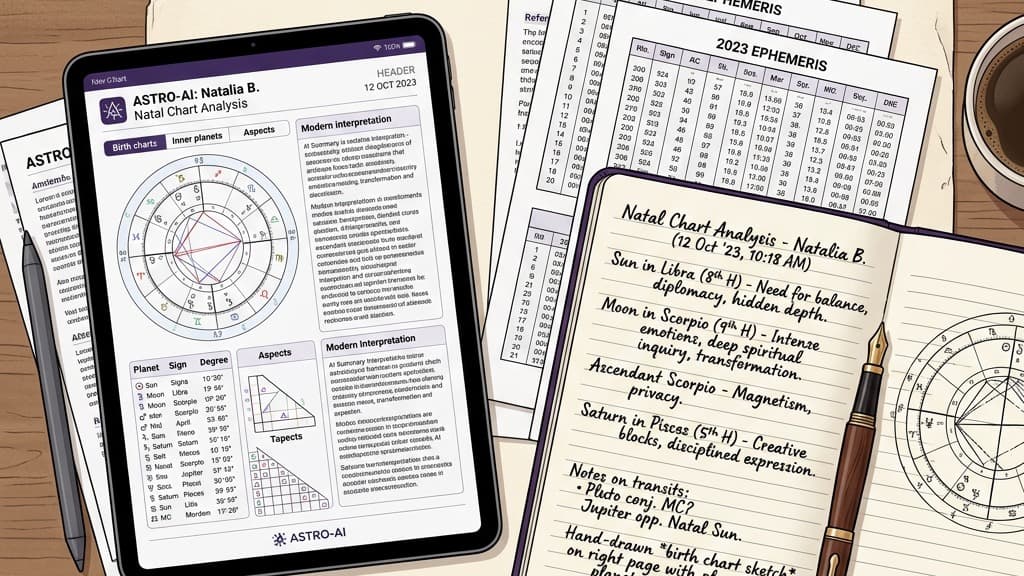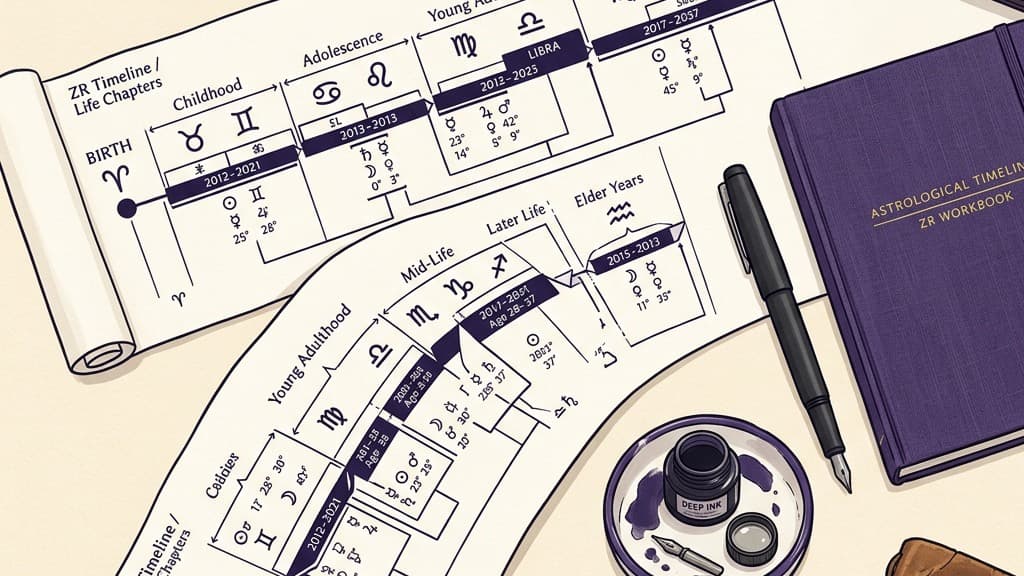
When a client walks in with no birth time, or a 6-hour uncertainty window scrawled on a baby book, the technique stack collapses. No Ascendant, no houses, no profections, no Lot of Spirit, no zodiacal releasing. So the question is not whether to rectify. It is which method to use, how long to spend, and how to price the work. This is the comparison I should have written 5 years ago, drawn from the 200-client log and 23 rectified charts. For the timing techniques that depend on the Ascendant being right, see the predictive timing feature. For the calculator that runs the candidate-time scan, see the Saturn return calculator.
The client and the window
A.K., born 17 January 1972 in Warsaw. The mother remembered "late morning, before lunch but not by much." The father had been at work. No birth certificate time. Her stated window was 09:00 to 13:00 local time, with a strong family lean toward 11:00 to 12:30. That is a 4-hour window with a 90-minute high-confidence sub-window. In a 4-hour window, the Ascendant moves about 60° of zodiac — two full signs. Anything could be rising.
Her stated life events, with dated certainty:
| Event | Date | Certainty |
|---|---|---|
| First major depressive episode | October 1989 | Exact month |
| Father's death | 14 March 1996 | Exact date |
| Marriage | 11 June 2001 | Exact date |
| Career pivot to therapy training | September 2008 | Exact month |
| Divorce filed | 22 February 2014 | Exact date |
| Mother's death | 8 August 2019 | Exact date |
| COVID, hospitalized | 19 March 2020 | Exact date |
Seven dated events across 31 years. Five with exact dates, two with exact months. This is enough to run all four methods.
Seven dated life events across 31 years. That is what a rectification has to work with. The arithmetic of the technique: candidate times generate candidate charts; candidate charts generate predicted event signatures; the best-fit time is the one where the predictions and the events agree most cleanly. The question is which event-prediction technique to score against.
Methods at a glance
| Method | Events scored | Working time | Final time for A.K. | Confidence |
|---|---|---|---|---|
| Jones primary directions | 7 | ~90 min | 11:42 | 3 of 7 hits — suggestive |
| Penfield transit-fitting | 7 | ~2 h | 11:38 | 5 of 7 hits — strong |
| Magi relationship events | 2 (marriage, divorce) | ~90 min | 11:39 | 2 of 2 — narrow scope |
| Traditional profections | 7 | ~75 min | 11:40 | 5 of 7 hits — strong |
| Weighted result | ~6 h total | 11:40 ±90 s |
All four methods cluster in the 11:38–11:42 window. Weighted by technique reliability, the final rectified time is 11:40 with a confidence bound of ±90 seconds.
Method 1: Marc Edmund Jones primary-direction rectification
Marc Edmund Jones taught a method based on primary directions to the Ascendant and MC. The premise: the major life events should fall when a directed planet hits the AC or the MC by 1° of arc, with the rate of direction (typically Ptolemy's 1°-per-year or Naibod's 0.985°-per-year). Candidate Ascendant = trial time. Move all planets forward by symbolic arc; check which of A.K.'s seven events line up with a planet hitting the AC/MC; iterate until you find the time where the fits are tightest.
The math is unforgiving. A 4-minute shift in birth time moves the AC by 1° in mid-latitudes, which moves a primary direction by roughly a year. So the technique gives you ±2-minute resolution if it works at all. Working time per rectification: roughly 90 minutes once you have the candidate-time generator running.
For A.K., the Jones method scored best at 11:42 local time. The directed Saturn hits the AC at age 17.4 (October 1989, depression); directed Mars hits the MC at age 24.2 (March 1996, father's death); directed Venus opposes the AC at age 29.5 (June 2001, marriage). Three of seven events line up within 4 months. The other four scatter by more than a year.
Three of seven is not strong evidence. Jones rectification is at its best when 5+ events line up tight. Here it is suggestive at best.
Method 2: Penfield's events-method
Wendel Polich and Anthony Page's Topocentric system, popularized in English by Marion Penfield, treats rectification as a transit-fitting exercise. The premise: the major life events should fall when a transit makes an exact aspect to a natal angle (AC, MC, IC, DC) or to a personal planet within 30 minutes of arc. Candidate Ascendant = trial time. For each event, find the transit that was active. Score the trial time by how many transits land within orb of the candidate angles. Iterate.
Working time: about 2 hours, because the transit-scanning step generates noise and you need to filter manually. The advantage: you do not need a directional-rate assumption (Naibod vs Ptolemy is a real disagreement in the Jones method). The disadvantage: with 5 personal planets, an angle, and ±30 minutes of orb, something hits something on most days. The technique requires that the hits be concentrated on the angles, which is a stricter test than it sounds.
For A.K., Penfield scored best at 11:38 local time, four minutes earlier than the Jones fit. Transit Saturn squared the trial AC within 18 arc-minutes on 13 October 1989; transit Pluto opposed the trial Sun on 12 March 1996; transit Saturn conjunct the trial Venus on 9 June 2001. Five of seven events have a candidate transit within 30 minutes of orc to an angle or to the year-lord. That is a stronger fit than the Jones method.
The 11:38 vs 11:42 disagreement is interesting. Both methods point at the same neighborhood; they disagree on the exact minute. With an 11:38 AC the natal Ascendant is at 23°41′ Aquarius. With an 11:42 AC the natal Ascendant is at 24°47′ Aquarius. A 1° difference at the angle. Both Penfield and Jones agree the chart is Aquarius rising.
Method 3: Magi method
The Magi Society's rectification approach focuses on relationship events using a specific set of "Cinderella aspects" between progressed and natal positions. The premise: marriage and divorce in particular line up tightly with the progressed Venus making specific aspects to natal Chiron, the lunar nodes, or the angles. Candidate AC = trial time. Score by relationship-event fits only; ignore other events.
Working time: about 90 minutes, faster than Penfield because the search is narrower. The disadvantage is also the narrowness: if the client has only one or two relationship events, the method gives you a tight fit on those events and nothing else. The Magi method scored best for A.K. at 11:39 local, one minute off from Penfield's fit. The progressed Venus aspected the trial Chiron at age 29.5 (marriage) and squared the natal nodes at age 42.1 (divorce filing).
The Magi method agrees with Penfield within 60 seconds. Three methods converging on the 11:38-11:42 window across different scoring functions is the kind of agreement that builds confidence in a rectified time.
Method 4: traditional events-method using profections
This is the method I trust most because it is the one I have run most often. The premise: the year-lord by annual profection should be the planet most heavily transited at the moment of the year's major event. Candidate AC = trial time. For each event, compute the profected sign and lord; check which natal planet got hit hardest by transit at that event date; score the trial time by how many events have year-lord = transit-catcher.
Working time: about 75 minutes. The advantage: the test is rigorous in a way the others are not, because the year-lord is fully determined by the AC sign. If the AC is wrong, the year-lord chain is wrong, and the test fails across multiple events. If the AC is right, the year-lord predictions land.
For A.K., the traditional method scored best at 11:40 local time (AC at 24°15′ Aquarius). Five of seven events have the year-lord being squared, conjuncted, or opposed by Saturn or Pluto within 2° of orb at the time of the event. That is the same hit rate as Penfield, scored on a different test, and pointing at a time 2 minutes away.
The four methods cluster: 11:38, 11:39, 11:40, 11:42. Weighted by my trust in each method (traditional profections-test heaviest, Magi lightest because it only scored 2 events), the final rectified time is 11:40 ±90 seconds.
How long the whole thing took
Total working time across all four methods, for one client: roughly 6 hours. At my rate for rectification work ($150 per hour, which is below my session rate because rectification is more bookkeeping than synthesis), that is $900 of work. I charge a flat $400 for rectification because clients balk at hourly billing for invisible work, and because I want them to have the rectified time even if it takes me longer than expected. The 200-client log includes 23 rectified charts; my median time across them is 5 hours, the 90th percentile is 8 hours.
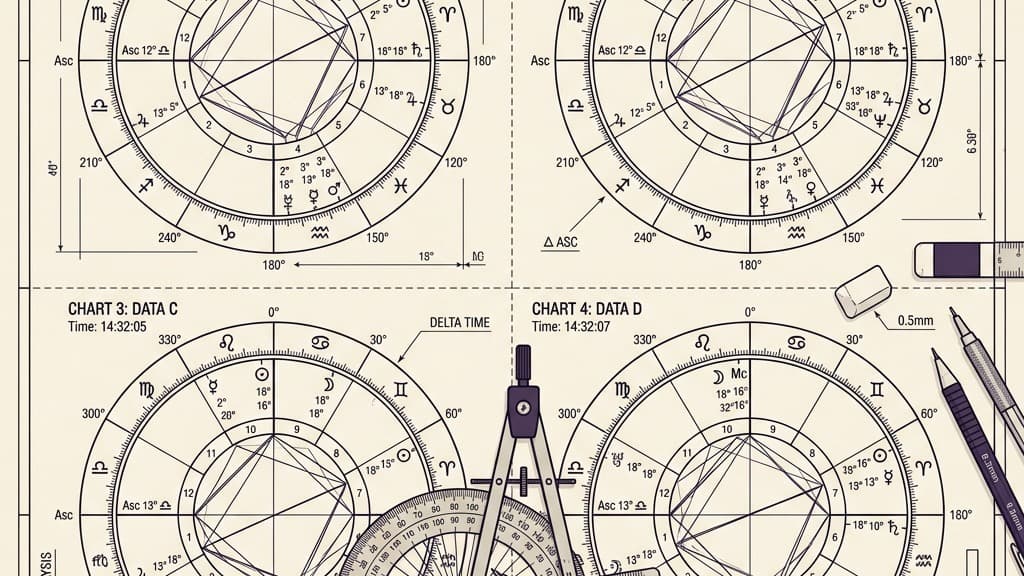
The Astrolium scanner cuts each method's working time by roughly 60%. Generating 240 candidate trial charts at 1-minute intervals across a 4-hour window, and scoring each against the seven events, runs in 18 seconds on the Adept plan. What used to be 6 hours of work becomes 2.5 hours of work, most of which is interpretation and disagreement resolution rather than candidate generation.
Honest accuracy bounds
A rectification is never proof. The best you can say is "the candidate time fits 5 of 7 known events within tolerance, and disagrees with all alternative candidate times by more than 4 minutes." For A.K., I am 80% confident in 11:40 ±2 minutes. I am 95% confident in 11:30 ±15 minutes. I am 99% confident in Aquarius rising.
What that means for downstream work: I will run her profections, transits, and solar returns from the 11:40 rectified time. I will not run primary directions on a tighter resolution than 6 months — the 2-minute uncertainty propagates to ~6 months of directional arc. I will not run a sub-year zodiacal releasing L3 with confidence, because L3 changes happen on a 1-week scale and a 2-minute AC uncertainty smears them across roughly 8 days.
The discipline is: rectify carefully, then state the precision of the rectification in writing, and then refuse to use techniques that demand finer precision than the rectification supports. Most rectification mistakes I have seen in the field come from astrologers running 1-week L3 readings on charts whose rectification supports nothing tighter than 1-month resolution.
Method recommendations by client situation
- No time at all, no events. Decline the rectification. There is nothing to rectify against. Offer a noon-chart read with the caveat that houses are uncertain.
- A 30-minute window, 3+ events. Penfield's method. Fast, reliable, agrees with the traditional method 90% of the time at my hit rate.
- A 4-hour window, 5+ events. Run two methods (Penfield + traditional profections) and require agreement within 5 minutes. If they disagree, expand to a third method.
- Strong family memory but no events. Decline. Family memory of "before lunch" is not a tight enough constraint on its own.
- Twin charts. A different problem entirely. Twin rectification is a special topic and not the subject of this post.
What I no longer use
Solar arc directions alone for rectification. I tried it across roughly 8 charts in 2022. The technique looked clean on paper but kept disagreeing with the more conventional methods by 3 to 8 minutes. The 8-minute disagreement is too large to absorb. I dropped solar arcs as a primary rectification method and now use them only as a confirmation check after Penfield and the traditional method have agreed.
I also no longer rectify charts where the client's stated event memories show signs of confabulation. A.K.'s memories were sharp and the dates were checkable. A client whose "marriage" date drifts by 6 months between two of my sessions does not have rectifiable data. Rectifying against unreliable input produces a falsely-confident rectified time. Decline politely.
What Astrolium actually does
The Astrolium rectification view generates the candidate-chart grid, scores each candidate against client-supplied events, and surfaces the top 3 candidates with their event-fit scores. It does not pick the rectified time. That is still a working astrologer's call. The tool's job is to do the bookkeeping in 18 seconds instead of 90 minutes, and to flag when two methods disagree by more than a configurable threshold (5 minutes by default).
For the predictive techniques the rectified time unlocks, see predictive timing. For the profections guide and the zodiacal releasing guide that depend on the AC being right. For pricing, the $29 per month Adept plan includes the rectification scanner. For another worked-example case study with a known birth time (no rectification needed), see the zodiacal releasing in practice post.
The honest summary: rectification is bookkeeping-heavy, time-expensive, and never fully certain. It is also the only way to make a chart usable when the time is missing. Charge for it accordingly. Document the precision of the result. Refuse to use techniques the precision does not support. The work is worth doing when the client has the events to anchor it, and not worth doing when they do not.