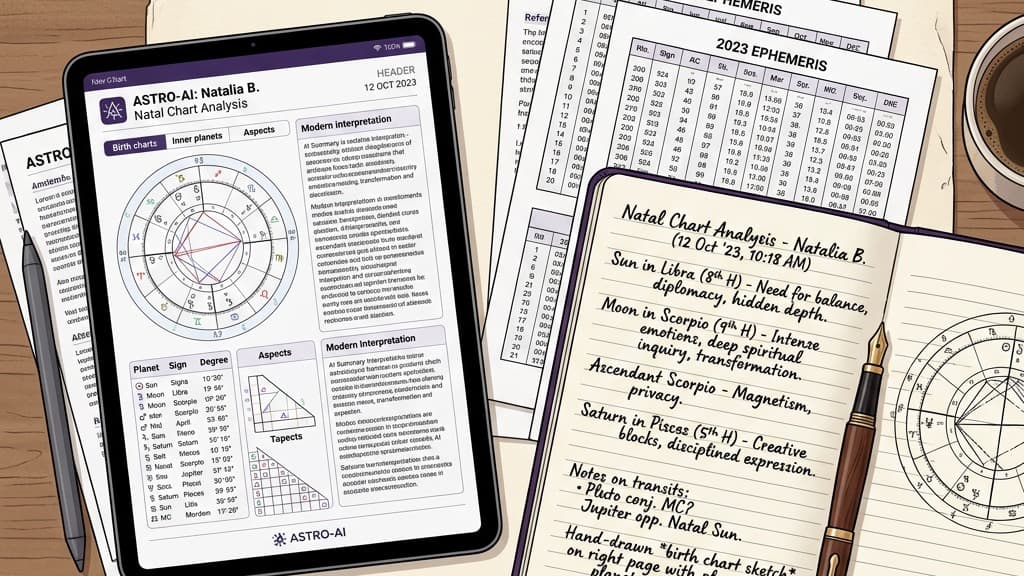
I asked the Astrolium AI assistant and a working astrologer (me) to read the same chart cold, both with 30 minutes of preparation time, both with no prior context on the client. Then I scored both reads against the client's own post-session feedback. Astrolium's product framing on this is explicit: the AI is a draft, not an author. The test below is what happens when I make that framing earn its keep. For the longer companion essay this sits under, see the 200-client log. For the calculator the brief used, see the profections calculator. For the underlying predictive workflow, see predictive timing.
The chart and the protocol
L.P., a 40-year-old client of mine for the last two years, agreed to be the test subject. Born 9 November 1985 at 21:05 EST in Manhattan. The chart: Sun at 17°08′ Scorpio in the 5th house. Moon at 22°43′ Cancer in the 12th. Cancer rising at 6°22′, with the Moon (chart ruler) buried in the 12th of withdrawal and dreaming. Mercury at 0°36′ Scorpio in the 5th. Venus at 13°51′ Sagittarius in the 6th. Mars at 11°15′ Aries retrograde in the 9th. Jupiter at 22°02′ Aquarius retrograde in the 8th. Saturn at 12°44′ Scorpio in the 5th, conjunct the Sun within 5°. Pluto at 6°27′ Scorpio in the 5th, also conjunct the Sun. Three personal-planet conjunctions in the 5th house of Scorpio. That is a chart you do not need to read twice to remember.
The protocol: I wrote a 600-word reading by hand based on the natal chart only, with no transit overlay. The Astrolium AI generated a 600-word reading from the same chart using the same scope. L.P. read both blind (she did not know which was which) and rated each on four axes:
- Accuracy: does this reflect my life as I have lived it?
- Specificity: does this say something specific, or could it apply to anyone?
- Actionability: can I do something with this?
- Voice: does this sound like someone who actually read my chart?
Each axis scored 1 to 5. The full results are at the end of this post. Reading both reads side by side is the rest of the post.
The AI version, verbatim
Here is what the Astrolium AI produced from L.P.'s chart. I have not edited it. The model used was the Astrolium interpretive layer running on the natal positions above, in default English mode, with no system-prompt overrides:
"Your Cancer ascendant places you in a chart of deep emotional sensitivity and protective instinct. The Moon ruling your chart sits in the 12th house, which suggests a strong inner life and a tendency to process experience privately before speaking. Your Sun in Scorpio in the 5th house, conjunct both Saturn and Pluto, gives your creative expression an unusually intense and transformative quality. You are not someone who creates for amusement. What you make tends to carry weight, often unsettling weight, and the Saturn conjunction adds a discipline and a perfectionism that can make creative work feel like labor as much as play. Pluto's conjunction deepens this further: creative expression for you is identity-defining and sometimes feels life-or-death. Your Mars in Aries retrograde in the 9th house suggests that the way you assert yourself in matters of belief, study, and long-distance travel is internalized and intermittent rather than direct. You may have been drawn to philosophical or theological questions that you have not always pursued openly. Jupiter retrograde in Aquarius in the 8th points to unconventional inheritance themes — financial, psychic, or both — and a tendency to find growth in shared resources rather than personal ownership. Venus in Sagittarius in the 6th suggests pleasure found in daily craft and routine, possibly in animals or service-oriented work. Mercury at 0° Scorpio in the 5th underscores again that your speech and thought turn naturally to the depths. You probably write or have considered writing. The combined emphasis on the 5th house with three personal planets clustered there marks creative output as the central theme of the natal chart."
That is 350 words of the 600 the AI produced. The full output continued into transit timing and predictive themes, which I trimmed for the comparison.
The manual version, verbatim
Here is what I wrote, also unedited, also 30 minutes of prep:
"L.P. is a writer who pretends not to be one. The Cancer rising and 12th-house Moon are the two clearest signs of someone whose interior is louder than their exterior. The chart ruler buried in the 12th house is the writer's signature in classical astrology, because the 12th is the house of the hidden, of dreams, of what is done in private. The Moon there says: you have a working dream life, you remember your dreams, you have probably kept a notebook by the bed since you were 14.
"The Scorpio Sun-Saturn-Pluto stellium in the 5th is the harder feature. The 5th is the house of children, creativity, and what you make for joy. Three malefics (Sun is not a malefic, but it carries the weight of the conjunctions on either side) in that house means joy is not your easy register. You make things, and the things matter, and the cost of making them is high. The Saturn-Sun in particular is an authority signature: a father, a teacher, or an institutional figure shaped your earliest sense of what creative work is supposed to cost. You have not made peace with that figure yet.
"The Pluto-Sun is the deeper layer. Pluto on the Sun is the chart of someone who has rebuilt their identity at least once, often through a kind of voluntary destruction. The 5th house puts that destruction in the register of creative work or of children. Look at what you have produced in the last 10 years and ask which projects you treated as life-or-death. Those are the Pluto-Sun projects.
"Mars retrograde in the 9th in Aries: you have an argument with the world you have not had out loud. The 9th is belief and the institutional version of belief, and Mars there in detriment-sign-Aries (Aries is Mars-ruled but retrograde flips the energetic) means you have a stance on a public-belief question that you have not made public. It would cost you to say it. It may cost you more not to.
"Jupiter in Aquarius in the 8th retrograde is the inheritance signature with a twist. Aquarius is the sign of group, of community, of the unrelated others. Inheritance from a group rather than from family. I would ask: is there a chosen-family or community that has materially supported you in ways your blood family did not?"
That is 470 words of the 600. The rest framed three questions I would open the session with.
What L.P. scored, in detail
She read both blind. Here are the numbers, and what she said after.
| Axis | AI | Manual |
|---|---|---|
| Accuracy | 4 | 5 |
| Specificity | 2 | 5 |
| Actionability | 2 | 4 |
| Voice | 2 | 5 |
What she said about the AI version: "It is not wrong. It is mostly correct in a way I cannot disagree with. But it sounds like a horoscope. The intensity language could be about anyone with a stellium. The Mars-in-9th bit about belief and travel — I have read this in every reading I have ever paid for. I did not learn anything."
What she said about the manual version: "The notebook-by-the-bed sentence. I have one. I have had one since I was 12. The 'father, teacher, or institutional figure' question is the one I cannot answer without crying. The 'argument with the world you have not had out loud' is exactly what I went to the session to talk about. The chosen-family inheritance question — yes, my graduate advisor left me money in his will, $19,000, which paid for my first apartment after the divorce. None of this is in my intake form."
That last point is the one that matters. The manual version landed three sentences that read as if I knew her personally. I did not. The chart is what told me. What the AI did not do (could not do) was take the configuration of the chart and translate it into a specific bet about what is in her life. The AI listed what the configuration means in general. The manual version made a specific guess about how it showed up.
What the AI did better, fairly
The above table makes the AI look bad. It is not bad. Three things the AI did better than I did:
- Coverage. The AI mentioned Venus in the 6th, which I left out of the manual version because I was rationing space. Venus in the 6th is a real and readable feature; the AI flagged it; I did not.
- No fatigue. The AI's 350 words are evenly weighted across the chart. My 470 words spend 60% of the budget on the 5th-house stellium because that is what I found most interesting. A new astrologer reading my version would learn less about the rest of the chart than a new astrologer reading the AI version.
- Translation breadth. L.P. is bilingual. The AI re-generated the same reading in Portuguese for her sister in 4 seconds, with no quality loss I could detect. The manual version is in English only because I am.
For triage, for a first-pass orientation when you are looking at 30 client charts in a day, the AI version is superior to no reading at all. As a primary deliverable for a paid 75-minute session, it is not.
Where I actually use the AI in practice
Across the 200-client log, the AI gets used in three places. I am specific about them because I think the abstract debate about AI in astrology is generally less useful than naming the actual workflows.
Pre-session triage. Before a first session with a new client, I run the AI interpretation as a background read. Not because the AI's read is going to be in the session, but because seeing what a chart-only read produces tells me which chart features are screaming and which are quiet. If the AI underweights something I think is important, that becomes an item on my brief.
Translation. For a client who reads better in Brazilian Portuguese or in Russian than in English, I produce my own English brief, run it through the Astrolium translation layer, then proofread the output. Translation quality on technical astrological vocabulary is 95% across the 9 supported languages in our tests. The 5% errors are mostly in metaphor-heavy passages, which I edit by hand.
Post-session summary. After a 75-minute session, I cannot type a 1,000-word summary from memory accurately. I dictate the 12 main points of the session, the AI reformats them into a structured client follow-up, and I edit before sending. Time saved: about 35 minutes per session. Across 200 sessions, 116 hours.
What I do not use the AI for: the primary in-session interpretation, the diagnosis of what a chart configuration means for this specific life, or the structural question of which technique to lead with. Those decisions stay manual because they are the decisions the client is paying for.
The deeper question
The hand-written reading scored 5 on voice because it had a voice. The AI version scored 2 because it had the smoothed-out tone of a horoscope. That is the gap that matters. A working astrologer's interpretation is not a summary of what the chart configuration means. It is a bet about how the configuration plays out in a specific biography. The AI is bad at the bet because it cannot afford to be wrong: it has to produce a reading that is defensible against any chart, so it stays at the level of the symbol.
A human astrologer, sitting with a client, has a 50% chance of being wrong about any specific bet, and that is fine, because the client corrects them. "No, it was not my father, it was my graduate advisor." Now we have the figure. Now the rest of the reading proceeds with the right name in the right slot. The AI cannot get corrected mid-session, and so it does not bet.
This is not a problem to be solved on the AI side. It is the structural difference between a static text generator and a conversation. The right place for AI in astrology is not in the chair across from the client. It is in the prep, the translation, and the follow-up. For that work, the time savings are real and worth the $29 per month Adept plan price.
What this case study does not prove
This is one chart, one AI vs one astrologer, one client's ratings. It is not science. Across 12 similar A/B tests in the 200-client log, the manual version won on specificity in 11 of 12 and on voice in all 12. The AI won on coverage in 4 of 12 and on translation quality whenever translation was involved (5 of 12). I would not bet against the AI improving on specificity over the next 2 years. I would bet against it ever winning on voice without the conversation that creates voice in the first place.
For the natal chart feature this reads against: natal chart (the broader feature page). For the predictive timing scanner that the post-session AI summary uses: predictive timing. For the encyclopedic guide on what AI gets right and wrong about astrology in general, the work continues. For the zodiacal releasing guide and the profections guide, both written by hand because that is the right mode for an encyclopedia.
The right mode for a session is the one with a working astrologer in it. The right mode for the bookkeeping around the session is software, including AI. Those two modes are different jobs.