Astrolium treats mundane astrology as the elder branch of the craft. The earliest surviving astrological texts (Babylonian omen literature, Hellenistic ingress methods, the Arabic-era conjunctionalist tradition) are mundane before they are natal. Mundane astrology reads the chart of a collective entity: a nation, a city, a treaty, the world. It asks what the sky says about the conditions of an era rather than the conditions of a person.
For the active mundane event of the late 2020s, see Saturn-Neptune in Aries. For the underlying chart work, the ephemeris gives outer planet positions you can plot against national charts and ingress moments.
Mundane astrology is the branch of the craft that applies astrological methods to collective entities (nations, organizations, world events) rather than to individuals, using ingress charts, lunation charts, eclipse charts, and outer planet cycles as primary tools. It is the elder branch: Babylonian omen literature, Hellenistic ingress methods, and the Arabic-era conjunctionalist tradition are mundane before they are natal. The dominant annual reference is the Aries ingress chart, cast for the moment the Sun crosses 0 degrees Aries each March 20 at a given capital. Key cycles include Jupiter-Saturn conjunctions (every 20 years, the Great Mutation entered air at 0 degrees Aquarius in December 2020), Saturn-Pluto conjunctions (every 33 to 38 years, structural crisis), and Saturn-Neptune conjunctions (every 36 years, next exact February 2026 in Aries). Nicholas Campion's Book of World Horoscopes catalogs national charts. Astrolium's ephemeris provides outer planet positions for plotting against ingress moments and national charts.
The four foundational charts
Working mundane practice rests on four chart types that, used together, cover most of what a serious practitioner needs:
The Aries ingress chart. Cast for the moment the Sun crosses 0° Aries each year, conventionally around March 20. The chart is calculated for whichever location the astrologer wants to study (Washington for US affairs, London for British, Beijing for Chinese, and so on). The Aries ingress is the dominant annual chart in the Western mundane tradition, with the chart's angles, luminaries, and the condition of the chart's ruler giving the year's basic signature for that location.
The capital city ingress charts. Some practitioners run quarterly ingresses (Aries for spring, Cancer for summer, Libra for autumn, Capricorn for winter), especially for cardinal sign rising charts where the Aries ingress is treated as effective for the full year and supplementary cardinal ingresses for the relevant quarters. The cardinal ingress doctrine traces to Ptolemy and was elaborated in the Arabic period.
The lunation charts. Every new moon and full moon produces a lunation chart. For mundane work, lunations close in degree to a chart's sensitive points (a national chart's MC, the Aries ingress chart's Ascendant) are treated as activating that point for the duration of the lunation (about 2 weeks for a new moon, 2 weeks for a full moon). Lunations are the short-term timing layer underneath the slower ingress and outer planet layers.
Eclipse charts. Solar and lunar eclipses are extreme lunations that carry forward for longer windows. A solar eclipse degree falling on or close to a national chart's luminary or angle correlates with major activation in that nation's affairs over the following 6 to 18 months. Eclipses also have multi-year cycles (the Saros series) that link an eclipse to the same Saros position 18 years earlier, which mundane astrologers use to anticipate themes recurring with a generation's delay.
National charts and the founding moment
A national chart is the horoscope cast for a nation's founding moment. The trouble is that most nations have several candidate founding moments, and practitioners argue about which to use. The argument is not academic: different charts produce different forecasts.
The United States is the textbook case. The Sibly chart (July 4, 1776, 5:10 PM in Philadelphia, Sagittarius rising) is the most widely used and the one most often cited in mundane research. Other practitioners prefer the Sibly chart's time as 5:00 PM, or the Gemini Rising chart (around 2:21 AM on July 4), or the Scorpio Rising chart from earlier sources. Nicholas Campion's The Book of World Horoscopes catalogs the contenders in detail and remains the working reference for national chart selection.
For the United Kingdom, William the Conqueror's coronation on December 25, 1066 in Westminster gives one frequently cited chart. The Act of Union of 1801 (creating the United Kingdom of Great Britain and Ireland) gives another. The current United Kingdom dates from 1922 (after Irish independence), giving yet a third. Each chart describes a different layer of the entity called Britain, and a careful practitioner often reads several in parallel.
The methodological discipline: never claim a single national chart "is" the chart of that nation. Hold several in parallel. Read for which chart speaks loudest to the period under study. A chart that goes silent for decades and then activates during a major event is showing you when it speaks; another chart speaks during other events. This is normal for entities as complex as nations.
What are the major planetary cycles in mundane astrology
Outer planet cycles give mundane astrology its long-range forecasting backbone. The cycles to track:
Jupiter-Saturn conjunction. Roughly every 20 years. The Great Mutation (the shift from one element to another) happens every 200 years approximately, with the most recent shift in December 2020 when Jupiter-Saturn left the earth element and entered air at 0° Aquarius. Air-element Jupiter-Saturn cycles run until approximately 2199 and are associated by mundane theorists with information, networks, and ideological systems as the dominant arenas of collective activity (where the prior earth cycle, running roughly 1802 to 2020, foregrounded materialism, industry, and territory).
Saturn-Pluto conjunction. Roughly every 33 to 38 years. Saturn-Pluto conjunctions and oppositions correlate with structural crisis: economic collapse, regime change, war. The 1914 Cancer conjunction, the 1947 Leo conjunction, the 1982 Libra conjunction, and the 2020 Capricorn conjunction all sit at major collective inflection points.
Saturn-Neptune conjunction. Roughly every 36 years. The 1917 Leo conjunction (Russian Revolution, end of empires), the 1953 Libra conjunction (postwar settlement, UN consolidation), the 1989 Capricorn conjunction (fall of the Berlin Wall, Soviet dissolution), and the 2026 Aries conjunction now active. See Saturn-Neptune in Aries for the detailed reading.
Jupiter-Uranus conjunction. Roughly every 14 years. Often correlates with technological or social breakthroughs (1969 lunar landing, 1983 emergent personal computing, 1997 internet mass adoption, 2010 mobile platform shift).
Uranus-Pluto. Conjunctions and squares of these two slow-moving planets define multi-decade revolutionary periods. The 1930s saw the conjunction (Depression, rise of totalitarian regimes); the 1960s saw the opposition (civil rights, anti-colonial movements, counterculture); the 2010s saw the square (Arab Spring, Occupy, the rise of mass digital protest movements). These are not single events but multi-year fields of activity.
How do eclipses function in mundane timing
Eclipse work in mundane astrology rests on a few stable principles. The eclipse degree matters most. A total solar eclipse at 18° Scorpio is meaningful for charts with planets or angles near 18° Scorpio (and at 18° Taurus by opposition, with squares at 18° Leo and Aquarius giving secondary activations).
The Saros series gives historical pattern. Each eclipse belongs to a Saros series of 71 to 87 eclipses spanning roughly 1,200 to 1,500 years. Eclipses in the same Saros series, separated by 18 years, frequently mark related thematic events. The 1991 total solar eclipse over Europe (Saros 136) preceded the formal Soviet dissolution by 5 months and the actual loss of the Eastern European satellite states by even less; the 2009 eclipse from the same Saros series fell during the European debt crisis and the broader Western financial unravel that began in 2008.
Angular eclipses are stronger. An eclipse falling on the angles (Ascendant, MC, IC, Descendant) of a national chart or an Aries ingress chart for a capital is treated as more strongly activating than an eclipse falling in a cadent house. Practitioners watch the next 6 to 18 months for events in the affairs of that nation that match the eclipse's house and sign signature.
The mundane reading of eclipses is not deterministic. An eclipse degree on a national luminary correlates with activation; it does not cause specific events. The practitioner uses the eclipse to identify when a nation will be in flux and where the flux will concentrate (which department of national life is most under pressure), then watches the actual unfolding rather than predicting it in advance.
Practitioner workflow for mundane work
A working method for a mundane practitioner who is not a full-time researcher:
-
Annual scan. Each year around the Aries ingress, cast the Aries ingress chart for the locations you cover (your country and 2 to 4 others you follow closely). Read the chart's angles, the condition of its ruler, and the placement of the outer planets. Note any conjunctions of the ingress chart's angles or luminaries with the chart's outer planets.
-
Quarterly refresh. At each cardinal ingress (Aries, Cancer, Libra, Capricorn), refresh the ingress chart and note shifts in the angular structure. Cardinal sign rising in the Aries ingress traditionally extends the chart's validity for the full year; non-cardinal rising signs traditionally require quarterly reset.
-
Monthly lunation watch. Each new moon and full moon, note where the lunation falls in degree. Check against your national charts and the year's ingress charts for hits within 2° of sensitive points. Hits give you a 2 to 4 week window of activation in that area.
-
Eclipse calendar. Maintain a calendar of solar and lunar eclipses 12 to 24 months ahead. Note the degree, the Saros series, and any contacts to charts you read. Eclipse hits on national luminaries are the strongest single signal in mundane forecasting.
-
Outer planet long range. Once a year, sketch the next 5 to 10 years of outer planet movement (Saturn through Pluto). Note the sign changes (Saturn changing signs roughly every 2.5 years, Uranus every 7, Neptune every 14, Pluto every 12 to 30 depending on its speed). Note conjunctions, oppositions, and squares between outer planets and their dates.
-
News calibration. Correlate your readings with actual events. Mundane astrology is judged by its hit rate over time, not by any single forecast. A practitioner who keeps a notebook of forecasts and outcomes builds calibration faster than one who only publishes the hits.
Where does mundane astrology intersect with personal practice
Outer planet transits to a natal chart are the mundane current arriving in a person's individual life. A native born with Sun at 5° Aries is receiving the 2026 Saturn-Neptune conjunction directly on the Sun, which means the mundane theme of the era and the personal theme of the year are the same theme for that person. This is the meeting point of mundane and natal astrology, and it explains why outer planet transits feel like external events imposing themselves on personal life: they are precisely that.
Generational signatures sit at the same intersection. A Pluto-in-Virgo cohort (born roughly 1957 to 1972) shares a generational signature that flavors how they collectively experience health, work, and detail. A Pluto-in-Scorpio cohort (born roughly 1983 to 1995) shares a different generational signature around power, intimacy, and transformation. These generational placements are mundane facts that shape personal natal readings.
The election year context is worth keeping in mind for vocational and business astrology. A client launching a venture in a year when the Aries ingress chart for their capital shows a malefic on the MC is launching into a year of public-affairs friction in that location. The election can still work; the mundane backdrop is part of the conditions the election has to thread.
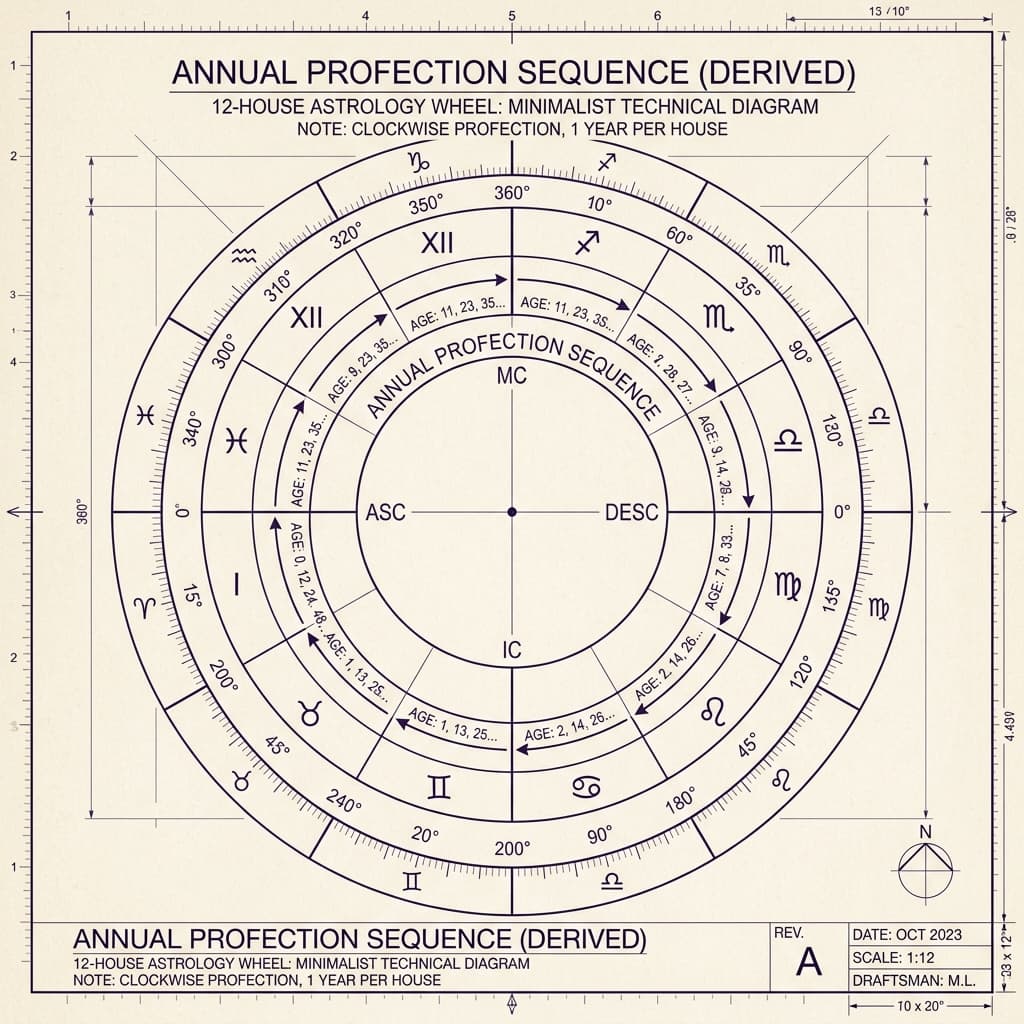
For the annual signatures specifically, the profections calculator gives the annual time lord for a natal chart, which integrates the personal year with the mundane year.
Recommended reading
- Nicholas Campion. The Book of World Horoscopes (Cinnabar Books, 1988, rev. 2004). The reference work for national charts.
- Nicholas Campion. Astrology and Popular Religion in the Modern West (Ashgate, 2012). The cultural history that contextualizes mundane practice.
- Richard Tarnas. Cosmos and Psyche (Plume, 2007). The major modern work correlating outer planet cycles with cultural history.
- Charles E. O. Carter. An Introduction to Political Astrology (Fowler, 1951). The classic British practitioner reference for political work.
- Liz Greene. The Outer Planets and Their Cycles (CRCS, 1983). The psychological-mundane intersection in workable form.
Astrolium's mundane resources include the ephemeris for outer planet positions, the Saturn-Neptune in Aries deep dive for the active conjunction, and the profections and annual profections guide for the personal year that overlays the mundane year. For mundane work that needs a moving symbolic clock against a national chart, the solar arc directions calculator is the standard technique. For the per-degree symbolic overlay applied to outer-planet stations, see the Sabian symbols calculator.