Your profection year is one calculation: take your age, divide by 12, add 1 to the remainder. The result is the house Astrolium activates for the twelve months between your last birthday and the next one. One house, one ruling planet, one year. This guide explains what to do with that number.
For an instant result, run the profections calculator. For the full forecasting stack with transits, returns, and zodiacal releasing on one timeline, see predictive timing.
What is an annual profection
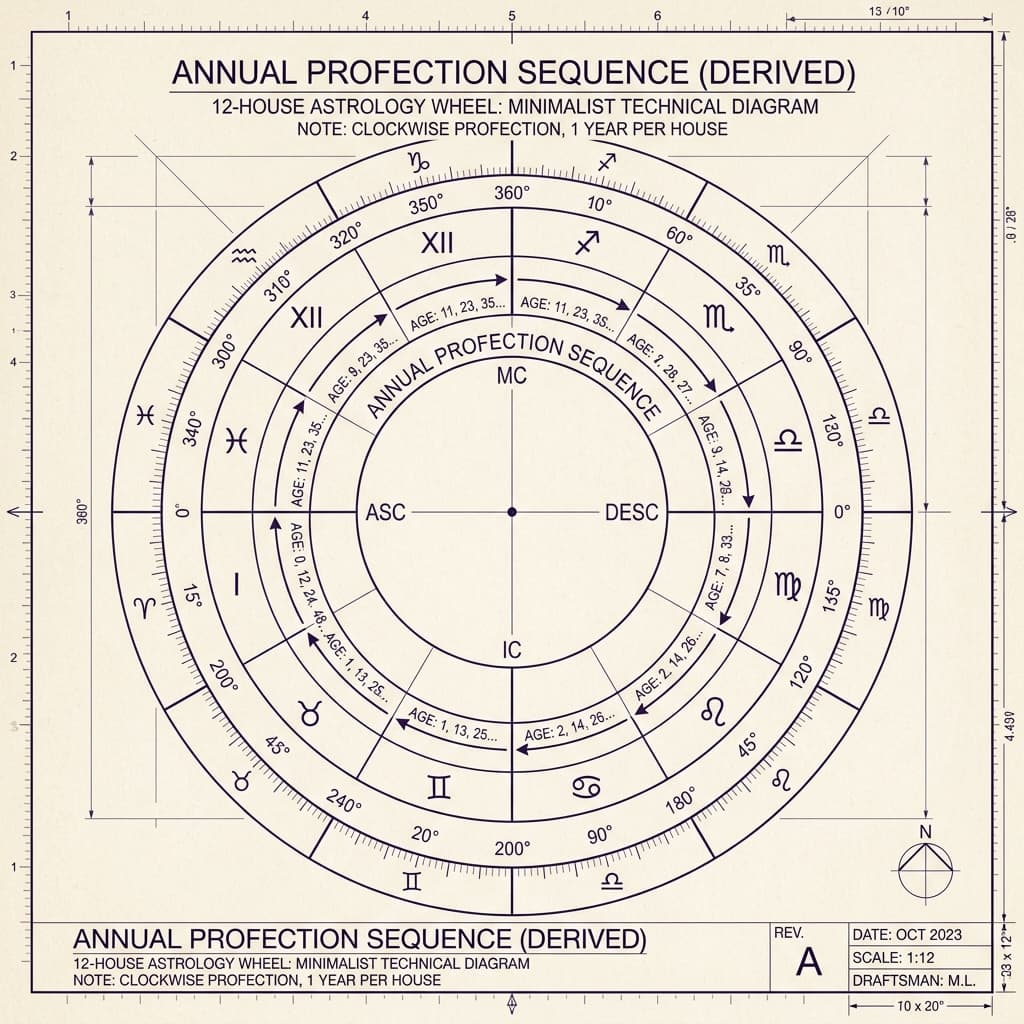
An annual profection is a Hellenistic timing technique that assigns each year of life to one of the 12 houses, cycling through them in order. Age 0 activates the 1st house. Age 12 returns to the 1st. Age 23 lands on the 12th. The planet ruling the activated sign becomes the time-lord of the year, and that lord's natal house, condition, and current transits set the year's structural agenda. The technique appears in Paulus Alexandrinus's fourth-century Introduction to Astrology and ran through the medieval tradition before disappearing under modern psychological astrology; the 1990s Project Hindsight translations returned it to working practice. Hand and Brennan both describe it as the most reliable annual timing tool in the Hellenistic toolkit. Astrolium computes profections from birth date and time, names the year-lord, reports the lord's natal placement and current transits, and stacks profections against transits and Zodiacal Releasing on one ribbon for the Adept tier. Free, no account required.
The technique appears in Paulus Alexandrinus's fourth-century CE Introduction to Astrology and runs through the whole medieval tradition. It disappeared from Western practice for several centuries as astrology turned psychological, then came back through the Project Hindsight translations in the 1990s. Robert Hand and Chris Brennan both describe it as the most reliable annual timing tool in the Hellenistic toolkit. The reason it lasted 17 centuries: it is almost embarrassingly simple, and it works.
Simple here means specific. At any moment you can identify one house, one sign, and one planet that carry the year's weight. That focus is not a limitation. It is the point.
For a deeper look at where the technique comes from and how the math is built, see the profections guide. This guide is organized around a different question: given that you know your profection year, what does it actually tell you?
How profections work
Each birthday you advance one whole sign from your Ascendant, moving through the zodiac in order. The sign you land on is the profected sign. The house it occupies in your natal chart is the profected house. The planet that rules that sign under classical rulership is your time-lord for the year.
The formula: house = (age mod 12) + 1.
Age 0 gives house 1. Age 11 gives house 12. Age 12 gives house 1 again.
A few things to know before you start reading:
- Always use classical rulerships. Mars rules Scorpio, Saturn rules Aquarius, Jupiter rules Pisces. The outer planets postdate the technique by almost two millennia and move too slowly to function as meaningful year-rulers.
- Always rotate by whole sign. Even if you read natal charts in Placidus, the profection wheel turns by sign, not by degree-based quadrant division.
- The year runs birthday to birthday, not calendar year to calendar year. If you turned 36 in October, your 7th-house profection year runs until next October.
The profected Ascendant is the sign the 1st house has moved to for the year. If your natal Ascendant is Taurus and you are 24, you have completed 24 full years of life. House = (24 mod 12) + 1 = 1. You are back in a 1st-house year, with Taurus profected, meaning your Ascendant sign and your profected sign coincide. The ruler of Taurus, Venus, is your time-lord.
At age 25: (25 mod 12) + 1 = 2. Second house, Gemini, Mercury rules the year.
The 12-year cycle
The wheel turns one sign per year and resets every 12. Each house carries its classical themes, and those themes become the year's primary territory.
1st house (ages 0, 12, 24, 36, 48, 60, 72, 84)
Self, body, identity, new beginnings. The time-lord is the planet ruling your Ascendant sign, which means this is a year when the ruler of you rules the year. Often a year of reorientation. New looks, new projects, a shift in how you present. More energy available.
The 1st-house return every 12 years is a natural reset. Age 12 is adolescence beginning. Age 24 is the first post-college identity. Age 36 is the mid-thirties reassessment. Each feels different because the time-lord is colored by whatever has happened to that planet in the intervening years.
2nd house (ages 1, 13, 25, 37, 49, 61, 73)
Money, possessions, what you value, what you own. Income shifts are common. Often the year someone renegotiates compensation, takes on debt, builds savings, or confronts how little they actually own of their own life. The 2nd house is also the house of your own resources: not just financial ones, but voice, skills, and what you have available to spend.
3rd house (ages 2, 14, 26, 38, 50, 62, 74)
Siblings, neighbors, communication, short travel, the daily mind. Writing, speaking, and teaching often intensify. Classes taken or taught. The local environment becomes charged. Email volume rises. Some practitioners find this is the year a piece of writing gets finished or published: the project that had been sitting in the drawer for two years.
4th house (ages 3, 15, 27, 39, 51, 63, 75)
Home, family of origin, ancestry, real estate. Literal moves are common. Family-of-origin matters surface, sometimes as a physical visit, sometimes as a pattern you suddenly recognize in your own behavior. Parents become significant. Often a year of digging: into the past, into the house you grew up in, into what you carry.
5th house (ages 4, 16, 28, 40, 52, 64, 76)
Children, creativity, romance, pleasure, play. The house of what you make for joy rather than necessity. Pregnancies cluster here in charts where children come. So do love affairs, creative breakthroughs, and the side projects that turn into the main project. Not a year for grinding. A year for making.
Note that age 28 is a 5th-house year for many people. It coincides with the first Saturn return window. A 5th-house profection during a Saturn return often shows up as creative labor made serious: the book finally written, the pregnancy finally kept.
6th house (ages 5, 17, 29, 41, 53, 65, 77)
Work, service, health, the daily routine. This is the grind house, but generative. Many people build their most durable practices here: the morning run, the therapy commitment, the new diet that actually sticks. Health concerns surface and, addressed, become disciplines. The 6th house rewards routine and punishes its absence.
7th house (ages 6, 18, 30, 42, 54, 66, 78)
Partnership: marriage, business collaboration, open enmity. The year's significant other walks in, whether as partner, rival, or both. Contracts. The 7th is the mirror house: who shows up is telling you something about yourself. Often the year of the wedding, the divorce, the lawsuit, or the business deal.
Age 30 is a 7th-house year. Combined with the tail end of a Saturn return, this is why so many people experience a major relationship shift in the year or two after their first Saturn return. The structures of the Saturn return land in a year when partnership is foregrounded.
8th house (ages 7, 19, 31, 43, 55, 67, 79)
Shared resources, debt, inheritance, the partner's money, mortality, and transformation. Not the easiest year. Often a death in the family, or a brush with mortality, or the first serious reckoning with debt or taxes. Chris Brennan describes the 8th house as the house of other people's resources: the year you deal with money that is not yours, on terms that are not yours. It compresses people. It usually produces depth.
9th house (ages 8, 20, 32, 44, 56, 68, 80)
Travel, higher education, philosophy, publishing, and the horizon. The year the world gets bigger. Often literal travel to somewhere significant. Often a return to school or a shift in worldview. Books get written and published. Belief systems that no longer fit get put down. The 9th house is where the mind reaches past what is familiar.
Age 32 is a 9th-house year, and it is worth flagging: this comes during the long tail of the first Saturn return in many charts. People who spent ages 28 to 30 rebuilding their structure often use the 9th-house year to educate themselves differently, to travel, or to articulate what they now believe. The rebuild and the expansion happen in that sequence.
10th house (ages 9, 21, 33, 45, 57, 69, 81)
Career, reputation, public role, authority. The ambition year. Promotions happen. Companies get founded. Public recognition arrives. The 10th house year is often the one that looks most legible from the outside, the year something visible was accomplished. Read the time-lord carefully: if it is afflicted natally, the apex can be a stumbling or a public correction rather than a triumph.
11th house (ages 10, 22, 34, 46, 58, 70, 82)
Friends, allies, community, hopes. Classical astrology called this the house of Good Spirit. In practice: a new friend arrives who changes something. A coalition forms. A long-held goal suddenly within reach. Often the year you find your people, or rediscover them after years of drift. Professionally, the year of the network event that matters.
12th house (ages 11, 23, 35, 47, 59, 71, 83)
Solitude, hidden enemies, what is being undone, retreat. The quiet year before the 1st-house reset. Often not much happens publicly. Quite a lot happens internally. This is the year for therapy, for spiritual practice, for clearing the desk. 12th-house years reward deliberate withdrawal; they punish overexertion in the wrong direction. Many people describe their 12th-house years as the ones they finally got honest with themselves.
The 12th house is also the house of what you cannot see. If there are enemies operating against you, they are not visible this year. If there are patterns running your life from underground, this is when they surface enough to be caught.
One practical note for clients approaching a 12th-house year: set expectations. This is the year to consolidate, to rest, to do the background work that does not show up in public yet. The 1st-house year that follows will use everything built here. The 12th-house year is not lost time. It is preparation that has not been announced.
The time-lord planet
Once you know your profected house, look at the planet ruling that sign. That planet is your time-lord for the year.
Classical rulerships:
- Sun rules Leo
- Moon rules Cancer
- Mercury rules Gemini and Virgo
- Venus rules Taurus and Libra
- Mars rules Aries and Scorpio
- Jupiter rules Sagittarius and Pisces
- Saturn rules Capricorn and Aquarius
Three things to read about your time-lord:
The natal house the time-lord occupies is the secondary area of life the year emphasizes. A year ruled by Mercury, with natal Mercury in the 4th, is a year where communication, writing, or learning shows up in the context of home and family. The profected house and the natal house of the time-lord are the year's two protagonists.
Its dignity matters. A time-lord in its own sign or exaltation has resources. It can act. A time-lord in detriment or fall is working against friction: the year's themes still show up, but the planet is less able to produce clean results. A 10th-house year with a time-lord in detriment often brings career visibility without the outcomes you wanted.
Its natal aspects are activated for the year. A Venus year with Venus conjunct Saturn natally means Saturn themes run through the entire Venus year: discipline, delay, restriction, and sometimes the serious commitment that felt impossible before.
Example
Suppose your Ascendant is Scorpio and you are turning 33. House = (33 mod 12) + 1 = 10. Tenth-house year. The 10th sign from Scorpio is Leo. The Sun rules Leo. The Sun is your time-lord.
Locate the natal Sun: say it is in the 3rd house in Capricorn, conjunct Saturn. This is a public career year (10th house) whose time-lord sits in the house of communication and writing (3rd), in the sign of structure and discipline (Capricorn), in a tight conjunction with Saturn.
The reading: a year when career becomes visible through writing, communication, or teaching. Saturn conjunct the Sun means the career year is structured and possibly slow. Not a windfall. A construction. When transiting Jupiter aspects the natal Sun, that is the opening window.
Profections and transits
The profection identifies the planet. Transits time the events.
On its own, knowing you are in a Venus year tells you what terrain the year covers. It does not tell you when or what. Transits to Venus answer those questions.
The time-lord functions as the year's transit catcher. Astrologers working with profections typically narrow their orbs and pay closer attention when any major planet aspects the natal time-lord, because the technique tells them this is the planet that matters this year. A Saturn square to the time-lord in March means March is when the year's structural pressure lands. A Jupiter trine in September means the year's opening arrives in September.
A few patterns worth knowing:
Saturn transits to the time-lord describe the year's limiting events: the contract, the ceiling, the consequence, the delay that turns out to be the right delay. Hard Saturn aspects (square, opposition, or conjunction) to the year-lord often coincide with the year's most defining pressures.
Jupiter transits to the time-lord are the opportunities. Jupiter moves fast enough to produce one or two clear windows per year. When Jupiter makes a trine or conjunction to your natal time-lord, that window is the year's most likely opening.
Mars transits to the time-lord are the dates within the larger movements: the day an event crystallizes, the week a conflict peaks. Mars moves quickly enough to describe individual events rather than seasons.
Eclipses on the time-lord's natal degree are the year's most significant markers. A solar or lunar eclipse on or opposite the natal time-lord often correlates with a turn in the year's narrative. When you are in a 7th-house profection year and an eclipse falls on your natal Venus, you are very likely looking at a major relationship event.
When the time-lord turns retrograde by transit during your profection year, the year's themes tend to deepen, loop back, or produce a revisitation of something from an earlier year. A Mercury retrograde during a Mercury-ruled year often brings back a conversation, a contract, or a person from a previous Mercury year. This is not always unwelcome. Sometimes the second pass resolves what the first pass only opened.
The year your time-lord is combust by conjunction to the transiting Sun is a year when the lord's significations are temporarily burned away. Events tied to those significations may not reach their expected form. This is a classical concern that modern practitioners sometimes overlook.
Profections in client work
The question that opens a profection reading is simple: what house are you in this year?
Many clients can answer this in a few seconds once you give them the formula. The house tells them what area of life the year foregrounds, and that often matches what they already sense. They came in about a career question and they are in a 10th-house year. They are navigating a relationship and they are in a 7th-house year.
The faster reading method: identify the profected house and the time-lord, then ask where the time-lord sits natally. That natal house gives you the second topic the year is running. The reading is then a conversation between two houses and the planet connecting them.
For client sessions, profections pair naturally with solar returns. The profection gives you the year's ruling planet and house. The solar return chart, drawn for the birthday and relocated if the client has moved, shows the year's angles and how the time-lord shows up in that chart. When the time-lord is angular in the solar return, the year tends to be eventful.
Profections and zodiacal releasing operate on different scales. ZR maps eras, often a decade or more. Profections map the year inside that era. When both techniques point at the same planet, when the profection time-lord also rules the current ZR L2, the year's themes are reinforced. When they diverge, you are often reading a year of mixed signals: one technique says career, the other says retreat.
A worked case
Suppose a client is a Virgo Ascendant at age 40, turning 41. House = (40 mod 12) + 1 = 5. Fifth-house year. The 5th sign from Virgo is Capricorn. Saturn rules Capricorn. Saturn is the time-lord.
Natal Saturn is in the 10th house in Gemini, square Venus in the 1st.
The reading: a creativity and children year (5th house) whose time-lord is Saturn in the career house (10th), square Venus in the 1st. This is not the easy 5th-house year of romance and play. It is a year when creative work becomes serious, possibly public, possibly lucrative. Saturn adds weight. The Venus square from the 1st means the creative output is entangled with identity and personal relationships. The client may find this is the year a creative side project becomes a professional commitment. When transiting Jupiter trines natal Saturn, that is when the project gets traction.
The practical instruction: watch Saturn's transit this year. Any hard aspect from a slow outer planet to natal Saturn is the year's structural pressure. The client's creative output is the terrain. The outcomes will feel more Saturn-flavored than the 5th-house label suggests.
How to calculate yours in Astrolium
Run the profections calculator: enter your birth data, and the tool returns your current profected house, the ruling sign, the time-lord planet, and the time-lord's natal position. No formula required.
The Astrolium natal chart shows the profection overlay in the timing panel, including the activated house highlighted in the profection wheel. If you are consulting for clients, the Adept plan at $29 per month runs profections across your entire roster and flags whose time-lord is being aspected by a major transit this month. That is your natural booking priority list.
For the full forecasting context alongside profections, the predictive timing feature stacks the profection year against zodiacal releasing, transits, and returns on one timeline.
The zodiacal releasing guide explains the longer cycle your profection year sits inside. The Saturn return guide covers the structural pivots that frame many of the most significant profection years. For the broader Hellenistic framework these techniques belong to, see the Hellenistic astrology guide.