
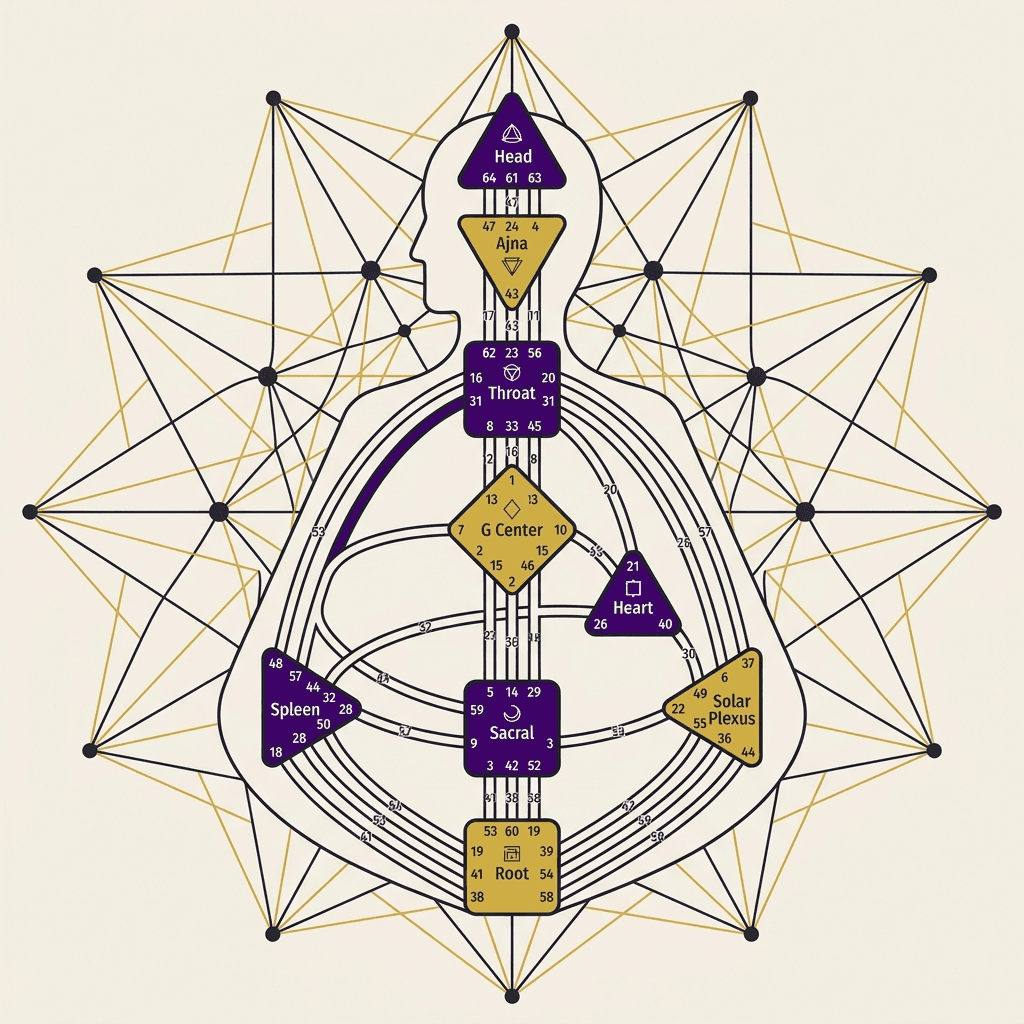
Astrolium's Human Design guide covers what you actually need to work with your chart: Type, Strategy, inner Authority, and the nine-center bodygraph. Human Design synthesizes four traditions into a single system, and its core claims are specific enough to be testable against your own experience. To calculate your bodygraph, use the Human Design calculator with your birth date, time, and city.
Human Design is a synthesis system developed by Alan Robert Krakower (writing as Ra Uru Hu) and made public in 1987, combining Western astrological positions, the 64 hexagrams of the I Ching, the Kabbalah's Tree of Life, and the Hindu-Brahmin chakra system into a single bodygraph diagram. The chart uses two calculations: the conscious moment of birth, and the unconscious chart from 88 degrees of solar arc before birth (roughly 88 days earlier). It produces 9 centers connected by 36 channels composed of 64 gates, generating one of 5 Types (Generator 37%, Manifesting Generator 33%, Projector 20%, Manifestor 8%, Reflector 1%) with a corresponding Strategy and one of 7 inner Authorities (Emotional, Sacral, Splenic, Ego, Self-Projected, Mental, Lunar). Defined centers produce a consistent signal; undefined centers amplify the environment. Astrolium's Human Design calculator generates your full bodygraph with Type, Strategy, and Authority from your birth data.
What is Human Design
Human Design was developed by Alan Robert Krakower, writing under the name Ra Uru Hu, and made public in 1987; it is taught today through Jovian Archive, the school he founded. It draws on four sources: Western astrology (for planetary positions and chart calculation), the I Ching (64 hexagrams mapped to 64 genetic codons and 64 gates in the bodygraph), the Kabbalah's Tree of Life (for the structure of the centers), and the Hindu-Brahmin chakra system (for the energy quality of those centers).
The synthesis produces a chart called a bodygraph: a diagram of nine centers connected by 36 channels, each channel composed of two gates. The gates are numbered 1 through 64 and correspond to hexagrams of the I Ching. A gate is activated when a planet occupies the corresponding degree zone in the chart. When both gates of a channel are activated, that channel is defined, and the center it connects becomes defined as well.
Defined centers are consistent sources of the quality that center represents. Undefined centers are open, taking in and amplifying that quality from the environment rather than generating it steadily. Whether a center is defined or undefined in your chart is the basis for almost everything else: your Type, your Authority, your energy management, and how you make decisions.
The five Types
Type is determined by which centers are defined and how they connect. There are five Types. The population breakdown is approximate but consistent across large Human Design datasets.
Generators make up about 37 percent of people. They have a defined sacral center, no defined throat-to-motor channel connecting directly to the throat, and are described as the workforce of humanity: they have sustained life-force energy that regenerates through sleep. The defined sacral produces a pre-verbal gut response, a literal "mm-hmm" or "un-uh," that signals whether something is correct for them before the mind gets involved.
Manifesting Generators account for roughly 33 percent. They share the Generator's defined sacral but also have a defined channel connecting a motor center to the throat, giving them the capacity to initiate action. They are faster and less linear than pure Generators: they frequently skip steps, circle back, and work in parallel tracks simultaneously.
Projectors are about 20 percent of the population. They have no defined sacral center and no consistent motor-to-throat channel. Instead of sustained generative energy, they have a penetrating awareness that can see into the energy and mechanics of others more clearly than Generators typically see themselves. They are designed to guide rather than produce, and they work most effectively when their guidance is specifically requested.
Manifestors are around 8 percent. They are the only Type with a direct motor-to-throat connection and no defined sacral. Historically, Ra Uru Hu described them as the initiators: the people designed to start things that others then sustain. They can act without waiting for anything, but their impact on the energy of people around them is significant, which makes informing before acting practically important rather than just polite.
Reflectors are the rarest Type, about 1 percent. They have no defined centers at all. Every part of their bodygraph takes in definition temporarily from people they spend time with and from the moon's transit through the 64 gates over a 28-day cycle. They are designed to reflect the health of the communities and environments they move through.
Strategy
Each Type has a Strategy: the recommended decision-making approach that tends to produce less resistance and more satisfaction over time.
Generator Strategy is to wait to respond. This runs against the common advice to go after what you want, which is why many Generators find it counterintuitive at first. Waiting to respond does not mean passivity. It means allowing circumstances, conversations, opportunities, or questions to arrive rather than mentally constructing a goal and pushing toward it. When something activates a genuine sacral response, the Generator has a clear signal. Ignoring that signal in favor of mental decisions tends to produce the frustration that Ra Uru Hu identifies as the Generator's primary signature of misalignment.
Manifesting Generator Strategy is the same: wait to respond, then inform. The addition of informing before acting matters because Manifesting Generators have the motor energy to move fast, and when they do without notice, they often encounter resistance from people who feel bypassed.
Projector Strategy is to wait for the invitation. For major life decisions, particularly involving work, relationships, and place of residence, Projectors tend to produce their best outcomes when they have been specifically invited rather than having pushed their way in. Unsolicited guidance, even when accurate, frequently falls flat for Projectors because the receptivity is not there. The emotional signature of a Projector out of alignment is bitterness; in alignment, it is success.
Manifestor Strategy is to inform. Because Manifestors initiate and move quickly, the people around them can feel blindsided. Informing before acting, not asking permission but simply communicating intent, tends to reduce the resistance Manifestors otherwise meet. Anger is the Manifestor's out-of-alignment signature.
Reflector Strategy is to wait a lunar cycle. Because Reflectors are entirely open and have no fixed energetic definition, they are significantly influenced by whoever they are around and by the moon's transit. Major decisions made before the 28-day cycle completes tend to feel premature later. The Reflector's signature when aligned is delight; when misaligned, disappointment.
Authority
Authority is the second operational concept in Human Design, and it is more specific than Type or Strategy. If Strategy tells you when to act, Authority tells you how to know what to do. The system identifies seven authorities, arranged in a hierarchy based on which centers carry the most consistent and reliable signal.
Emotional authority applies to everyone with a defined solar plexus center, roughly half of all charts. The emotional center produces a wave that moves between highs and lows on its own schedule. Human Design's position is that any decision made at a peak or a trough of that wave is being made under distortion. The guidance is to wait for the wave to settle, not to a flat neutral, but to a place of relative clarity, before committing. This can take hours, days, or longer depending on the decision.
Sacral authority applies to Generators and Manifesting Generators with an undefined solar plexus. The sacral response is immediate and bodily: a sound, a gut tightening or opening, a physical sense of expansion or contraction. It precedes thought. The challenge is learning to ask yes-or-no questions that can activate a sacral response rather than abstract ones that require mental analysis.
Splenic authority is rare. The spleen center in Human Design is the system's intuitive immune response. When it speaks, it speaks once, quietly, and does not repeat. People with splenic authority are designed to act on that first intuition without waiting or deliberating.
Ego authority (also called Will or Heart authority) is uncommon and applies to specific Projector and Manifestor bodygraphs. The will center drives decisions. If it doesn't want to, the answer is no.
Self-Projected authority applies to Projectors with a defined Identity center (G center) connected to the throat but no defined sacral or solar plexus. Decision-making happens through talking it through with trusted others, not to get their advice but to hear what comes out of one's own mouth.
Mental (Environmental) authority applies to Projectors with no defined center below the throat. These people are designed to make decisions by changing their environment and noticing what feels right there.
Lunar authority belongs to Reflectors alone, who rely on the full 28-day moon cycle described in the Strategy section.
How to use your Human Design in Astrolium
Astrolium's Human Design calculator generates your full bodygraph from birth date, time, and location. It identifies your Type, Strategy, and Authority, marks every defined and undefined center, and shows your gates and channels with both the conscious (birth) and unconscious (88 degrees before birth) activations distinguished. That is the free, no-account version.
The Human Design workspace in the app keeps the same chart on a saved birth record and splits the reading across nine tabs: Overview, Centers, Channels, Activations, Transits, PHS, Cycles, Timing and Pair. Overview holds the core mechanics, and it names the Incarnation Cross with its angle, labelled Right Angle, Juxtaposition or Left Angle, beside Type, Strategy, Authority, Profile and Definition. Centers gives each of the 9 its state and the channels producing it; Channels lists both gates and the circuit they belong to; Activations is the raw list of 26 placements across Design and Personality.
Transits works on a moment rather than a vague today: enter a date and time in UTC and the tab returns the transit gate activations, the temporary channels they complete against your natal gates, and any center that comes into definition for that moment, with a standing note that none of it changes Type, Strategy or Authority. Cycles handles the slower passes in Human Design terms, covering Solar Return, Lunar Return, Saturn Return, Uranus Opposition and Chiron Return, each with its exact instant and whether the planet was direct or retrograde. Timing is the birth-time sensitivity check: pick an interval around the recorded time and the app lists which layers stay stable and which flip, which is the honest way to handle a client who says "sometime in the evening."
PHS carries the Variables, Determination and Environment among them, in observational language throughout, with a health notice stating plainly that Determination is not diet, medical or nutritional advice. Pair puts two saved people into one combined BodyGraph, classifies every channel contact as Electromagnetic, Companionship, Dominance or Compromise, and produces no compatibility percentage at all, deliberately. Both the single chart and the pair sheet export as PDF, Report Studio assembles a full written reading or a pair reading from the calculated facts, and Sky, the assistant, answers scoped to what is on screen and is instructed against medical claims and guaranteed events.
Start with your Type and Strategy. These two pieces alone are enough to begin experimenting. Try following your Strategy for 90 days across low-stakes decisions and notice what changes. Human Design practitioners generally hold that the system becomes meaningful through lived experience rather than intellectual agreement.
Then look at your Authority. Check whether you have emotional authority: if your solar plexus is defined, you are designed to wait through the emotional wave before deciding anything significant, and that single adjustment tends to produce noticeable results quickly for people who have been making decisions from the high or low of their emotional cycle.
For the astrological input that feeds your bodygraph, see the guide on how to read a natal chart. Human Design uses the same planetary positions as Western astrology but maps them to the I Ching gate system rather than signs and houses. The two frameworks are parallel entries into the same birth data, not competing ones.
For a working astrologer's account of where Human Design actually earns its place in a session, read Human Design in readings.