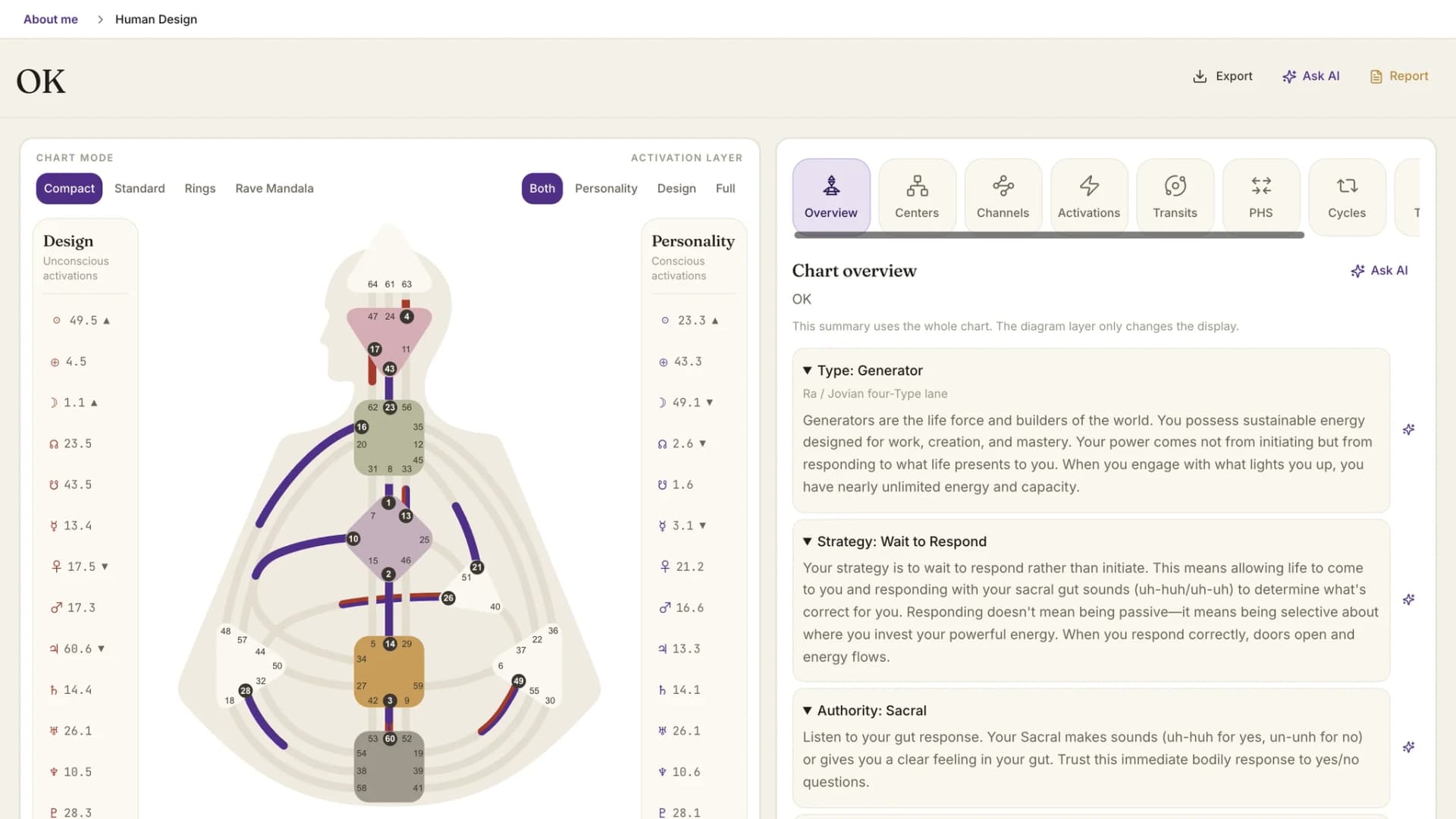
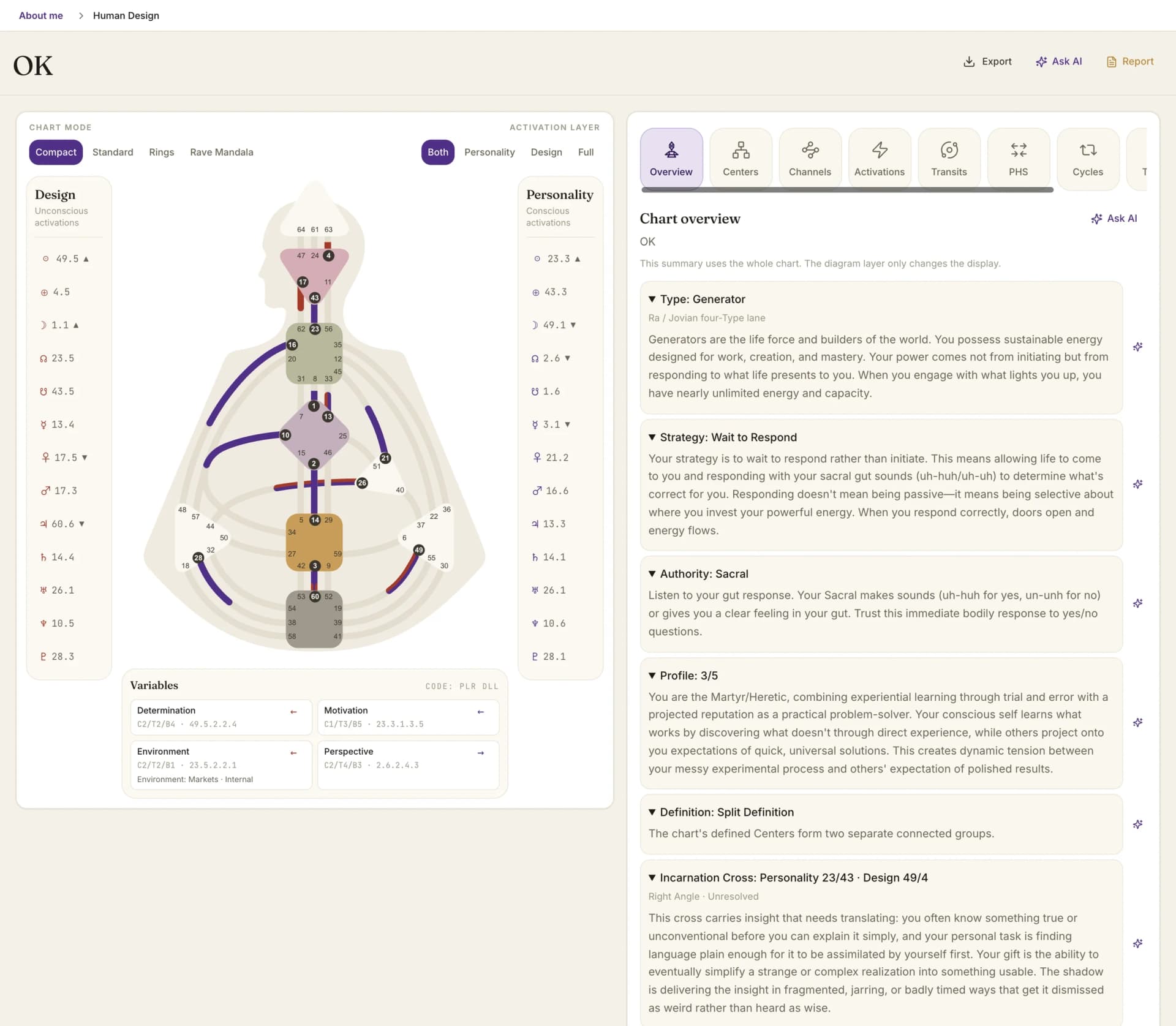
Astrolium keeps a client's BodyGraph on the same record as their natal chart, then gives it nine tabs instead of a summary card. Type and Authority are where a reading starts, not where the software should stop.
For a free single chart, run the Human Design calculator. For the system itself, read the Human Design guide. For the daily gate picture without an account, use Human Design transits.
What the workspace holds
Human Design sits awkwardly in most astrology software. It borrows planetary positions but reads them through a different diagram, so tools either ignore it or hand it off to a separate site. Astrolium treats it as a module on the same client record: one birth entry, one place to correct a time, one roster.
Overview and the chart itself
The top of the screen is core mechanics. Type, with Manifesting Generator shown as a Generator-family subtype rather than a separate Type. Strategy in the phrasing that belongs to it, from waiting to respond through informing before acting. Authority, whether Sacral, Solar Plexus, Splenic, Ego, Self-Projected or Mental. Profile, Definition from single through quadruple split, and the Incarnation Cross with its angle named.
The BodyGraph renders in four modes from the same calculation. Compact for a quick look, Standard for the familiar nine-center diagram, Rings for the planetary ordering, and the Rave Mandala for the zodiacal frame. Design activations are drawn as the unconscious layer, Personality as the conscious one, each row reading as planet, gate and line.
Centers, channels, activations
Each of the nine centers gets its own reading: defined or open, and which channels produce that state. Channels list both gates with the explanation of the circuit they sit in. The Activations tab is the raw list, 26 placements across Design and Personality, with colour, tone and base substructure available where the calculation returns it.
Transits and Cycles
Transits works on a moment, not on a vague "today". Enter a date and time in UTC, and the tab returns the transit gate activations, the channels they complete against natal gates, and the centers that come into temporary definition. The heading is explicit that this is a temporary layer over a fixed chart.
Cycles handles the returns in Human Design terms. Five kinds are supported: Solar Return, Lunar Return, Saturn Return, Uranus Opposition and Chiron Return. Each is listed as an exact pass with its instant and its motion, direct or retrograde, and the first pass renders as a chart you can set beside the saved one. Passes already behind the reference date are marked past; if none has occurred, the next upcoming one is shown instead.
The Pair tab
Two saved people, 2 charts, one combined BodyGraph, and no percentage.
Every channel contact is classified. Electromagnetic is one gate each, the classic attraction-and-friction contact. Companionship is the same channel defined in both charts. Dominance is a whole channel held by one person. Compromise is the awkward one, where the contact exists but the circuit runs unevenly. Contact counts appear beside each category with a note that counts describe channel contacts and not relationship quality.
Center definition is shown for the pair: filled means defined, outline means undefined, and a highlight marks a center that becomes defined only when the two are together, labelled as newly defined together rather than a shared authority. Under it all sits a reflection line stating that Human Design is a symbolic self-observation system, not scientifically established, and that each person keeps their own decision process.
The free Human Design compatibility calculator covers the same mechanics for people without an account.
PHS, Variables and the line that does not get crossed
The PHS tab carries Determination, Environment, Motivation and Perspective with the provider notation behind each. The copy is observational throughout: notice ordinary intake conditions without changing what or when you eat; notice whether a view and distance from bustle help you observe. Environment carries its own note that it is a lens for spaces you already use, not advice to relocate or pick a city.
The health notice is not buried. Determination is stated as not diet, medical or nutritional advice, with a direct instruction to consult a clinician where a health condition, eating disorder or prescribed diet is involved. Variables are also flagged as time-sensitive, so an approximate birth time makes them provisional.
Out of the app
Both the single chart and the pair sheet export as PDF. Report Studio carries two Human Design recipes, one for a full individual reading and one for a pair, so a client document is assembled from the calculated facts rather than retyped. Sky, the AI assistant, answers questions scoped to what is on screen, and its Human Design prompts explicitly forbid medical claims and guaranteed events.
For the reading method, the Human Design guide is the long-form companion. For what each plan includes, see pricing.