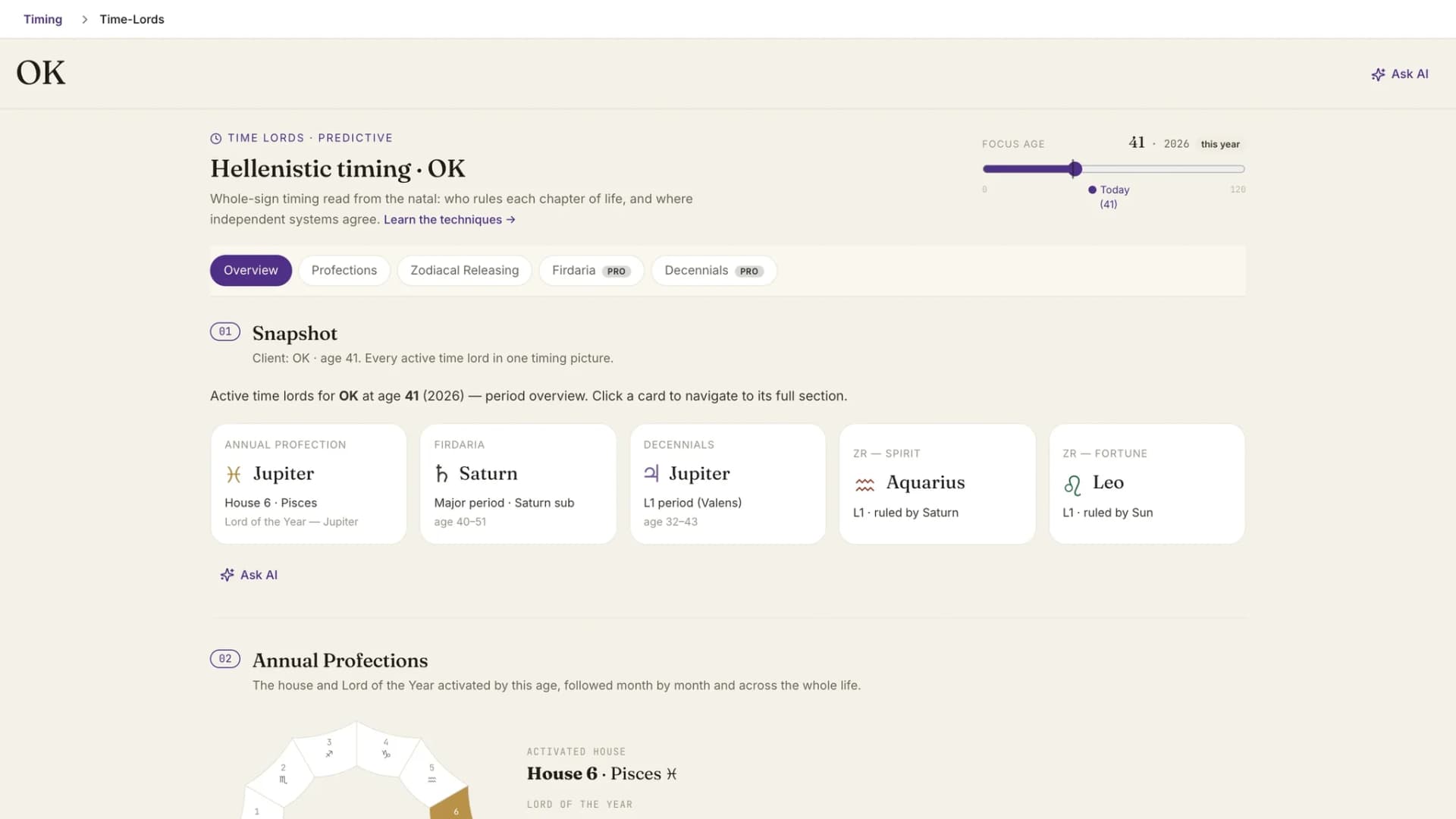
Hellenistic astrology encompasses the techniques developed in the ancient Mediterranean world between the third century BCE and the seventh century CE. The primary texts, from authors like Vettius Valens, Dorotheus of Sidon, and Claudius Ptolemy, describe a system that is both more structured and more nuanced than modern popular astrology.
The foundational difference from modern Western astrology is the use of whole sign houses — one sign filling each of the 12 houses — alongside sect, essential dignities, and time-lord systems. The 7 planets of traditional astrology are not simply in signs — they have varying strength depending on whether the chart is a day or night chart, whether the planet is in a sign it rules or a sign where it has dignity, and what planetary period the native is currently running. This is why the choice of house system matters more here than in modern practice.
Annual profections move the chart forward one house per year of life, returning to the 1st house every 12 years and activating a sign, a house topic, and a time-lord planet that colors all transits for that year. Zodiacal Releasing, drawn from Valens, uses the Lots to produce a major/minor period structure spanning decades. Together, these techniques give Hellenistic astrology its reputation for precise timing; the annual profections guide works through a full delineation.
Two things most software leaves out
A planet square the lunar nodal axis is a contact traditional astrologers call the bendings and evolutionary astrologers call the skipped step. Software usually drops it, because the nodal axis is excluded from pattern detection for a good reason: its two ends sit 180 degrees apart by construction, so admitting the node into configuration logic invents a T-square in every chart ever cast. Astrolium keeps the exclusion and adds the positive half separately. Any enabled body within 3 degrees of a bending is reported as a standing two-body statement, naming the axis and the end it falls on, northern or southern. Outers included: Pluto or Saturn at the bendings is among the readings that matter most. It is on every natal chart, with no tier gate and no toggle to find.
The second is sect on a borderline chart. When the Sun sits within a fraction of a degree of the horizon, some software quietly declines to say whether the chart is diurnal or nocturnal. Astrolium names it and marks it borderline, and states what rides on the call: triplicity rulers, hayz, and the Lots of Spirit and Fortune. The same verdict reaches the client-facing traditional report rather than stopping at the practitioner's screen.
The lots panel also opens expanded on the natal chart instead of hiding behind a disclosure, and each lot shows the formula it was computed from. Where a lot has competing formulations in the tradition, the caveat sits next to it rather than in a footnote nobody reads.
Astrolium implements all of these tools using the Swiss Ephemeris, with full support for day/night sect switching, Ptolemaic essential dignity tables, and the complete set of all 7 lots of the Hermetic tradition. The same traditional engine drives the horary feature, the electional search, and the wider predictive timing suite. For the wheel these layers sit on, see the natal chart.