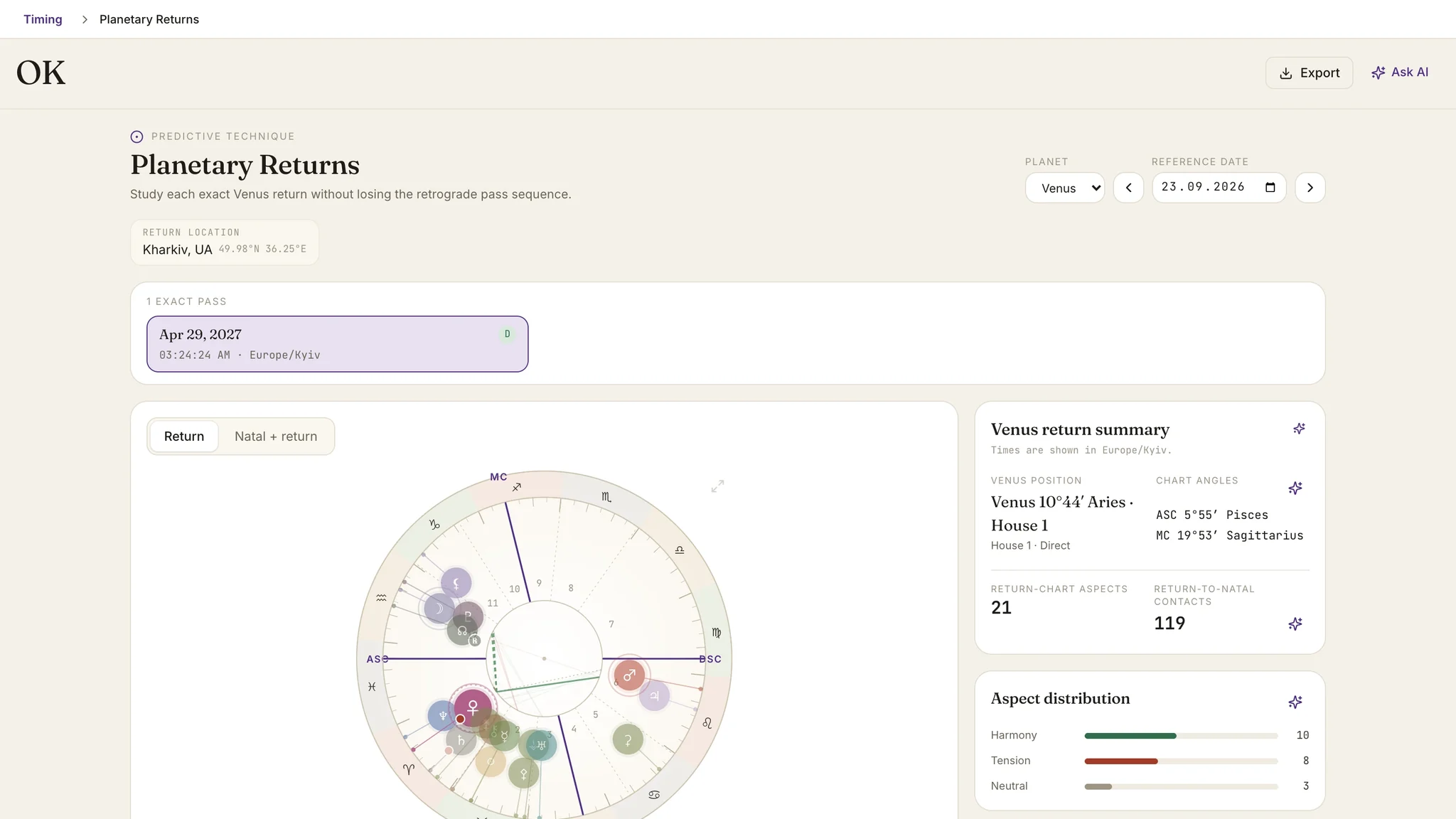
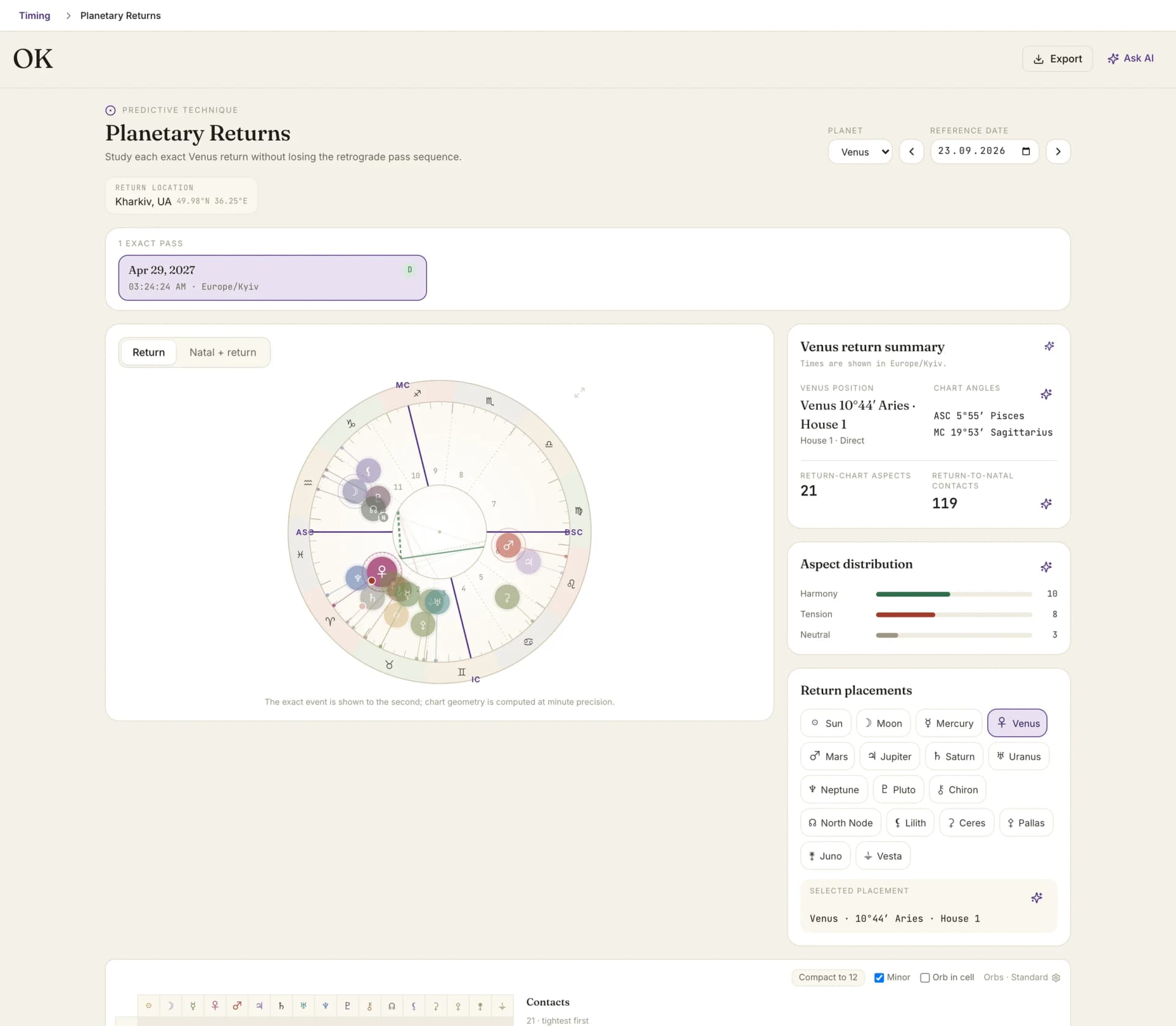
Astrolium treats a return as a sequence rather than a moment. Every exact pass is listed with its motion, and any pass opens as a biwheel against the natal chart.
For a single free answer, run the Venus return calculator. For the return method in general, the solar return guide covers the reasoning that carries across bodies.
What the module does
Return work has a structural problem that most software inherits without noticing. The solver is written to find one root: the instant the planet's longitude matches its natal value. That is correct for the Sun, which never turns retrograde. For every other body it can be wrong in an interesting way.
Why the pass sequence matters
Venus stations near the natal degree often enough that the single-answer approach fails regularly. When it does, the planet crosses the degree going forward, crosses back over it during the retrograde, then crosses a third time on the way out. Three exact contacts, weeks or months apart, and a single-chart tool shows you one of them with no indication that the other two exist.
The module lists them all. Pass 1 direct, pass 2 retrograde, pass 3 direct, each with its instant. The reading is the shape of the sequence: what began at the first crossing, what came back at the second, what settled at the third.
The chart around the pass
Select a pass and the wheel fills. Two views are available, a single return wheel and a natal biwheel, and the biwheel keeps its three layers visually distinct: the return chart, the natal chart, and the contacts running between them.
Four panels carry the detail:
- Venus position and return placements. Where the returning body sits, and the rest of the return chart around it.
- Chart angles. The return Ascendant and Midheaven, read against the location you chose.
- Return-chart aspects. The internal structure of the return, under your orb settings.
- Return-to-natal contacts. The part most readings live on. When nothing falls inside your active orbs, the panel says there are no contacts rather than quietly widening.
An aspect distribution summary splits the chart into harmony, tension and neutral, which is a fast way to characterise a return before reading it closely.
Location is a decision, not a default
Where a return is cast changes its angles and houses completely, and schools disagree about whether to use the birthplace, the current residence or wherever the person happens to be. The module makes it a field you set. That is one more click than a default, and it is the right one, because the return ASC and MC section is where the consequences of that choice become visible.
Asking about it
Each panel has its own question. Ask about the return as a whole, about Venus in its return sign, about a single return placement, about the angles, about the aspect distribution, or about the return-to-natal contacts. The AI receives the facts from that panel and nothing else, which keeps answers anchored to the chart rather than to generic return copy.
In a working week
Some shapes this takes in practice.
The dated question. A client wants to know when the Venus year turns over. You open the module, step to the next return, and read the instant with its timezone. If the sequence shows a retrograde run, the answer is a window rather than a date, and the pass list is what lets you say so with a straight face.
The relocation question. Someone is spending the year abroad. Set the return location to where they will actually be, and the return Ascendant and Midheaven change accordingly. Reading the same pass twice, once for home and once for away, is a short and legible comparison.
The follow-up. A reading given at the first pass gets revisited at the third. Because the passes are numbered and dated on one screen, going back to the sequence six months later takes a click instead of a recalculation and a guess about which chart you originally used.
Where it sits beside the other returns
The Sun comes back to its natal degree once every 12 months and the Moon roughly every 27 days, and both have had their own screens in Astrolium for longer, covered on solar return and lunar return. This module is the one that handles bodies whose returns are not annual and clean. It exists because the interesting cases are the retrograde ones, and those need a list rather than a number.
For plan detail see pricing. For a free single calculation without an account, the Venus return calculator runs on the same ephemeris.