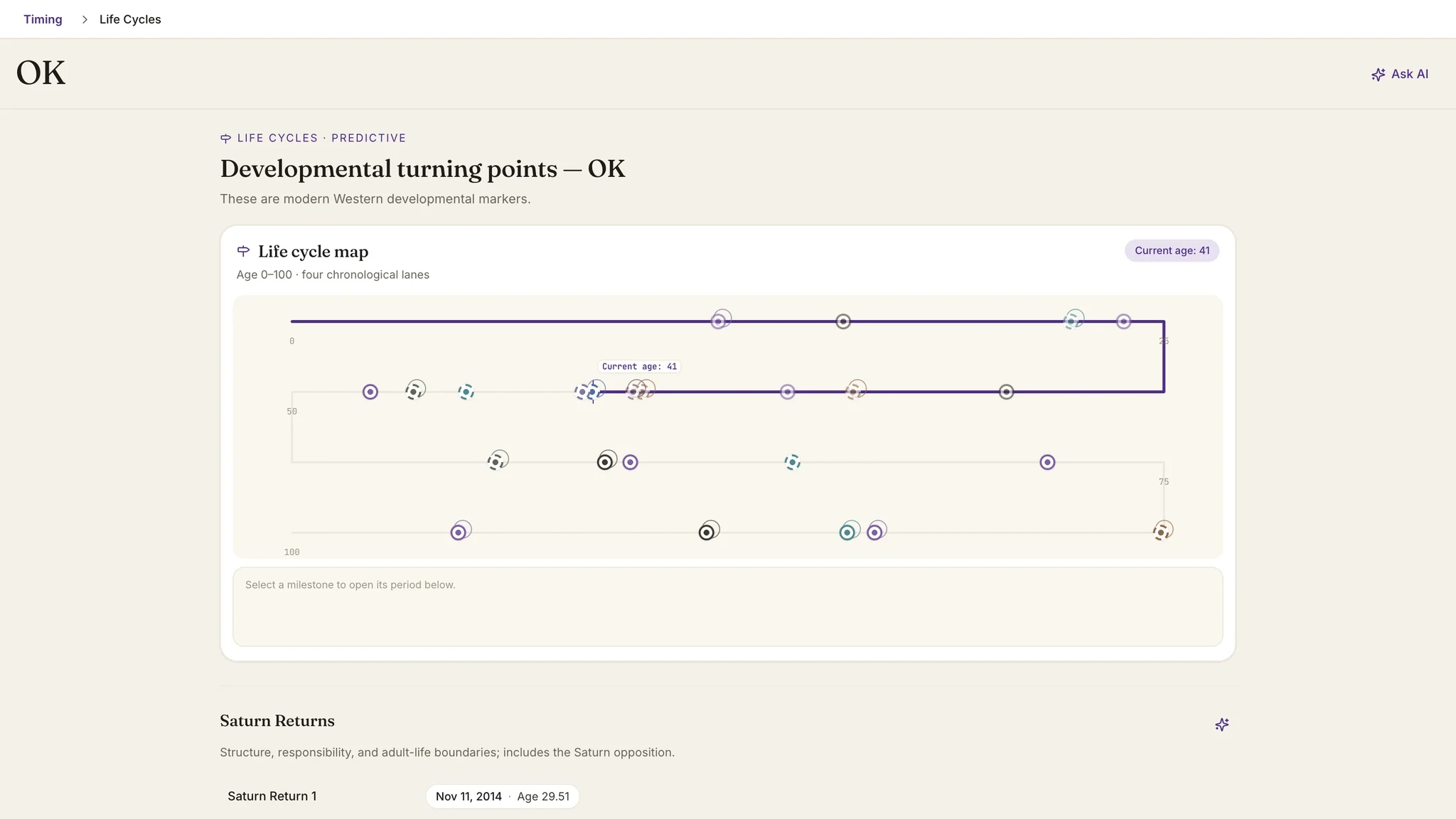
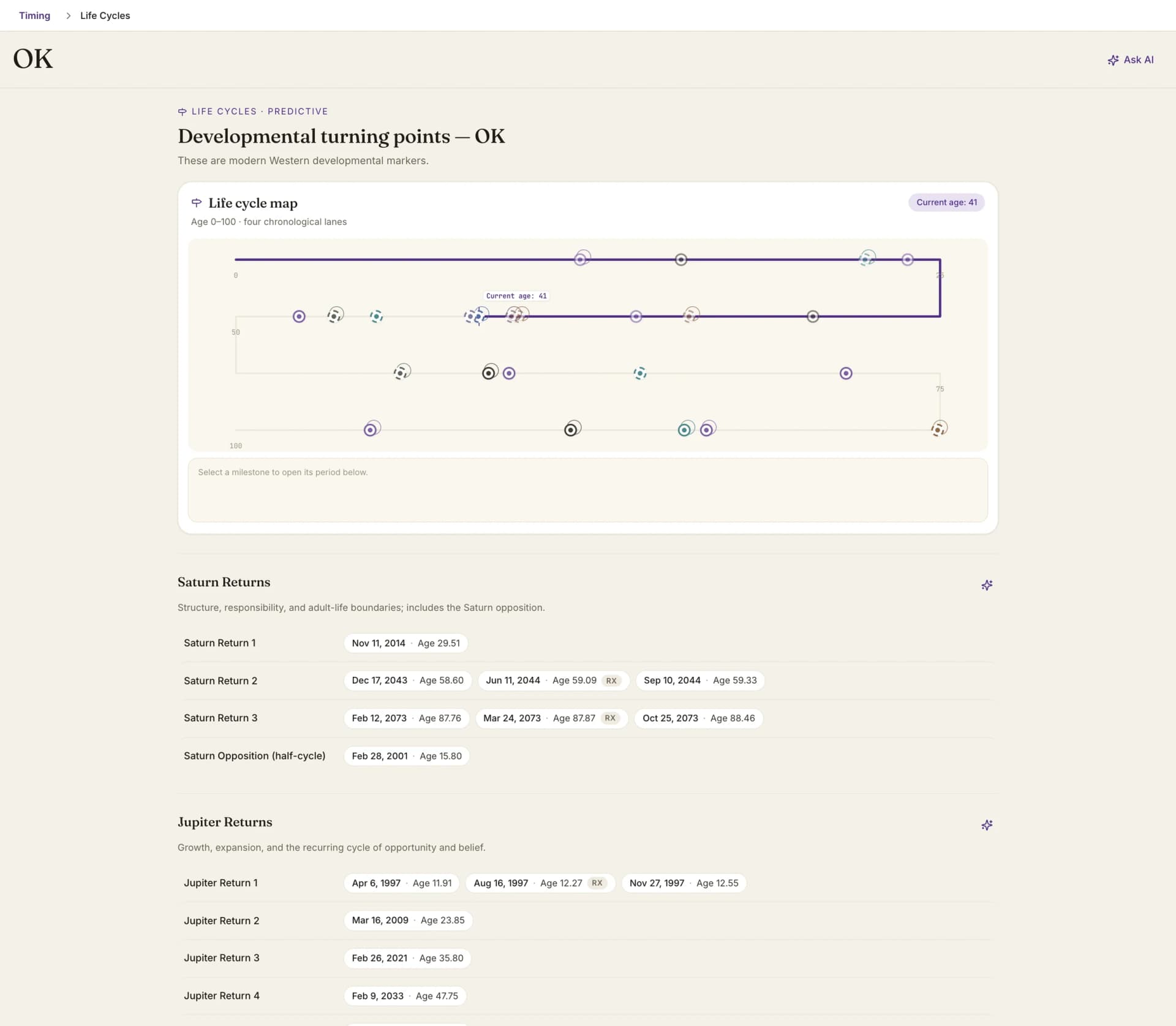
Astrolium's Life Cycles module answers the question every client eventually asks: what happens next, and when. It folds ages 0 to 100 into a four-lane ribbon, marks every developmental passage on one continuous scale, and opens each one into a dated section underneath. Life Cycles is included with the $11 per month Pro plan; see pricing.
For the single most-asked passage on its own, run the Saturn return calculator. For the annual cycle, use the Jupiter return tool. For the wounded-healer passage, see the Chiron return calculator.
What the module does
Astrology has a habit of answering the near question well and the long question badly. Transits tell a client what this month feels like. Time lords tell them what this year is about. Neither of them draws the shape of a life, and the shape of a life is what somebody sitting in front of you at 28 or at 42 usually wants.
The developmental cycles do draw it, because they are keyed to real orbital periods rather than to a narrative. Saturn comes back at roughly 29. Uranus opposes itself near 42. Chiron returns around 50. The nodal axis completes in about 18.6 years and swaps ends halfway through. These are not interpretive choices. They are arithmetic, and their arithmetic is what makes them worth putting on one scale.
Why a ribbon and not a line
A century-long domain on a single horizontal line does not survive contact with a real screen. Two milestones eleven months apart land on the same few pixels, and the practitioner ends up hovering to find out what is under the cursor.
The ribbon folds the horizon into four lanes instead. Age increases continuously from 0 to 100, every lane uses the same scale, and the chronological direction alternates at each fold so the path reads as one unbroken line. The already-lived portion carries the accent treatment. The remaining path stays visible but quiet. A compact labelled tick marks the current age, calculated from birth date and today.
It is a navigation layer and nothing more. The ribbon never calculates, renames, rounds or filters anything: it reads the same canonical rows the sections and the AI context use. If a point is disabled in Settings, it does not quietly become a milestone.
Practitioners who have reduced motion turned on get the same map without the path animation.
Precision is part of the reading
Two markers, two meanings.
- Solid circle: an exact date. The calculation resolves to a day.
- Dashed outline: month precision. The month is reliable, the day is not, and no day is printed anywhere.
A passage with several passes gets one milestone, positioned at the midpoint of its first and last crossing, with a restrained second contour rather than three competing markers. The tooltip carries the full span and the crossing count. Retrograde passes are flagged.
This matters most on the node. On the mean node, speed is constant by construction, so the axis never stations and every passage resolves to a single crossing. On the true node, the axis librates by roughly 1.5 degrees, and a passage can perfect several times. Astrolium lists every crossing and shows the full span instead of nominating one as the date. Which behaviour you get follows your own node setting, and the row says which model produced it.
What sits in each section
The sections below the ribbon are where the work happens.
- Saturn Returns. Structure, responsibility and adult-life boundaries, including the opposition at the half-cycle.
- Jupiter Returns. The recurring twelve-year rhythm of opportunity and belief.
- Uranus Return and, separately, Uranus Squares and Opposition. Waxing square, opposition and waning square to natal Uranus, the familiar midlife sequence.
- Neptune Square. The square to natal Neptune.
- Pluto Square. Solved from this client's natal Pluto rather than a fixed age table. Pluto's orbit is eccentric enough that a table is simply wrong for most people.
- Nodal Return and Reversal. The full cycle at about 18.6 years and the swap of ends at about 9.3.
- Chiron Return, Square and Opposition.
- Progressed Lunation Phase. The current progressed Moon to Sun phase and the date of its next transition, which is where the pace of a client's decade tends to be legible.
Each row carries a short interpretive line, and each section and row carries its own Ask AI button.
Where it fits against the rest of the timing stack
Life Cycles is the whole-life view. Predictive timing is the working year: profections, zodiacal releasing, progressions and transits on one navigable surface. The transit finder is the roster question, asked across every client at once.
They answer different things, and the module says as much on screen: these are modern Western developmental markers, not Hellenistic time-lord periods. A practitioner who mixes the two vocabularies in a session ends up with two clocks and no reading.
How practitioners use it
-
The 28-year-old who booked because of the internet. They know the phrase Saturn return and nothing else. The ribbon shows the passage they are in, the exact dates of each pass, and the Saturn opposition at 44 that gives the conversation somewhere to go.
-
Session prep for a long-running client. Open the ribbon, look at the fifteen years ahead of the current tick, and walk in already knowing that the Chiron square lands next spring.
-
The client in a midlife crisis who wants a name for it. The Uranus opposition, the Neptune square and the progressed lunation phase often cluster in the same handful of years. Seeing them stacked on one scale usually does more than any single interpretation of any one of them.
Cross-link
For the standalone calculators behind these passages, see the Saturn return calculator, the Jupiter return tool and the Chiron return calculator. For the method behind the best-known of them, read the Saturn return guide. For the year-scale timing layer, see predictive timing.