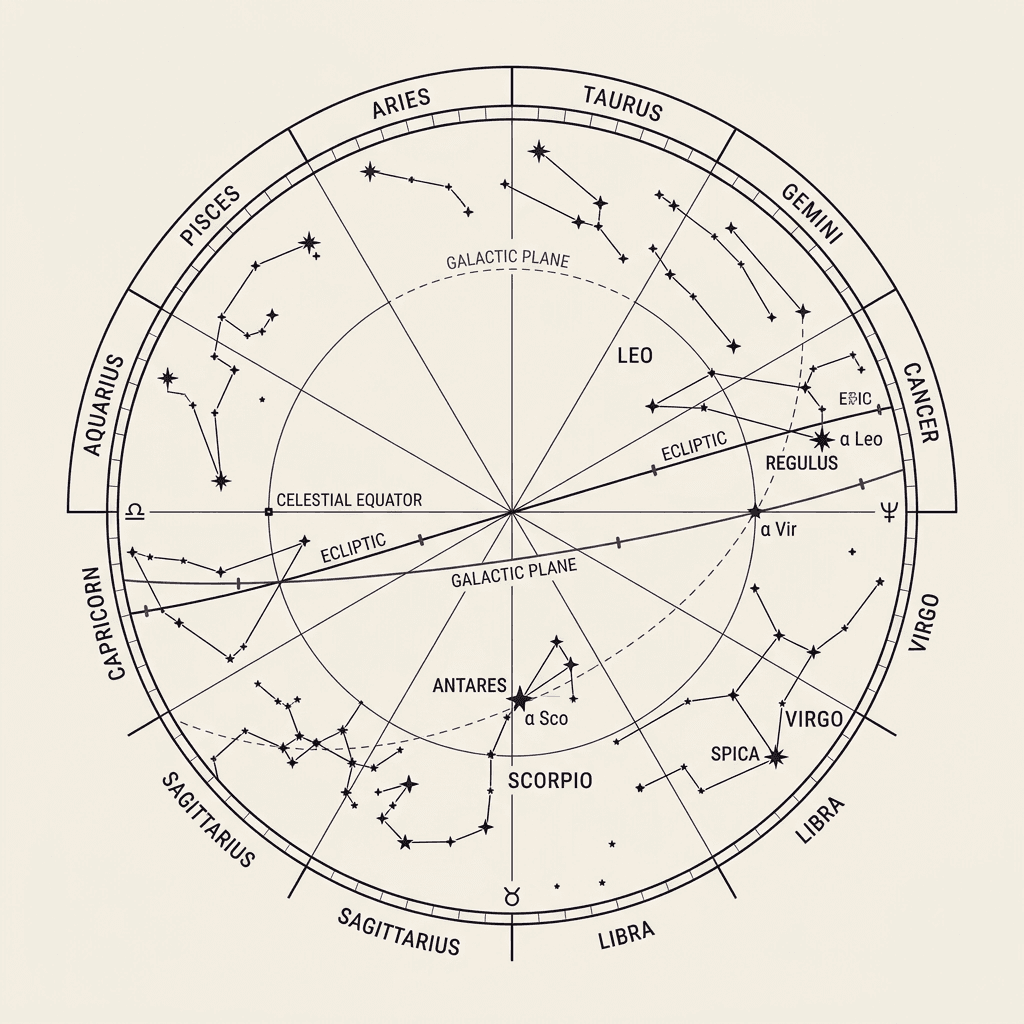
Astrolium maintains fixed stars as a working layer of traditional natal practice, not a curiosity. Fixed stars are the stars beyond the solar system: Sirius, Regulus, Algol, the Pleiades, the great winter and summer constellations. They are "fixed" only relative to the planets, which move quickly against them. Against the tropical zodiac, the fixed stars drift forward by about 1° every 72 years through precession, which is slow enough that the canonical readings remain stable across centuries.
The fixed-star tradition predates the planetary tradition. Babylonian astronomy worked with fixed stars before it had organized the zodiac. The Egyptian decans were rooted in fixed-star observation. Ptolemy, in Tetrabiblos Book 1 chapter 9, gave the fixed stars planetary natures (Aldebaran is "of the nature of Mars," Regulus "of Mars and Jupiter," Sirius "of Jupiter and a little of Mars") that still organize modern interpretation. The medieval and Renaissance magical traditions then layered the Behenian system on top, adding ritual and talismanic uses. Modern revival is largely the work of Vivian Robson (1923), Bernadette Brady (1998), and Christopher Warnock (ongoing). The fixed stars calculator reports which stars contact your natal points within a tight orb.
Fixed stars in astrology are the bright stars beyond the solar system (Sirius, Regulus, Algol, Antares, Spica, Aldebaran, the Pleiades) read as natal-chart influences when they conjunct a planet or angle within a 1-degree to 2-degree orb. They are called "fixed" because they drift forward against the tropical zodiac by only about 1 degree every 72 years through precession. The canonical interpretive framework begins with Ptolemy's Tetrabiblos (2nd century CE), which assigned each star a planetary nature. The 15 Behenian stars (Cornelius Agrippa, 1531) form the medieval magical canon; the 4 Royal Stars of Persia (Aldebaran, Regulus, Antares, Fomalhaut) predate the Behenian list as cardinal-direction guardians from roughly 3000 BCE. Modern practice runs through Vivian Robson (1923), Bernadette Brady (1998), and Christopher Warnock. Traditional reading uses conjunctions only, not aspects. Astrolium's fixed stars calculator reports which canonical stars contact your natal points at current precessed longitudes.
The 15 Behenian fixed stars
The Behenian list comes from Cornelius Agrippa's Three Books of Occult Philosophy (1531), drawing on earlier Arabic-era magical sources. The name "Behenian" comes from the Arabic bahman, meaning root, suggesting these stars are root sources of celestial power. There are 15:
| Star | Constellation | Current longitude | Nature (Ptolemy) |
|---|---|---|---|
| Algol | Perseus | 26° Taurus | Saturn, Jupiter |
| Pleiades | Taurus | 0° Gemini | Moon, Mars |
| Aldebaran | Taurus | 10° Gemini | Mars |
| Capella | Auriga | 22° Gemini | Mars, Mercury |
| Sirius | Canis Major | 14° Cancer | Jupiter, Mars |
| Procyon | Canis Minor | 26° Cancer | Mercury, Mars |
| Regulus | Leo | 0° Virgo | Mars, Jupiter |
| Algorab | Corvus | 13° Libra | Mars, Saturn |
| Spica | Virgo | 24° Libra | Venus, Mars |
| Arcturus | Boötes | 24° Libra | Mars, Jupiter |
| Alphecca | Corona Borealis | 12° Scorpio | Venus, Mercury |
| Antares | Scorpio | 9° Sagittarius | Mars, Jupiter |
| Vega | Lyra | 15° Capricorn | Venus, Mercury |
| Deneb Algedi | Capricorn | 23° Aquarius | Saturn, Jupiter |
| Fomalhaut | Piscis Austrinus | 4° Pisces | Venus, Mercury |
(Positions are approximate for the early 21st century. Precession shifts them forward by roughly 50 arcseconds per year.)
Each Behenian star has, in Agrippa's framework, a stone, a plant, an image, and a use in talismanic work. The practitioner working in the magical tradition (most notably Christopher Warnock, whose Renaissance Astrology school keeps the magical tradition alive) elects times when one of these stars is angular, in good aspect to its natural ruler, and on a planetary hour that supports the operation. The talisman is consecrated at that moment with the corresponding stone, plant, and image. The astrological logic is the same as electional astrology: the moment of consecration carries the qualities of the chart, including the angular fixed star.
For natal interpretation, the Behenian list is useful because it preselects the stars worth checking. A natal planet within 1° of any Behenian longitude is worth attention. The interpretive signature draws on the star's Ptolemaic planetary nature and on the constellation's mythology.
What are the 4 Royal Stars of Persia
The Royal Stars of Persia predate the Behenian system by centuries and have a distinct cosmological role. They are the four stars that, in roughly 3,000 BCE, marked the cardinal points of the year as the watchers of the four directions:
- Aldebaran, the eye of Taurus, watcher of the east (spring equinox marker in the third millennium BCE)
- Regulus, the heart of Leo, watcher of the north (summer solstice marker)
- Antares, the heart of Scorpio, watcher of the west (autumn equinox marker)
- Fomalhaut, the mouth of the Southern Fish, watcher of the south (winter solstice marker)
Precession has carried each Royal Star away from its original cardinal alignment, but their status as the four watchers persists in the tradition. The Royal Stars carry a stronger weight in interpretation than non-Royal stars of similar brightness, partly from their historical role and partly because three of the four are first-magnitude (the brightest visible class).
In a natal chart, a Royal Star conjunct a personal point (Sun, Moon, Ascendant, MC) is treated as a major signature. The tradition holds that the gifts of a Royal Star come with a corresponding test: each Royal Star can be lost, in the classical phrasing, if the native fails its test. Aldebaran demands integrity, Regulus demands the avoidance of revenge, Antares demands the avoidance of compulsive intensity, Fomalhaut demands attention to spiritual rather than worldly reward. The doctrine of the Royal Star's "fall" through failure of its test is one of the rare fatalistic elements in modern fixed-star reading; treat it as a flag for the area where the native's gift has a corresponding shadow rather than as a prediction.
Algol
Algol carries the heaviest reputation of any fixed star, currently at approximately 26° Taurus. The name comes from the Arabic al-Ghul (the ghoul or demon), and the star sits in the constellation Perseus, representing the head of Medusa that Perseus carries as a trophy. The mythology gives the star its character. Medusa is the Gorgon whose direct gaze turns onlookers to stone; what cannot be looked at directly.
Algol is also an eclipsing binary, dimming visibly every 2.87 days as its companion star passes in front of it. This was observed by ancient astronomers long before the binary nature was understood, and the regular dimming reinforced the star's reputation for change and concealment. Some classical sources call Algol the most malefic star in the heavens.
In natal work, Algol conjunct a personal point within 1° is significant. Traditional readings emphasize violence, sudden change, beheading (literal in some medieval texts, metaphorical in modern reading as the cutting off of something the native cannot keep). Modern readings emphasize the capacity to look at what others cannot face: the native confronts dense material directly. Therapists, surgeons, journalists working in conflict zones, and trauma specialists often have Algol prominent in their natal charts.
The interpretive question is not whether Algol is good or bad but what the native does with what cannot be looked at directly. Suppressed, Algol expresses as the eruption of the avoided material; engaged, it gives unusual capacity for confrontation with shadow.
Regulus
Regulus, the heart of Leo, the Royal Star of the north, currently at approximately 0° Virgo. Regulus is one of the four cardinal Royal Stars and historically the marker of kingship and recognized authority. The Ptolemaic nature is Mars and Jupiter, giving Regulus a martial-noble quality.
Regulus precessed out of Leo and into Virgo in late November 2011, after roughly 2,160 years in Leo. This is one of the rare events in fixed-star astrology that has happened within living memory and has produced an active interpretive debate. Some practitioners (notably those working in the strict tropical frame) treat the shift as significant and read post-2011 Regulus differently. Others (more common in the traditional camp) treat the star's nature as intrinsic and the sign change as a calendar update rather than a meaning change.
The interpretive consensus for natal work: Regulus conjunct the Sun, Moon, Ascendant, or MC indicates a native marked for visibility and authority, with the classical caveat that the gift is conditional on avoiding revenge. The medieval texts repeat this point insistently: Regulus gives prominence and falls when the native pursues vengeance against an enemy. In modern reading, the same warning recasts as a tendency for the prominent Regulus native to consume their own gift through preoccupation with rivals rather than with their own work.
A Regulus reading worth giving to a client: this is the placement of a king or queen, and the work is to remain centered in your own authority rather than spending it on settling scores.
Antares
Antares, the heart of Scorpio, the Royal Star of the west, currently at approximately 9° Sagittarius. Antares is roughly opposite Aldebaran in longitude (within a few degrees of an exact 180°), and the two Royal Stars are often read as a polarity: Aldebaran the establishment, Antares the rebellion against the establishment; Aldebaran integrity through structure, Antares integrity through risk.
The Ptolemaic nature is Mars and Jupiter, the same as Regulus, but the constellation gives Antares its distinctive flavor. Scorpio is the sign of intensity, transformation, and depth; Antares is the brightest fixed point inside the Scorpio mythology. In natal work, Antares prominent indicates a native drawn to intensity, transformation, and the willingness to court conflict.
The classical warning for Antares concerns compulsive intensity: the native loses the Royal Star's gift when intensity becomes self-consuming. War, transformation, and depth all serve the native who can hold them in a larger life; the same forces destroy the native who organizes their entire identity around them. Antares prominent in surgeons, athletes, war correspondents, and transformative therapists tracks the same theme: capacity for confrontation that has to be paced.
Antares conjunct the Sun gives a forceful, transformative personality with the capacity for sustained battle. Antares conjunct the Moon gives an emotional depth that can become rumination if not directed outward. Antares conjunct the Ascendant gives a presence others read as intense from the first encounter.
Spica
Spica, the ear of wheat in the Virgin's hand, currently at approximately 24° Libra. Spica is widely held to be the most fortunate fixed star and is one of the few stars in the classical canon with an unambiguously positive interpretation. The Ptolemaic nature is Venus and Mars.
Spica's reputation traces to its association with the harvest (the wheat sheaf) and with the great goddess figure who in pre-classical mythology held it. The star's brightness (first magnitude) and the regularity of its association with agricultural prosperity in the ancient world stabilized its meaning as fortune, gift, and protection.
In natal work, Spica conjunct a personal point is treated as a clear blessing in the matter of that point. Spica conjunct the Sun: a native protected in their vital affairs. Spica conjunct the Moon: emotional grace and resilience. Spica conjunct the Ascendant: physical attractiveness and an easy presence. Spica conjunct the MC: success in the public domain.
Modern fixed-star practitioners sometimes use Spica as a counterweight when reading a difficult chart: if Spica contacts a personal point in an otherwise stressed chart, the contact provides a resource the native can draw on. Robson notes that even a small contact with Spica often correlates with the native receiving help at critical moments.
Sirius
Sirius, the brightest star in the night sky, currently at approximately 14° Cancer. Sirius is so bright (apparent magnitude −1.46, more than twice as bright as any other star) that ancient cultures gave it special status across multiple unrelated traditions. The Egyptians called Sirius Sopdet and timed their year by its heliacal rising in early summer; the Greeks called it the Dog Star and associated its rising with the hottest weeks of the summer (the "dog days"); various esoteric traditions, especially the Theosophical, treat Sirius as a "spiritual sun" with particular significance for spiritual evolution.
The Ptolemaic nature is Jupiter with a touch of Mars. The interpretive signature in natal work emphasizes ambition, achievement, and the drive toward greatness, with the caveat that the same drive carries the potential for self-destruction if poorly channeled. Sirius is the brightest gift in the sky, and bright gifts demand maturity.
In modern fixed-star practice, Sirius conjunct the Sun is read as a major signature of high ambition and probable public recognition. Sirius conjunct the Moon: deep emotional ambition, often associated with mystical or visionary experiences. Sirius conjunct the Ascendant: a striking presence that draws attention immediately. The Theosophical reading layers in a spiritual dimension that not all practitioners use, but that is worth mentioning to clients with strong Sirius contacts who feel drawn to mystical traditions.
Aldebaran
Aldebaran, the eye of Taurus, the Royal Star of the east, currently at approximately 10° Gemini. The name comes from the Arabic al-Dabaran (the follower), referring to the star's apparent following of the Pleiades across the sky. Aldebaran's Ptolemaic nature is purely Martian.
As one of the four Royal Stars, Aldebaran carries the weight of cardinal-direction guardianship in the early Persian system. Its classical signature is integrity, foundation, and conservative authority. Aldebaran prominent in a chart suggests a native who builds and holds. The Royal Star test for Aldebaran is integrity: the gift of Aldebaran is lost when the native compromises their word or their core principles.
In natal work, Aldebaran conjunct the Sun gives a foundational, leadership-oriented personality with strong principles. Aldebaran conjunct the Moon gives emotional steadiness and a conservative emotional temperament. Aldebaran conjunct the Ascendant gives a grounded, present physical bearing. Aldebaran conjunct the MC gives public recognition for reliability and principle.
The polarity with Antares is worth reading. Natives with strong Aldebaran-Antares contacts (Sun on one, Moon on the other, or angles activated by both) live the tension between the established way and the transformative path. The integration of both Royal Stars in a single chart is rare and worth flagging when present.
What are parans, Brady's geographical extension
Bernadette Brady's major methodological contribution is the paran, a technique that extends fixed-star work from longitude conjunctions into the geographical and temporal frame. A paran (from the Greek paranatellonta, "rising alongside") occurs when two celestial bodies are simultaneously on the four angles of the chart at a given location and moment. A planet rising while a fixed star is culminating, for example, forms a paran. Parans depend on latitude: the same chart cast at 40° North and at 40° South produces different parans because the rising and setting times of any star vary with latitude.
The technique matters because it captures contacts between planets and fixed stars that the longitude method misses. A star may be 30° away from a planet in longitude and never come within a longitude orb of conjunction, but the same star and planet may share an angular moment at a specific latitude. Parans are read as life themes activated at the latitude where the paran occurs. A native with Saturn paran Algol at the latitude of Berlin carries the theme of confronting dense or hidden material in the affairs of structure, work, or authority, and the theme activates strongly when the native lives or works at that latitude.
For practitioners using parans, Brady's Book of Fixed Stars catalogs interpretations for the major planet-star paran combinations. The technique pairs naturally with astrocartography, which maps the same logic into specific geographic lines. A native whose chart contains Sun paran Spica at a specific latitude can be advised to consider relocation to that latitude band for projects requiring fortune and protection. Parans take a few hours of study to learn and a calculator to compute reliably; the fixed stars calculator supports paran computation alongside longitude contacts.
How do practitioners read fixed stars in natal work
A practical method for incorporating fixed stars into a natal reading:
-
Use a 1° orb for conjunctions. A planet within 1° of a fixed star's longitude (in either direction) is considered conjunct. Some practitioners extend to 2° for the brightest stars or for star-on-angle contacts. Beyond 2°, the contact is not classical.
-
Read conjunctions only. Traditional fixed-star practice does not use squares, trines, oppositions, or sextiles. The star projects at its longitude; the projection is direct rather than aspected. Bernadette Brady's modern technique of parans (rising, culminating, setting, lower-culminating contacts in time rather than longitude) extends fixed-star work but is a separate technique from the longitude conjunction.
-
Weight contacts by point. Conjunctions to the Ascendant or MC are the strongest. Conjunctions to the Sun or Moon are next. Conjunctions to the inner planets (Mercury, Venus, Mars) carry significant weight in the affairs of that planet. Conjunctions to the outer planets (Jupiter through Pluto) are read in collective and generational terms more than personal ones.
-
Layer star nature and constellation mythology. The Ptolemaic nature gives the planetary signature; the constellation mythology gives the imaginal context. Algol is Saturn-Jupiter in nature but Medusa-the-Gorgon in mythology. Both layers contribute to the reading.
-
Cross check with the rest of the chart. A fixed star conjunction is one signature among many. A Sun-Spica conjunction in an otherwise difficult chart provides a resource; a Sun-Spica conjunction in an already supported chart confirms and emphasizes the support. Read the star contact alongside the rest of the natal picture.
-
Use a calculator for accuracy. Fixed-star longitudes precess. A printed table from 1990 is already 35 years out of date and off by approximately 30 arcseconds, which matters when working with a 1° orb. The fixed stars calculator gives current longitudes precise to the date you enter.
Recommended reading
- Vivian E. Robson. The Fixed Stars and Constellations in Astrology (1923). Despite its age, still the standard reference for the canonical 100 stars with their natures, mythologies, and natal interpretations. Robson is the source most modern fixed-star writers draw on.
- Bernadette Brady. Brady's Book of Fixed Stars (Weiser, 1998). The major modern work. Brady extends the technique with parans and provides updated longitudes, working interpretations, and case studies.
- Bernadette Brady. Star and Planet Combinations (Wessex, 2008). The companion volume that catalogs interpretations for each fixed star combined with each planet. A working bench reference for natal readers.
- Christopher Warnock. Renaissance Astrology school resources on Behenian fixed-star magic. The living tradition of magical practice using the Behenian list, with electional methods for talisman consecration.
- Cornelius Agrippa. Three Books of Occult Philosophy (1531). The medieval source for the Behenian list. Translated editions are widely available.
Astrolium pairs these texts with the fixed stars calculator for finding your natal contacts, the astrocartography guide for the related technique of star-on-place mapping (where Brady's paran method extends fixed-star work into geography), and the electional search for finding moments when a Behenian star is angular for magical work.